






 Portuguese
  Spanish


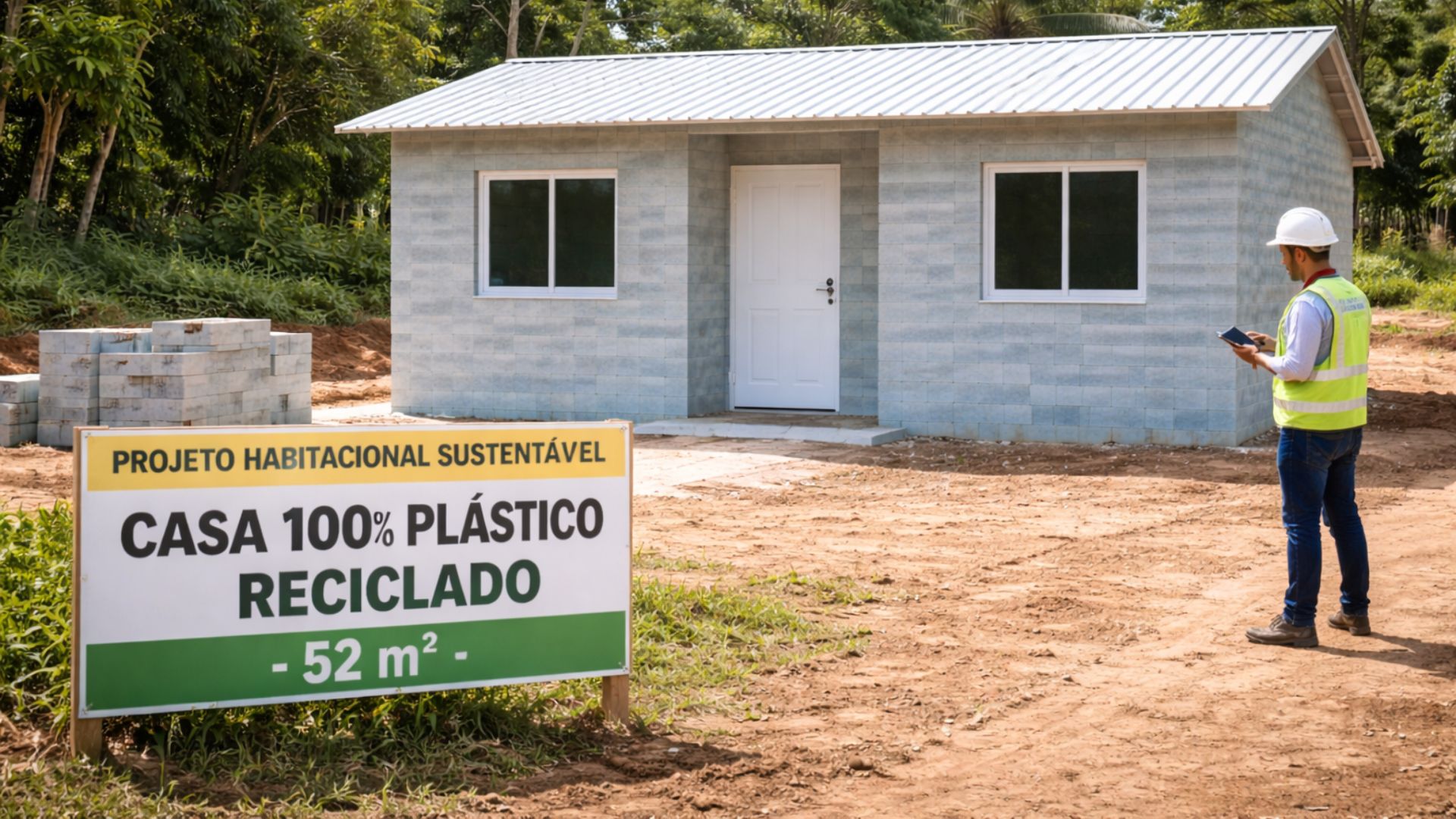


Modular Construction Technology Using Recycled Plastic Advances in Analysis for Affordable Housing on the Coast of Santa Catarina, Following a Technical Visit to the Factory in São Paulo and Discussion on Reduced Timelines, Sustainability, and Potential Application in Municipal Public Programs.
The City Hall of Porto Belo, on the coast of Santa Catarina, has started to study the adoption of a model of affordable housing made with blocks produced from recycled plastic, featuring modular assembly and pre-molded pieces, seen as a way to accelerate construction and reduce waste on site.
The evaluation gained visibility after a technical visit by Mayor Joel Lucinda to the Fuplastic factory in Cotia, in the metropolitan region of São Paulo, cited as a reference in this type of solution applied to civil construction with a focus on sustainability.
According to the report that echoed the meeting, the technology is based on structures formed by blocks made with PCR, an acronym used for “Post-Consumer Recycled plastics”, that is, materials that have already circulated in the market and return to the production cycle through recycling.
-
Couple Converts 1925 Detroit Bank into Home, Earns $40,000 Annually on Airbnb

-
Tired of Seeing People Sleep in the Cold, London, Canada Opens First Modular Shelter for Homeless with 60 Cabins, Heating, Meals, and Dog Area
-
Brazil’s $1.3 Billion, 870-Meter Immersed Tunnel to Be Latin America’s First of Its Kind, Featuring Special Public Facilities and Information Center
-
Brazilian Innovator Develops Concrete Blocks from Recycled Plastic, Eliminating Mortar and Reducing Construction Costs


According to the same disclosure, the company claims that the houses are designed according to the client’s needs and can be built in less than two weeks, associating the system with thermal comfort, “zero waste,” and structural performance.
In the municipality, the topic is treated as a feasibility analysis, with the intention of understanding how the method would work in a public housing program and what conditions would be required for its implementation, without an announcement of contracts or construction initiated.
Houses Made from Recycled Plastic and Modular Dry Construction


In a statement reproduced by Rádio Cidade 104.1, the mayor related the model to the reuse of plastic and the possibility of reducing costs and shortening timelines, citing the search for formats that combine agility and sustainability in housing planning.
In the proposed solution, construction follows an industrialized logic: instead of ceramic bricks and traditional masonry steps, the structure is formed by standardized modules that fit together to form walls and partitions, with assembly planned in stages.
Fuplastic describes the method as “dry construction,” a term associated with processes that reduce the use of mortar and prioritize ready-to-fit components, which tends to increase the predictability of assembly and organization on site, according to institutional materials.
In the content published by the company, the blocks are produced with technical polypropylene containing 100% recycled material, and modularity is presented as a factor that facilitates shorter timelines, with less debris generation and less rework on site.
The promise of “zero waste” is linked to the standardization of pieces and the reduction of surplus on site, a common argument in industrialized systems, but public discussion involves whether execution time, total cost, and durability meet the demands of public works.
Timeline of Up to 14 Days and Stages Beyond Assembly
One of the points that stands out in the news is the expression “built in less than two weeks,” usually associated with the assembly of the main body of the house from prefabricated components, while other stages follow their own timelines and specific rules.

Site preparation, foundation, hydraulic and electrical installations, finishes, and inspections typically require separate planning, and, in public projects, must be compatible with technical specifications, oversight, and administrative routines that go beyond assembly time.
Therefore, when the city hall talks about evaluating the proposal, the trend is to look at the timeline from start to finish, from hiring to delivery to the resident, considering guarantees, maintenance, and performance over time, as well as implementation conditions.
Another aspect that often weighs in housing programs is the adaptation to climate and use, as the company associates the system with thermal comfort and maintains that the modular design facilitates expansions and adjustments, with modules incorporated as per the project.
Circular Economy and Social Experiences in Brazil
The appeal of the model also lies in the raw material because post-consumer plastic that could end up in landfills or illegal disposal is being transformed into blocks, connecting housing to the logic of circular economy, where waste returns as raw material.
In addition to the municipal debate, the technology has already appeared in social initiatives in Brazil, such as the delivery of two homes in Carapicuíba, in Greater São Paulo, in partnership between the NGO TETO Brasil, Airbnb, and Fuplastic, according to a report by the magazine Casa.
In the report, representatives from the organizations highlighted the symbolic impact of the solution in vulnerable areas, and the social manager of TETO Brasil, Ygor Santos Melo, stated that the goal was to “impact the life of the person receiving the housing” and inspire new deliveries.

Materials from the company itself and content related to the project also associate the initiative with the removal of up to two tons of plastic from the environment per unit, in a proposal that, according to the organizers, seeks to combine construction technology with waste reuse.
Porto Belo Evaluates Feasibility for Housing Policy
In the case of Porto Belo, the visit to the factory in Cotia was presented as a step of recognition of the production process and models already applied, and the city hall signaled that the discussion makes sense by occurring in parallel to the search for solutions to housing demand.
If the municipality moves forward, the decision is likely to require the definition of typologies, standardization of projects, hiring criteria, and performance parameters that allow comparing the system with traditional methods, including from the perspective of cost-benefit and maintenance.
Without any announcement of hiring so far, public curiosity remains focused on the potential for scale and how the model fits into the requirements of a housing policy that needs to balance speed, technical control, and durability to meet low-income families.
If the city hall confirms the feasibility, houses made from 100% recycled plastic and modular assembly will truly be able to move from the evaluation stage to becoming a recurring alternative in public housing in Porto Belo?




É a tecnologia e inteligência humana sendo usada a favor da sustentabilidade. Se quiserem nos favorecer com uma casa modelo, estamos aqui 🫣🫣🤭
Nós já temos microplástico dentro do nosso corpo só por respirar, comer e beber água. Uma casa feita 100% de plástico só vai agravar a situação
Aguenta ventos fortes?E a temperatura dentro dessas casas, não será muito quente?