Portuguese
  Spanish


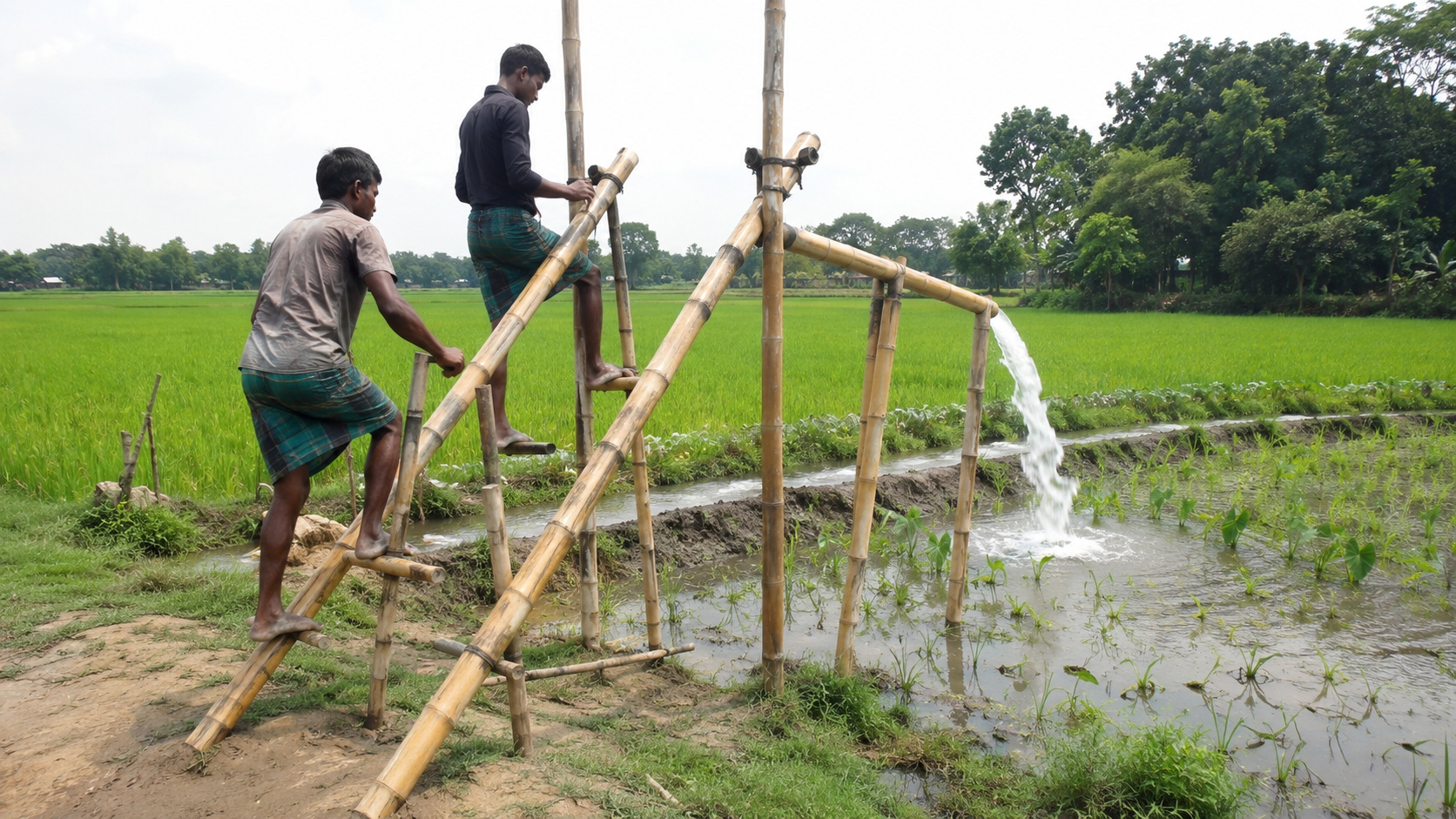

Created in Bangladesh, the bamboo pedal pump irrigates small properties without fuel, reaches up to 8 meters, and increased rural income.
In rural areas of Asia, small farmers began to irrigate crops using only the power of their legs, without relying on diesel, electricity, or engines. The technology became internationally known as the treadle pump, or pedal pump, and established itself as one of the most widespread low-cost irrigation solutions for family farms.
Developed in Bangladesh in the early 1980s, the pump combines a simple set of metal cylinders with a structure operated by bamboo or wooden pedals. Over about 15 years, nearly 2 million units were disseminated in Bangladesh, India, Nepal, and other countries in Asia and Africa, while iDE reports that, in Bangladesh alone, more than 1.5 million pumps had been sold by 2015.
Bangladesh pedal pump emerged to provide cheap irrigation to small rural properties without fuel
The expansion of the treadle pump occurred in a context where many family farmers could not afford motor pumps or maintain recurring fuel costs.
-
Brazilian Forests Could Expand by an Area Twice the Size of Switzerland by 2035, but Agricultural Sector Holds the Key, Study Finds

-
Brazilian Student Develops Solar-Powered Agricultural Machine Capable of Processing 250 Kilograms per Hour

-
Brazilian Farmer’s Viral Video on Onion Prices Opens New Income Opportunities Online

-
Brazil’s Chicken Exports Hit Record 2.936 Million Tons in Six Months, Earning $5.7 Billion, with China, Japan, and the Middle East Among Top Buyers



The solution gained traction precisely because it offers zero operational fuel cost and can be manufactured locally with simple materials and standard metalworking workshops.
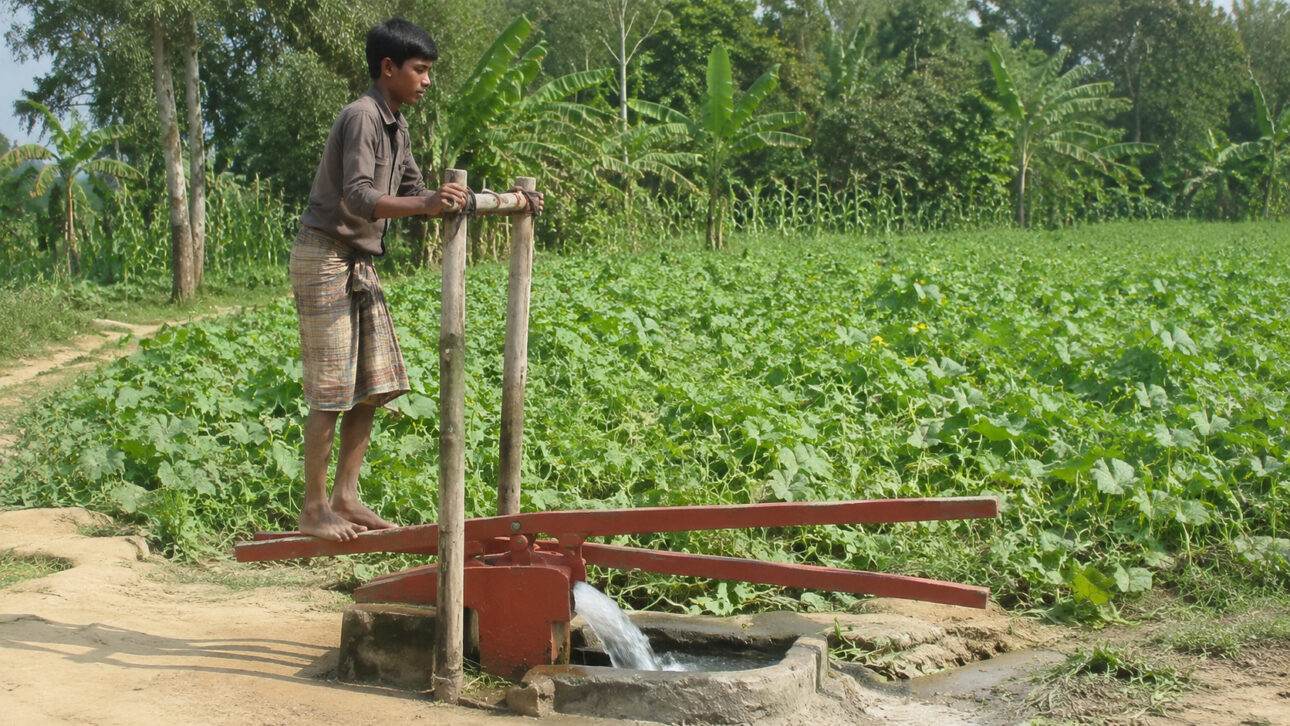
The technology was designed for small agricultural areas and for families with access to their own labor. In the Practical Action material, the pump appears as an alternative aimed at irrigating areas of 2,000 to 3,000 m², with local installation and manual operation, which helped make it attractive to small producers.
How the bamboo treadle pump works, pumping water with feet in an almost continuous flow
The pump mechanism is straightforward: it uses two cylinders, pistons, and check valves operated by two pedals. When the operator alternates their feet, the pistons work in opposite motions, generating suction and raising the water in almost continuous pulses.
The upper structure is usually made with bamboo or wood, while the pump body is mostly metallic.
The FAO describes the equipment as a portable pump for shallow water, with two barrels and bamboo pedals, while Practical Action highlights that the use of double cylinders makes the water output more stable and efficient than that of single-cylinder manual pumps.
Low-cost irrigation technology reaches up to 7 to 8 meters and allows cultivation beyond the rainy season
The FAO reports that the bamboo treadle pump is used to draw water from depths of up to 7 to 8 meters, both in shallow wells and boreholes and in surface water bodies.
The material highlights that the system was mainly designed to irrigate higher-value crops, such as vegetables, without requiring additional inputs for operation.


Technical data varies according to the model, depth, and operator’s strength. Practical Action records an approximate flow rate of 0.8 to 1.0 liters per second and recommends a pumping depth of up to 22 feet, exceptionally 25 feet, which corresponds to about 6.7 to 7.6 meters.
In practice, this has allowed many farmers to plant during the dry season as well. The FAO states that the pump gives the producer direct control over irrigation, favors year-round cultivation, and expands the possibility of working with a wider range of crops.
Millions of treadle pumps were disseminated and helped increase agricultural income in Bangladesh and other countries
The scale of adoption was one of the elements that turned the treadle pump into a global reference for frugal innovation. Practical Action states that, over a period of 15 years, almost 2 million pumps were disseminated in Bangladesh, India, Nepal, and other countries in Asia and Africa.

The iDE records that, in the early 1980s, the lack of irrigation during the dry season in Bangladesh opened up space for the expansion of technology. According to the organization, more than 1.5 million treadle pumps had been sold in the country by 2015, creating US$ 1.4 billion in additional net income per year.
The FAO also links the pump to direct income gains and food security. In the material about bamboo treadle pump, the organization states that previous experiences in India and Bangladesh showed that farmers’ income at least doubled with the use of the equipment, with increases between US$ 50 and US$ 500 per year.
Bamboo pump became a symbol of simple, cheap agricultural innovation adapted to small producers
The success of the treadle pump did not come from sophisticated automation, but from the combination of mechanical simplicity, low cost, and adaptation to the rural context.
The FAO describes the technology as a simple and economical device, made with lightweight materials, capable of bringing water to farmers on marginal lands and still generating work in the production, distribution, and installation of the pumps.
Even with the advancement of motorized and automated systems, the pedal pump continues to be remembered as one of the most emblematic cases of appropriate technology for family farming. With bamboo pedals, two cylinders, and human labor, it showed that efficient irrigation does not always depend on engines, fuel, or complex electrical infrastructure.