Portuguese
  Spanish




With a Free Span of 470 Meters That Defies Gravity, the Integration Bridge Establishes Itself as a Landmark of Engineering, But a Planning Paradox Keeps It Closed.
In the heart of South America, Brazil is home to the largest cable-stayed bridge on the continent. However, this claim reveals a fascinating dispute between two giants of national engineering. The title of “largest bridge” crucially depends on the criterion used: total length or main free span. While one impresses with its length, the other represents the pinnacle of technical complexity.
Understand the Difference Between Length and Free Span
For engineering, the free span, the distance between the supporting pillars, is the most relevant indicator of the audacity of a cable-stayed bridge. It is in this aspect that the new Integration Bridge, connecting Brazil to Paraguay, stands out.
On the other hand, the Journalist Phelippe Daou Bridge, known as the Rio Negro Bridge, in Manaus, holds the record for the longest cable-stayed bridge in Brazil in total length, with an impressive 3,595 meters.
-
A Japanese governor single-handedly stalled the construction of the world’s fastest train for nine years, and only now has he agreed to allow a tunnel excavated at a depth of 1,400 meters.

-
A 180-meter ship with a deck the size of a football field was christened to carry 25,000 tons of giant energy modules around the world.
-
While modern cities rely on pumps and electricity, in Iran, ancient tunnels carried water through the desert using only slope and gravity.
-
In the land of soybeans, Sinop’s first 42-story skyscraper will consume 1,900 truckloads of concrete and 350,000 kilograms of steel, with a foundation of 50 meters, deeper than that of the future “tallest building in Brazil” in Balneário Camboriú.


The True Largest Bridge in Engineering Complexity
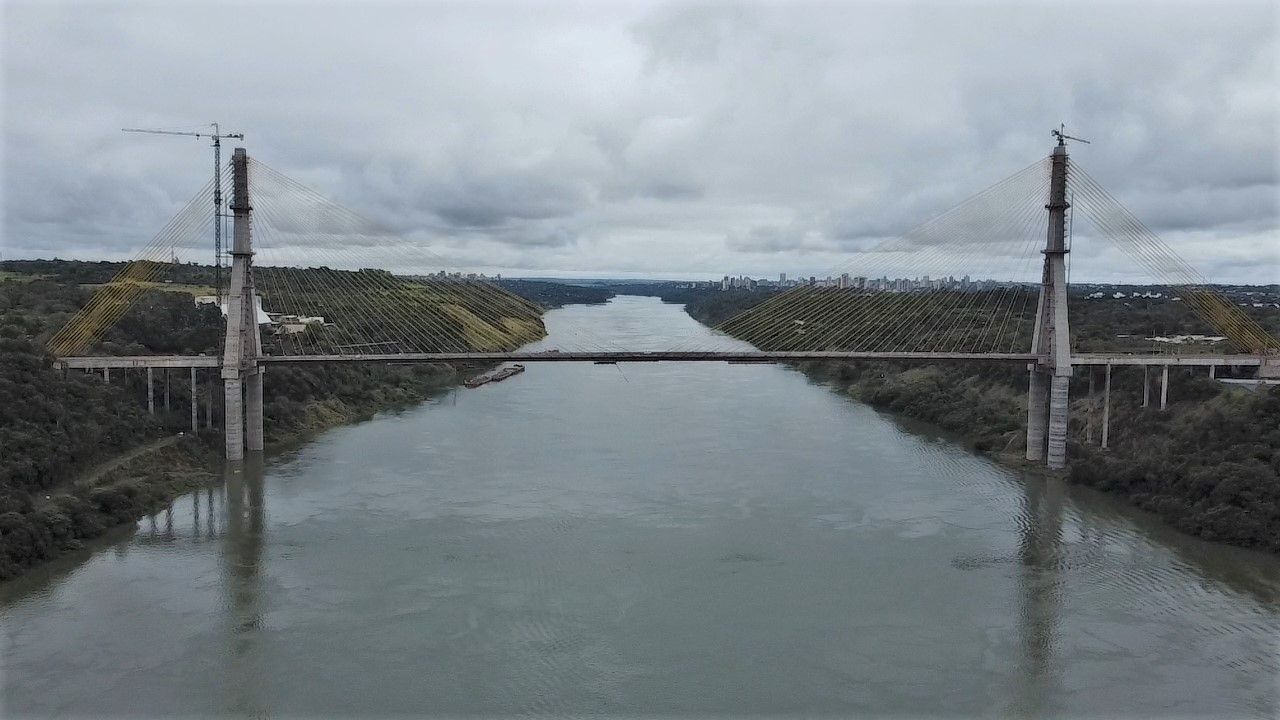
The International Integration Bridge holds the most coveted record: the largest free span cable-stayed bridge in Latin America, with 470 meters. This structure connects Foz do Iguaçu (PR) to Presidente Franco in Paraguay over the Paraná River.
Its bold design and structural complexity position it as the forefront of bridge technology in the region. It was designed to be a key logistics corridor for Mercosur, reshaping the freight transportation map.
The Specifications of the Latin American Record Holder
The grandeur of the Integration Bridge is reflected in its technical data. Each number reveals an engineering solution to overcome geographical and strategic challenges.
- Main Free Span: 470 meters (Record in Latin America)
- Total Length: 760 meters
- Pylon Height: Approximately 190 meters
- Structural Type: Cable-stayed bridge with asymmetric geometry
- Materials: About 37,000 m³ of concrete and 3,500 tons of steel
- Cable Design: Semi-fan arrangement
Its design also includes a modern LED scenic lighting system, capable of creating night spectacles and celebrating commemorative dates, consolidating the bridge as a new cultural and tourist icon.
The Paradox of the Largest Bridge Without Access
Despite the excellence of its engineering, the Integration Bridge faces a huge challenge. The main structure was completed in late 2023, but it remains closed and inaccessible to traffic. The reason is a stark contrast between engineering success and planning failures.
On the Brazilian side, the main obstacle is the completion of the Eastern Perimeter Highway, a 15-kilometer road that will connect the bridge to BR-277. In Paraguay, the situation is similar, with delays in finishing the access roads and customs infrastructure. Engineering has surpassed physics, but it has been halted by bureaucracy.
The Amazonian Competitor and Its Length Record
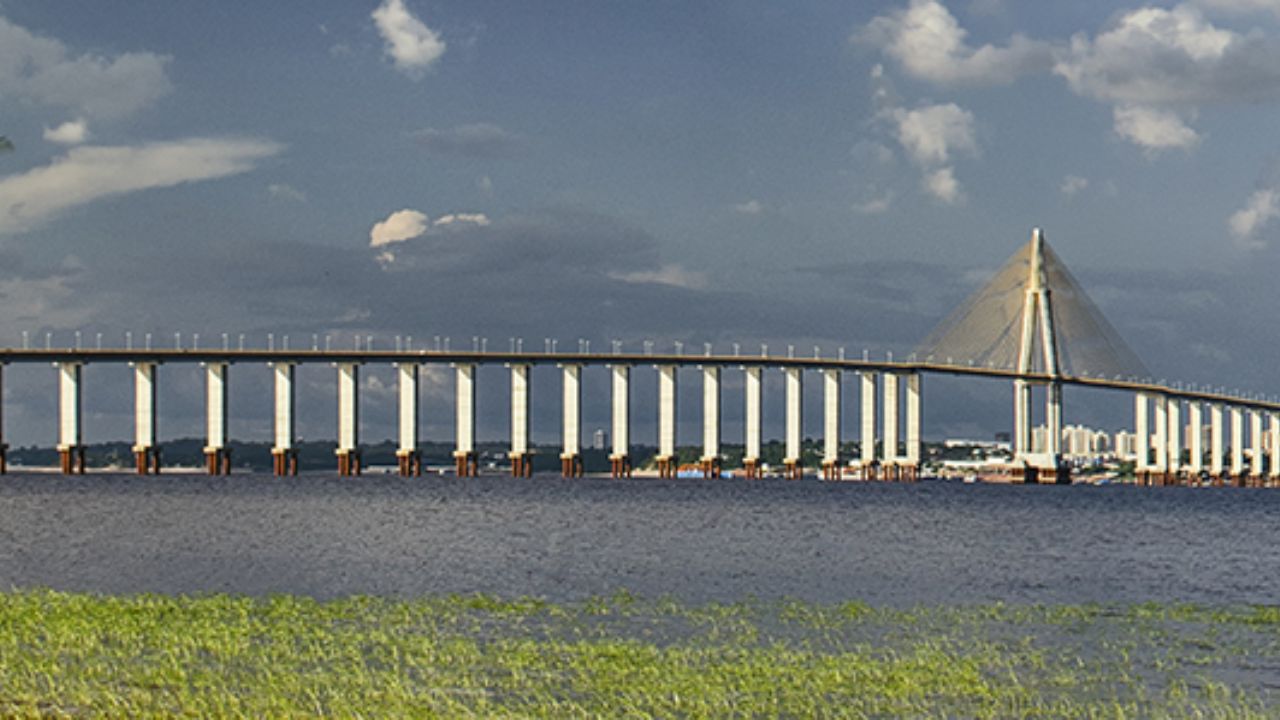
For comparison, the Rio Negro Bridge, inaugurated in 2011, is a monumental scale work with its 3,595 meters of total length. It crosses the largest blackwater river in the world to connect Manaus to Iranduba. Its main cable-stayed span is 400 meters, supported by a single central pylon. Although it is a remarkable feat, its national logistical impact is limited as it does not connect to the main highway network south of the Amazon River.
While the Rio Negro Bridge impresses with its scale, the Integration Bridge represents the greatest technical advancement, establishing itself as the main reference for cable-stayed bridges in Latin America due to the complexity of its record-setting free span.