






 Portuguese
  Spanish
  2 min of reading
  0 comments


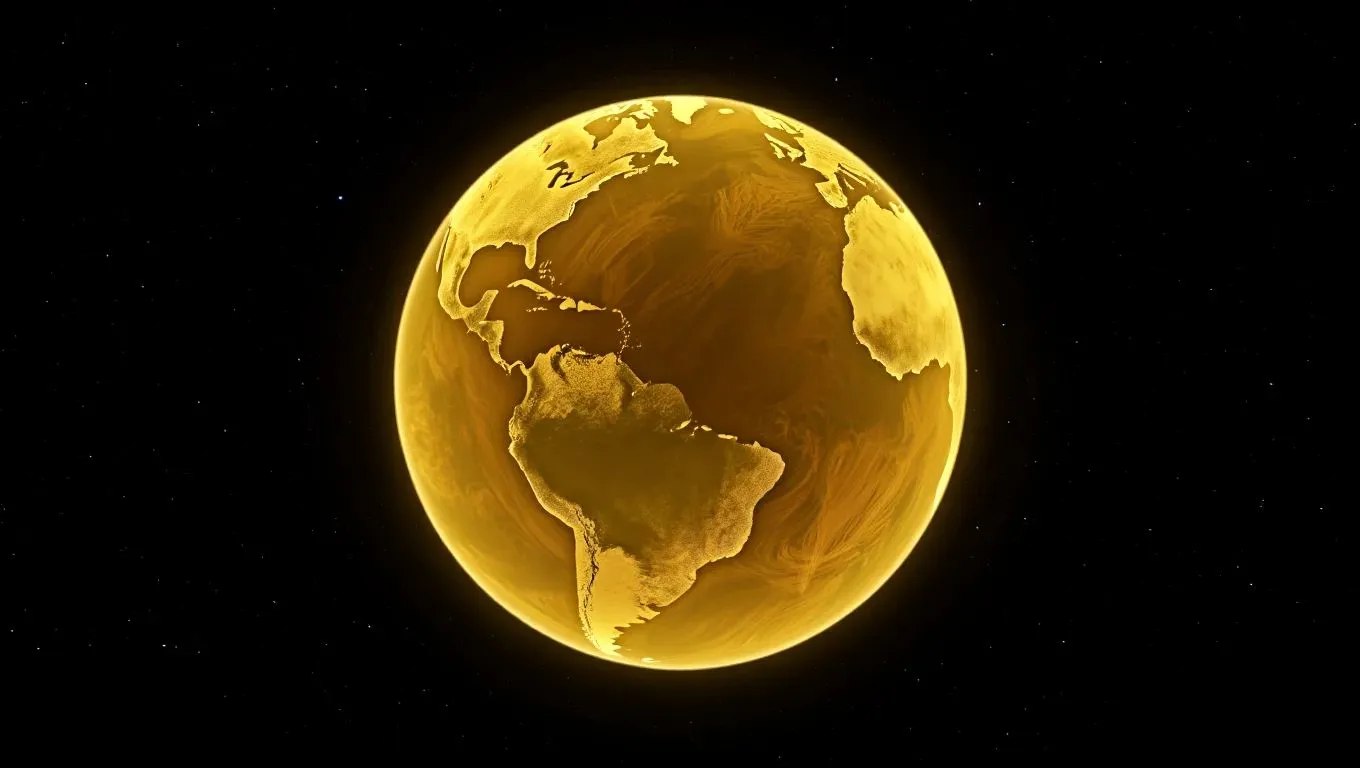
Even After Centuries of Mining, Most of the Earth’s Gold Remains Inaccessible, Hidden in the Core and Spread in Particles in the Crust
Gold has always sparked human interest, but its distribution on the planet shows that there is still much to be understood. It is estimated that most of this precious metal is in inaccessible locations, well beyond the Earth’s crust.
Current Extraction and Known Reserves
According to the U.S. Geological Survey and the World Gold Council, humanity has extracted between 206,000 and 238,000 tons.
However, current exploitable reserves amount to only about 70,550 tons. Most of them are concentrated in countries like Russia, Australia, and South Africa.
-
Helicopter Drops 180 Tons of Sand and Gravel on Swedish River to Revive Ecosystem Damaged by Decades of Exploitation

-
Brazilian Company Launches Retro Smartphone with 48 MP Camera, T9 Keyboard, and Privacy Features for Social Media-Free Use

-
Self-Taught Chinese Farmer Builds 5-Ton Submarine from Scrap, Launches It in Anhui River
-
Invisible Induction Technology Enables Wireless Power for Blenders, Coffee Makers, and Air Fryers, Reducing Countertop Cables





As of 2024, China leads as the world’s top producer of the metal.
Even with all mining efforts, the numbers are small compared to the estimated amount of gold existing on the planet. Most remains in the Earth’s core, where it is beyond the reach of current technology.
Low Concentration in the Earth’s Crust
The Earth’s crust has very little gold scattered in the rocks. On average, there are only 4 parts of gold for every billion parts of rock. This means that if you had 1 billion grams of rock (1,000 tons), you would find only 4 grams of gold within all of that.
The metal is dispersed in small particles, both in rocks and in oceans.
Cosmic Origin of the Metal
The origin of gold goes far beyond the Earth. According to the most accepted scientific theory, gold forms in collisions between neutron stars — rare and extremely violent events in the Universe.
At those moments, the so-called nucleosynthesis via rapid neutron capture occurs, a process capable of generating heavy elements like the metal.
These elements are then ejected into space and can be incorporated into forming planets. That is how gold came to Earth — and that is why it is so rare.





-

1 person reacted to this.