






 Portuguese
  Spanish


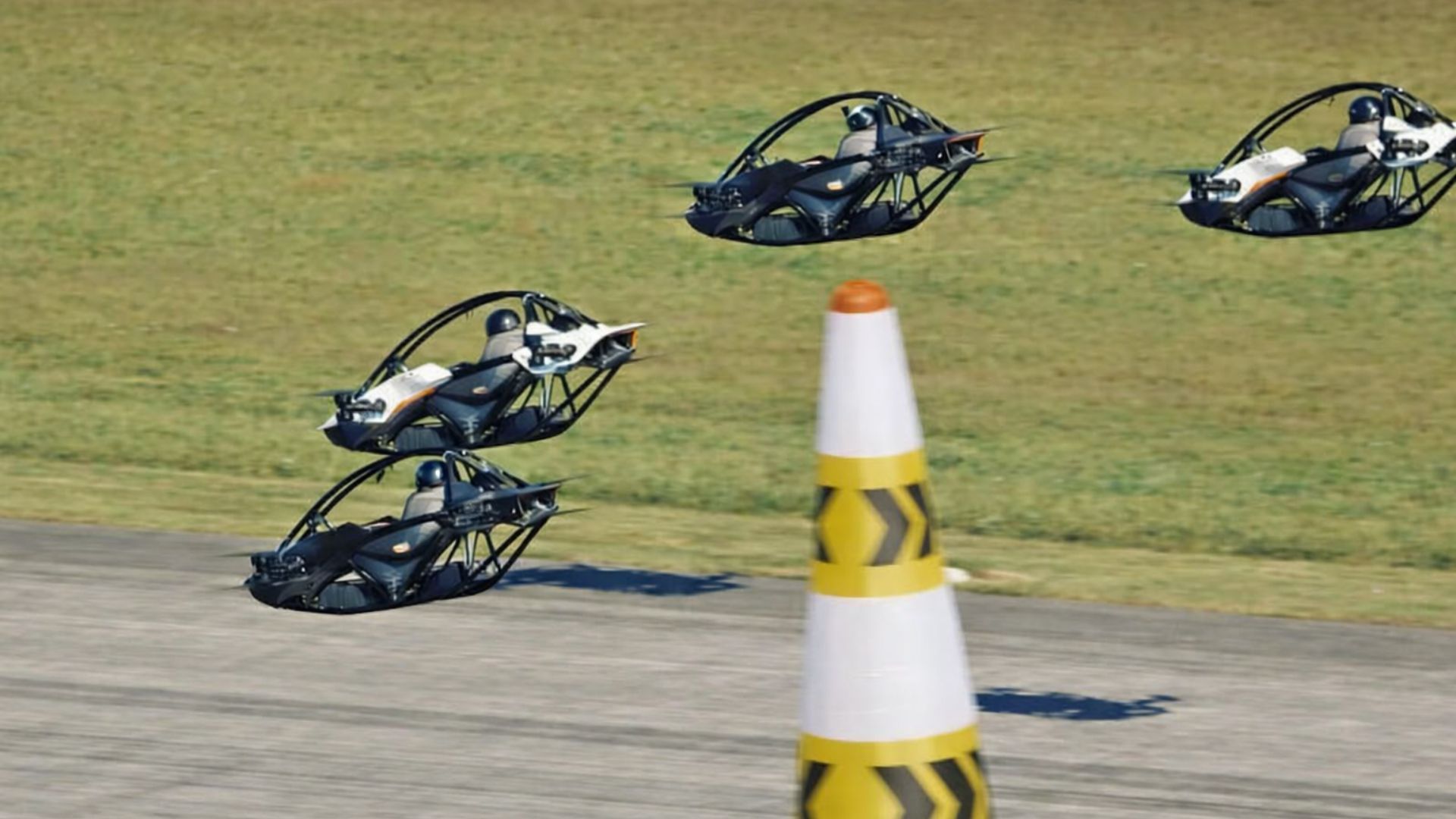
An Unprecedented Air Competition Pitted Electric Vertical Takeoff Vehicles Against Each Other, Showing That Racing in the Skies Is Already a Reality and No Longer Science Fiction
Races with flying cars have definitively left the realm of science fiction after the first Jetson Air Games, an event that had four personal aerial vehicles competing for position on a real circuit. The initiative was described by organizers as the “Formula 1 of the Skies”, marking a new chapter in the development of individual air mobility.
The event featured pilots operating four units of the Jetson One, an electric vertical takeoff and landing aircraft that the manufacturer describes as a “race car for the sky.” Each participant aimed to cross the finish line first, demonstrating control, stability, and speed in a controlled aerial environment.
This information was released by the website Live Science, which covered the demonstration held in mid-October during the UP.Summit 2025, a private meeting that brings together investors and leaders in the advanced transportation sector. According to the portal, the event aimed to show that personal aircraft have already reached a level of maturity sufficient for applications beyond simple laboratory tests.
-
Toyota Launches First 100% Electric Car in Brazil: bZ4X with 343 HP, All-Wheel Drive, 361 km Range, Priced at $419,990 BRL, Limited to 99 Units

-
Chinese SUV Achieves 24.4 km/l, Outperforms Toyota Yaris Cross in Real-World Tests with 224 hp Hybrid System, Offers 51-Liter Tank for Greater Range, and Costs Up to R$ 5,000 Less.

-
Uber Black Revamps Fleet, Drops Ten Car Models and Sets Deadline for Electric BYD Dolphin
-
Chinese Giant Uses Metal Structures and Cranes to Deliver Over 700 Electric Cars to Brazil


The released images show the four Jetson Ones flying at about 20 feet, equivalent to approximately 6 meters in height, while traversing a route marked by cones. During the race, the aircraft flew over grassy areas and stretches of asphalt, alternating speed and maneuvers at low altitudes, which reinforces the experimental but highly controlled nature of the race.
How the Jetson One Works and Its eVTOL Technology

The Jetson One is classified as an eVTOL (electric vertical take-off and landing) aircraft, meaning it uses electric propulsion to take off, land, and hover vertically, similar to a helicopter. However, after gaining altitude, its flight behavior resembles that of a light airplane.
According to the manufacturer’s technical specifications, the vehicle has a maximum flight autonomy of 20 minutes, a relevant data point for the current generation of personal electric aircraft. Additionally, the Jetson One weighs about 120 pounds, equivalent to 54 kilograms, which contributes to its agility and energy efficiency.
Another important piece of information is its performance in altitude and speed. The aircraft can reach up to 1,500 feet in height, approximately 457 meters, and achieve a maximum speed of 63 miles per hour, or about 102 km/h. These figures place the Jetson One at a mid-level between advanced drones and traditional manned aircraft.
Despite its futuristic appearance, reminiscent of flying vehicles from science fiction films, the Jetson One is designed to carry only one person. In the United States, the model currently does not require a pilot’s license for operation, which enhances its potential as a recreational personal aircraft.
Safety, Risks, and Advances in eVTOL Development

Even with technological advances, the use of personal aircraft involves significant risks. To address these concerns, Jetson states that it has incorporated multiple safety systems into the design. Among them is an automatic landing system with radar sensors, which assists the pilot in critical situations.
Furthermore, the Jetson One was designed to continue flying safely even in the event of a failure of one of its eight electric motors, a fundamental characteristic for aircraft of this type. The vehicle also features a ballistic parachute, designed to deploy extremely quickly in emergencies.
The eVTOL concept is not new. It has been studied since at least 2009, when NASA introduced the conceptual design Puffin. Developed in collaboration with MIT and the Georgia Institute of Technology, NASA Puffin was created to demonstrate the viability of low-noise personal electric aircraft.
The prototype was built at a reduced scale and tested in 2010, with the goal of evaluating its aerodynamic performance. Although it was successful as a proof of concept, the project never made it to full-scale production.
Since then, several companies around the world have rapidly advanced in this sector. The Chinese company Ehang received permission to mass-produce autonomous air taxis in April 2024. Meanwhile, Supernal, a subsidiary of Hyundai, began flight tests of its air taxi for four passengers in April 2025. Companies like Honda and Airbus have also invested in the development of eVTOL aircraft in recent years.
Currently, the Jetson One is available for order at approximately US$ 150,000, excluding taxes and additional fees. According to the company, the new ordered units are expected to be delivered by 2028, indicating a growing demand for this type of personal aerial vehicle.
Do you believe that races with electric flying cars can accelerate regulation and make personal air mobility a reality in the daily life of cities?





-

-

-

-

12 people reacted to this.