






 Portuguese
  Spanish


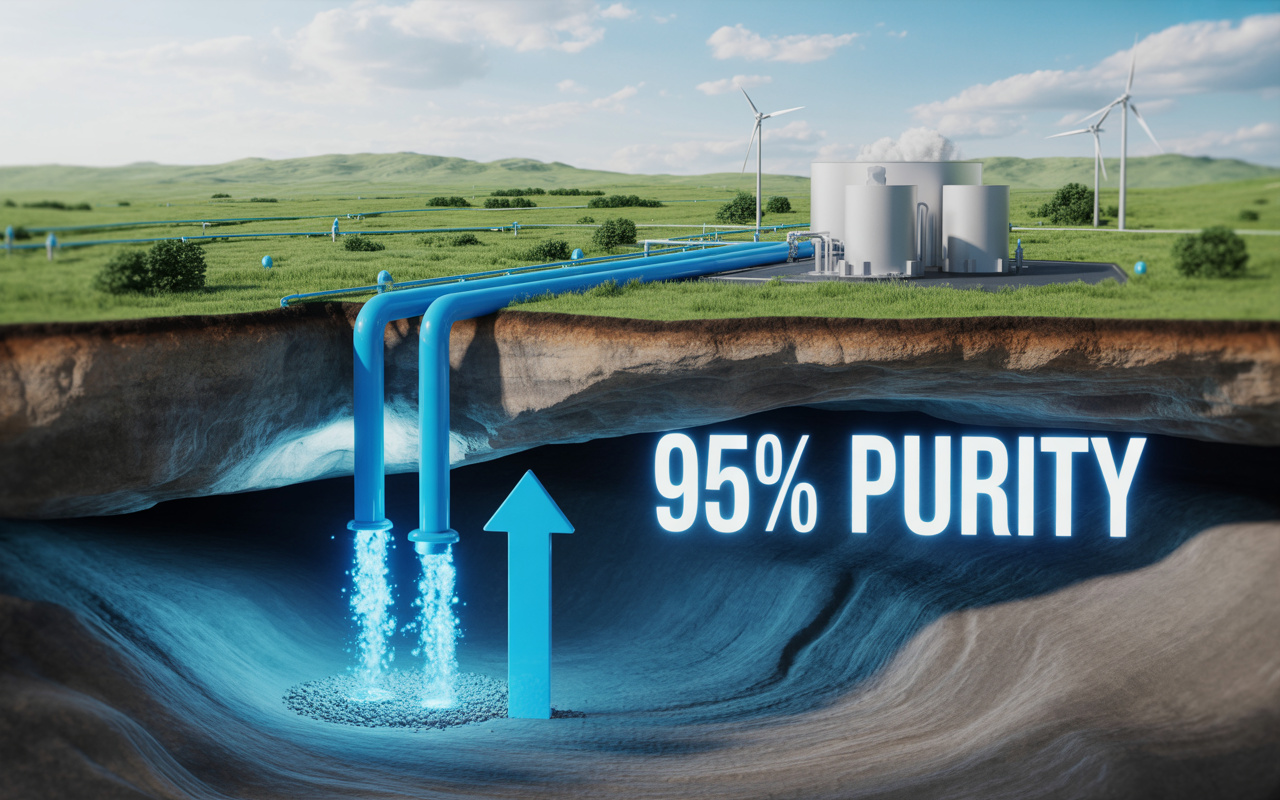


Natural Hydrogen With Purity Above 95% Is Released Continuously From The Ground, Producing Tens Of Millions Of M³ Per Year And Can Supply Countries For Centuries Without Emissions.
What seemed to be a drilling mistake ended up revealing one of the most intriguing energy discoveries of the century. Instead of natural gas, a well released practically pure hydrogen, coming out of the ground continuously. The phenomenon hasn’t lasted hours or days: it has been active for years, with purity above 95%, significant volumes, and a geological mechanism indicating permanent production over thousands of years. The most well-known case occurs in Bourakébougou, Mali, but it is now known that it is not unique, just the first to be observed in detail.
A Gas That Springs Up On Its Own: What The Numbers Show
Independent measurements indicate natural hydrogen (also called “white hydrogen”) with purity over 95%, something rare even for industrial hydrogen. Flow estimates suggest tens of millions of cubic meters per year in comparable systems when considered on a regional scale. Unlike oil and gas, this is not just a static reserve: there is continuous generation.

In energy terms, each 1 m³ of H₂ contains about 3 kWh. This means that tens of millions of m³/year equate to hundreds of GWh annually, enough to sustain regional power grids. In scenarios of accumulation and production sustained over centuries, the potential increases to supply entire countries, with zero carbon in the end use.
-
California Project Aims to Store Heat Underground in Former Oil Reservoir to Generate 100 kW of Electricity for Over 12 Hours

-
French Port Harnesses Industrial Waste Heat to Power Up to 30,000 Homes
-
Belgian Port to Install Shore Power for Cruise Ships by 2027, Cutting Dock Emissions by Up to 5% and Meeting EU Regulations
-
Canadian Project Converts Hot Water from Mature Oil Fields into Electricity, Repurposing Existing Wells and Infrastructure




The Geological Factory: How Hydrogen Is Produced
The motor of this system is a set of rock-water reactions known as serpentinization. Underground, iron-rich minerals come into contact with water under heat and pressure, releasing H₂ as a chemical byproduct. It is a natural, continuous, and self-sustaining process as long as there is water, reactive rock, and thermal gradient.

This detail changes everything: unlike fossil fuels, white hydrogen does not need to have been formed in the remote past, it is being formed now.
Depth, Pressure, And Purity: Why The Gas Arrives “Clean”
The reservoirs are typically found hundreds to over 1,000 meters deep, where the pressure keeps the gas concentrated. Since the process does not involve organic matter, there is no sulfur, CO₂, or hydrocarbons associated.
The result is hydrogen that emerges almost ready for use, drastically reducing costly purification steps.
This high purity is one of the factors that position natural hydrogen as a direct competitor to “green” hydrogen (electrolytic), especially in terms of cost.
Why This Could Be Cheaper Than Green Hydrogen
Producing green hydrogen requires renewable electricity, treated water, electrolyzers, and heavy infrastructure. In natural hydrogen, nature has already done the chemical work. The operation is closer to capture and flow control than to industrial synthesis.

Preliminary studies indicate potential costs significantly lower than those of green hydrogen in favorable regions, with the added advantage of continuous production (not intermittent).
Global Scale: Not An Isolated Case
After Mali, evidence and measurements confirmed natural exudations of H₂ on several continents: Africa, Europe, North America, Asia, and Oceania.
In many locations, the gas was ignored or confused with leaks from other systems. Today, geophysical and geochemical mappings are being redone with a specific focus on hydrogen.
The emerging conclusion is clear: the phenomenon is global, but only now is it being measured with the correct lens.
Hydrogen is light and flammable, but non-toxic. In natural reservoirs, the challenge is controlling flows, preventing mixing with oxygen at the surface, and maintaining safe collection systems. Experience in Bourakébougou has shown that simple and robust operations are sufficient for continuous local use — including stable electricity generation for years.
Climate Impact: Zero Carbon In End Use
In end use, hydrogen emits only water vapor. If captured with proper environmental control, natural hydrogen offers emission-free energy and without the intensive mining impacts associated with other routes. The surface footprint is relatively small, especially when compared to large industrial parks.
The big open question is how much of these systems function as closed reservoirs and how much operate as sources of continuous flow. Evidence in Mali and other points indicates active replenishment, which redefines classic concepts of “reserve”.
If confirmed on a large scale, natural hydrogen would not just be a fuel — it would be a new category of energy resource.
What Is Needed To Become An Energy Matrix
Three fronts are advancing in parallel:
- Global Mapping with specific sensors for H₂
- Regulatory Standardization (the gas does not fit into the oil/gas frameworks)
- Industrial Scaling of collection, compression, and usage
With these steps, the transition from a “curious find” to energy infrastructure could be rapid.
If regional volumes are confirmed, countries without oil or large rivers could become strategic hydrogen producers, reducing dependencies and redesigning supply chains. Local, clean, and continuous energy is a rare and powerful combination.

Because it combines, in a single resource, purity above 95%, continuous production for thousands of years, volumes in the tens of millions of m³ per year and zero emissions in end use. It is not a distant promise: it is already happening.
If the 20th century was shaped by oil and gas, the 21st century may be opening an unexpected route — not created in a lab, but in the depths of the Earth’s crust.







E o Brasil-(América do Sul/Latina), que nasceram abençoados por Deus, só falta o homem tomar consciência e saber usar a natureza a nosso favor que Deus nos concedeu de maneira racional, inteligente e sem corrupção.
O Brasil, com as características de nosso território, devemos ter uma das maiores presenças deste combustível do futuro. Afinal, de acordo c/as afirmativas da matéria, temos as maiores reservas de ferro do mundo, presente em todas as regiões do país, principalmente no Nordeste, Minas Gerais e a nossa grande reserva da região da Serra dos Carajás, no Pará e na Amazônia vlmo im todo.
Caro Francisco, você é filho do ex-superintendente de Itaipu, também Francisco Fortes Filho?