Portuguese
  Spanish




Innovation That Unites Robotics and Sustainability Redefines the Way Houses Are Built and Promises to Take Technology to Earth and Space
Since October 2025, Robot Charlotte has been gaining global attention by combining advanced robotics and 3D printing to construct houses in just 24 hours. Additionally, the automated system promises to reduce costs, accelerate timelines, and minimize environmental impact.
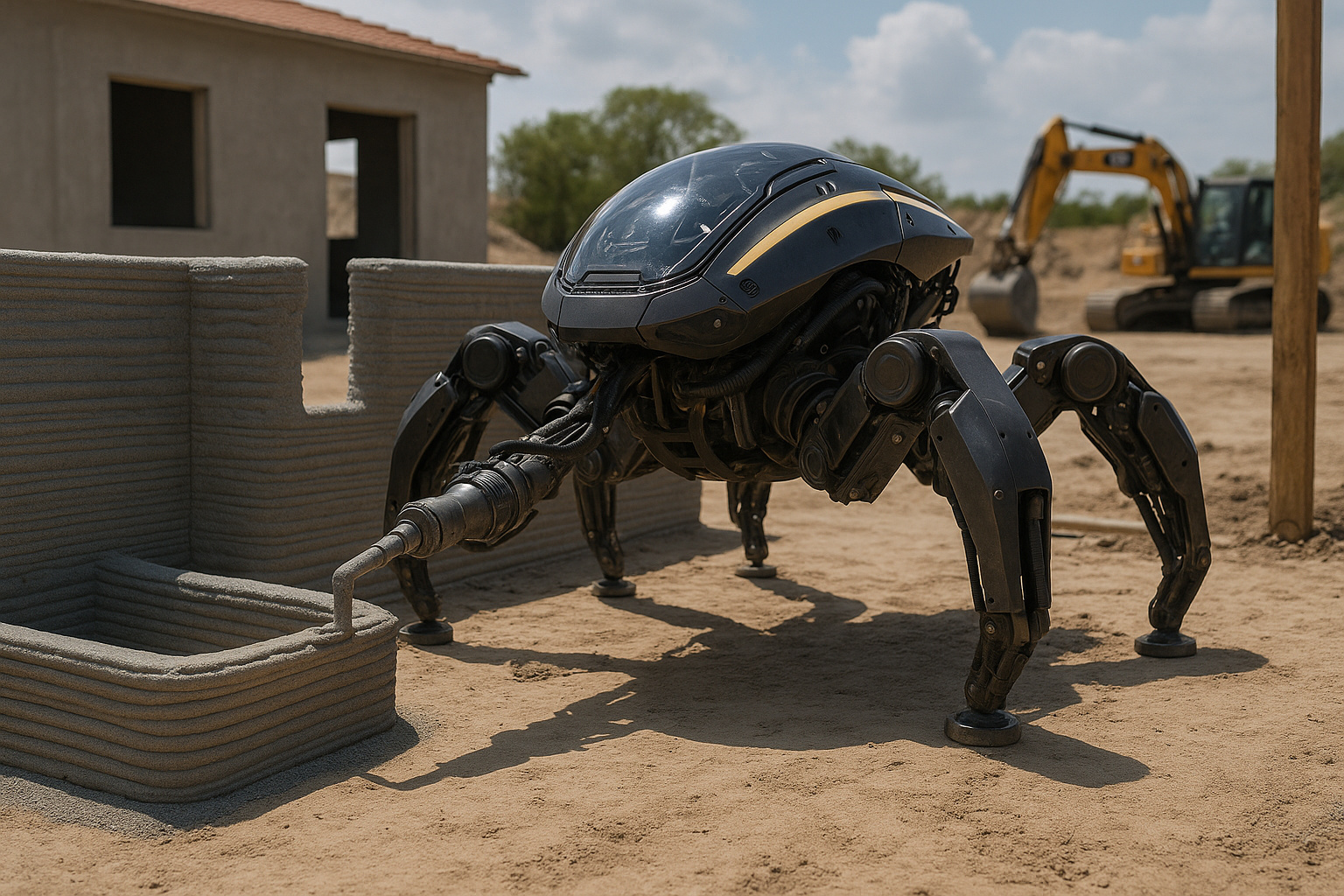
Developed by the startups Crest Robotics and Earthbuilt Technology, the robot has six movable legs, capable of operating with autonomous mobility and millimetric precision. This way, it prints structures directly onto the ground using sustainable materials that eliminate the need for cement and reduce emissions.
This innovation marks a historical turning point in civil construction, a sector that has always heavily relied on human labor and manual processes. Thus, Charlotte emerges as a symbol of a new industrial era, driven by automation and energy efficiency.
How Robot Charlotte Is Transforming the Sector
The project was presented on October 7, 2025, during IAC 2025, and quickly made headlines on platforms like 3D Printing Industry and Designboom. Since then, experts have highlighted its potential to transform civil works and reduce the reliance on workers in the field.
The hexapod robot, inspired by a spider, utilizes extrusion and compaction systems to mold local materials like sand and crushed brick. This way, it eliminates the need for cement, reducing the carbon footprint and increasing the sustainability of the process.
According to Earthbuilt Technology, the system allows for the construction of homes of up to 200 square meters with high precision and low human intervention. The technology is still in the testing phase, however, it shows immediate viability for urban applications and space projects.
Ultimately, the expectation is that this innovation will also contribute to the global reduction of the housing deficit, as it enhances the speed of housing production.
ARTICLE CONTINUES BELOWSee also
Affordable Housing Project in Brazil’s Mato Grosso Aims for 700 Deliveries and $34 Million in 2026, Outpacing Major Developers in High-Demand Areas

Brazil’s Largest Port to Accommodate Bigger Ships by October as Ibama Approves Non-Explosive Removal of Hidden Rocks and Sediments
Mexico Develops 3D-Printed Concrete from Corn Waste, Cutting Emissions by 70% and Reducing Construction Waste by 90%
Traditional Mortar to Decline by 2026: ACIII-E Solution for Large Porcelain Tiles Offers Better Adhesion and Reduces Risk of Loose Pieces in Floors and Facades


Main Benefits of 3D Printing in Civil Construction
3D printing has revolutionized modern construction with concrete results. Among its main benefits, the following stand out:
- Cost reduction and waste elimination, increasing productivity.
- Agility in execution, with deliveries within shorter timelines.
- Increased sustainability, by leveraging local resources and minimizing transportation.
- Enhanced safety, with reduced risks in work areas.
Moreover, the use of robots like Charlotte simplifies logistics and improves operational flow on construction sites. As a result, the productive chain becomes more efficient and eco-friendly.
According to Crest Robotics, the goal is to reduce construction environmental impact by up to 70% by 2030, following the UN carbon neutrality goals. Thus, technology aligns innovation with environmental responsibility, something essential for the future of the sector.
Applications in Space and Technological Advances
The potential of Charlotte goes far beyond Earth. The responsible startups are already developing adapted versions for the lunar environment, capable of operating with solar energy and locally available materials, such as regolith.
This application could enable the construction of self-sufficient bases in future space missions, with support from agencies like NASA and ESA. This way, Charlotte becomes a strategic piece in interplanetary engineering.
As explained by David Gordon, a researcher at Earthbuilt Technology, the goal is to “create autonomous and intelligent systems, capable of building structures that are safe and resistant to radiation and extreme weather.”
The use of clean energy and the adaptation to hostile environments make the robot indispensable for sustainable space exploration.
Challenges and Prospects for the Future of Automated Construction
While promising, the system still faces technical and regulatory challenges. Among them are adapting to safety standards, resilience to varied climates, and the initial implementation cost.
Currently, the robot operates in single-family homes and small structures, but the plan is to expand its use to larger public and commercial projects.
As partnerships between companies and space agencies strengthen, the model should evolve rapidly. Consequently, Charlotte could be used in smart cities, modular infrastructures, and even in habitable lunar bases.
According to industry experts, the integration of robotics and construction defines a new productive paradigm, in which technology optimizes resources, increases safety, and promotes global sustainability.
Finally, the union between engineering, automation, and 3D printing points to a future where civil construction will become cleaner, faster, and smarter. Charlotte is just the first step of an inevitable revolution.