






 Portuguese
  Spanish
  4 min of reading
  0 comments


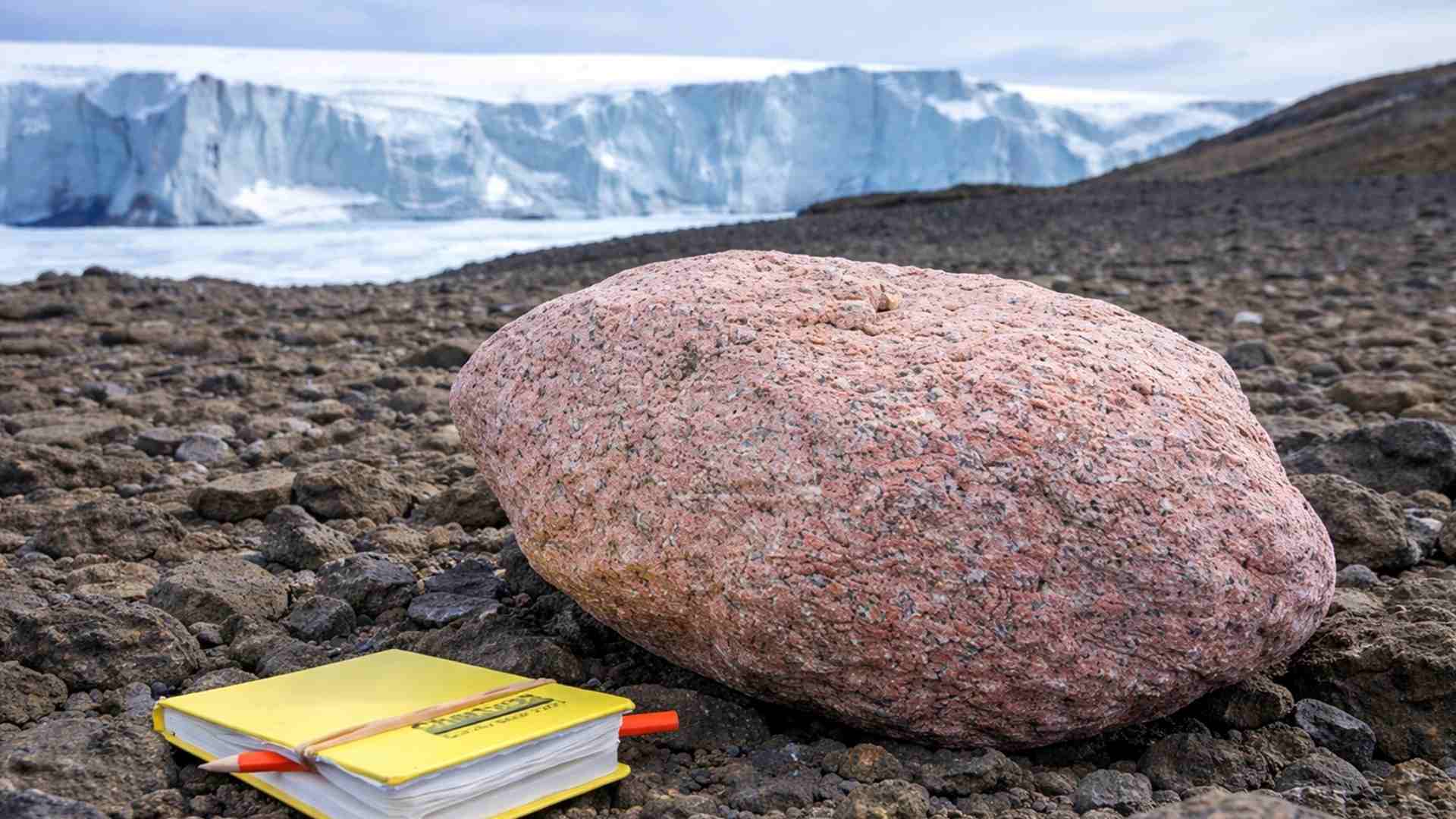
The Identification of a Granite Body Almost 100 Kilometers Wide and Up to 7 Kilometers Thick Under the Pine Island Glacier Connects Surface Rock Blocks to Ice Dynamics About 175 Million Years Ago and Helps Refine Models About the Past and Future Behavior of West Antarctica
A vast body of granite buried beneath the Pine Island Glacier in West Antarctica has been identified by scientists after decades of surface clues, revealing a structure about 100 kilometers wide and directly impacting the reconstruction of the past and present ice flow in the region.
Pink granite rocks scattered across the dark volcanic peaks of the Hudson Mountains in West Antarctica led researchers to identify a huge granite formation hidden beneath the Pine Island Glacier. The buried mass is nearly 100 kilometers wide and approximately 7 kilometers thick, dimensions that make it about half the size of Wales.
These rock blocks have caught scientists’ attention for decades because they stand out from the locally dominant volcanic geology.
-
A discarded microwave may contain 22-carat gold in internal components; study recovered a 450 mg nugget from electronic boards.

-
Who has the highest IQ: the oldest child, the middle child, or the youngest? A study with 240,000 people published in Science reveals a difference of up to 3.2 points and indicates which position in the family tends to have an advantage.
-
A YouTuber spent almost a year transforming the failed invention into an autonomous flying umbrella: the drone uses a camera and Raspberry Pi to follow the person and protect them from the rain on its own.
-
The first trillionaire in history, Elon Musk notices Brazil and its internet, Starlink, which works even in the middle of nowhere, emerges for just R$ 600, fits in a backpack, operates via satellites, and offers dual-band Wi-Fi with WPA3 security.


The presence of this material in elevated points has always raised questions about its origin and the processes responsible for its transport to the mountain tops.
The identification of the underground structure reformulates the understanding of the geological and glaciological history of the region, connecting visible rocks at the surface to a large rock body hidden beneath kilometers of ice.
Dating of the Blocks and Clues About the Origin
To unravel the mystery, a team led by the British Antarctic Survey analyzed the granite blocks by measuring the radioactive decay of elements trapped in microscopic crystals. The dating indicated that the rocks formed about 175 million years ago during the Jurassic period.
Despite the determined age, the question of how these blocks reached the Hudson Mountains remained unanswered. The hypothesis of transport by ancient ice existed but lacked direct evidence connecting the surface rocks to a specific source underground.
The solution began to emerge when scientists combined geological data with recent geophysical surveys, allowing for a more detailed view of what lies beneath the thick ice layer of West Antarctica.

Aerial Surveys Reveal a Hidden Giant
High-resolution gravimetric measurements, conducted by Twin Otter aircraft from the British Antarctic Survey and other planes that flew over the region, detected an anomalous signal beneath the Pine Island Glacier. This signal corresponded to what would be expected for a large granite body buried deep beneath the ice.
The correspondence between the gravimetric signal and the characteristics of the granite blocks observed at the surface allowed for the establishment of a direct link between the two. According to researchers, this association represents a significant advance in understanding the subglacial geology of West Antarctica.
The discovery explains how a much thicker ice layer, existing in the past, was able to dislodge large blocks from the bedrock and transport them to elevated areas of the surrounding mountains before retreating.
Reconstruction of Ice Flow in the Last Ice Age
The connection between the hidden granite and the surface blocks provides fundamental information about the behavior of the Pine Island Glacier during the last ice age, about 20,000 years ago. During that period, the ice had greater thickness and erosive capacity.
With this data, researchers can reconstruct ancient ice flow patterns and estimate the thickness of the ice layer in the past. This information is considered essential for refining computational models that simulate the dynamics of polar ice caps.
According to geophysicist Tom Jordan, the lead author of the study, the combination of geological dating and gravimetric surveys not only resolved the origin of the rocks but also revealed how the ice flowed previously and how it may evolve in the future.
Influence of Geology on Current Ice Loss
The discovery also has direct implications for understanding the current processes beneath the Pine Island Glacier, one of the areas that has experienced the fastest rates of ice loss in Antarctica in recent decades. The geology of the bed influences the sliding of the ice and the drainage of subglacial meltwater.
A detailed knowledge of this granite structure helps explain variations in glacier behavior and contributes to improving models used to project sea level rise. These models depend on the interaction between ice, rock, and water to produce more reliable projections.
Geologist Joanne Johnson, co-author of the study, highlighted that the granite blocks act as a natural record of the planet’s changes over time, showing how the ice has eroded and reshaped the Antarctic landscape in profound and prolonged ways.
By identifying the origin of these blocks, scientists can reconstruct the paths traveled by the ice and gain insights into how the West Antarctic ice sheet may change in the future, information deemed vital for assessing global impacts of rising sea levels.
Integration of Geology and Geophysics
The study highlights the importance of integrating different scientific fields to understand processes hidden beneath the Earth’s surface. The combination of geology and geophysics has revealed a previously invisible structure and reinterpreted data observed for decades.
Researchers emphasize that similar formations may exist in other regions of Antarctica, awaiting identification through airborne techniques. The approach adopted in this work paves the way for new investigations into the bedrock of large glaciers.
The results were published on October 22, 2025, in the journal Communications Earth & Environment, with support from the Natural Environment Research Council and British polar science programs.
According to the authors, understanding these deep structures is essential for modeling the future behavior of glaciers in an ongoing climate change scenario, even as many details remain hidden beneath the Antarctic ice.


-

-

-

5 people reacted to this.