Portuguese
  Spanish


With The Plant Occupied Since 2022, Russia Now Advances In An Unprecedented Operation: Reconnecting A Nuclear Power Plant In An Active Conflict Zone
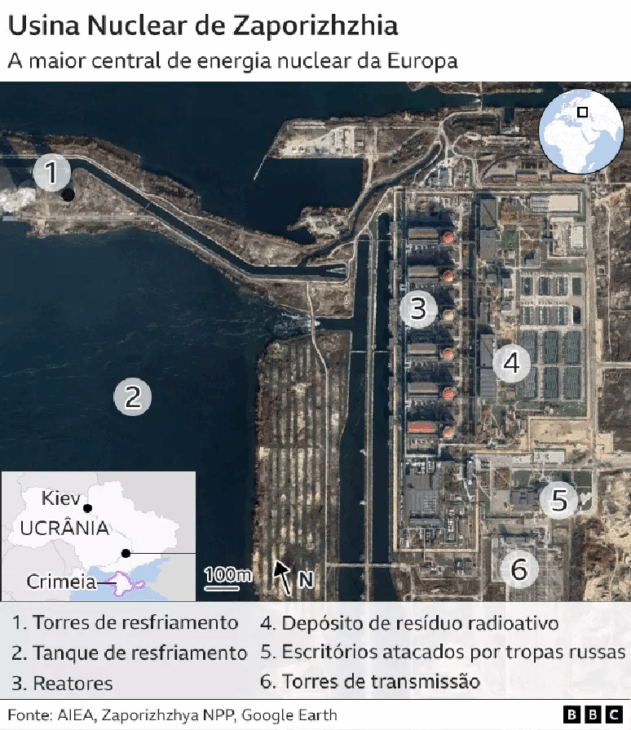
The Zaporizhzhia plant, the largest nuclear power plant in Europe, is at the center of a risky maneuver. Captured by Russian forces in 2022, at the beginning of the war, the plant has been shut down for three years. But recent satellite images reveal that Russia is building new transmission lines to connect it to its own power grid, raising alarms about the risks of a nuclear disaster in an active conflict zone.
An Unprecedented Project In The Midst Of War
According to the news agency Reuters, Russia is building over 80 kilometers of transmission lines in occupied southern Ukraine, aiming to connect the largest nuclear power plant in Europe to its own electrical grid. The information was confirmed through satellite images analyzed by Greenpeace and used as a basis for a formal protest by the Ukrainian government to the International Atomic Energy Agency (IAEA).
This type of operation has never been done before in a war context. It represents an unprecedented attempt to utilize a captured nuclear power plant as an energy source for itself, something that violates international agreements and poses a serious threat to Europe’s security.
-
Angra 3 becomes Brazil’s R$ 24 billion dilemma: finishing the 66% complete plant costs almost the same as abandoning it, right in the race for energy in the AI era.

-
Nvidia Secures Billion-Dollar Deal to Supply Up to 170,000 AI Accelerators to a 360 MW Data Center in Indonesia, Aiming to Transform Batam into an Advanced Computing Hub

-
NuScale proposes revised plan for six VOYGR SMR reactors in Poland after ending U.S. project
-
Holtec and EDF Submit Joint Proposal to Install Four SMR-300 Reactors in England with Combined Capacity of 1.3 GW


A Plant In Operational Ruins
Zaporizhzhia has six reactors and the capacity to supply millions of people. However, since the Russian occupation, the plant has faced serious problems: part of the cooling systems was compromised by the destruction of the Kakhovka dam, which provided essential water to prevent overheating of the nuclear fuel.
In addition, most of the Ukrainian technicians who worked at the plant abandoned the site after the occupation. Russia is trying to operate the complex with its own personnel from the state-owned Rosatom, but there is no guarantee that the new operators fully understand how the plant works — which only increases the risks of an accident.
The Response From Ukraine And The International Community
The Ukrainian Minister of Energy, German Galushchenko, was direct: any attempt to reconnect the reactors without international oversight could have “unpredictable” consequences. She reminds that the plant is in an area of active combat, under constant risk of attacks or sabotage.
The International Atomic Energy Agency (IAEA), which has been monitoring the situation since 2022, has also warned about the risks. Rafael Grossi, the agency’s director, has stated that the safe operation of the plant can only occur with complete technical inspections and international oversight — something that Russia has made difficult.
Despite the appeals, the Kremlin continues to push forward with its plans. The director of Rosatom, Alexey Likhachev, recently stated that “the dream of reactivating Zaporizhzhia is still alive” and that the company already has a technical plan ready to bring the plant back into operation.
Energy As A Geopolitical Weapon
More than just an energy supply issue, the plant has become a key piece in the political chessboard of the war. Controlling Zaporizhzhia allows Russia to use energy as a leverage tool, both against Ukraine and against Western Europe.
The idea of linking the plant to the Russian grid is based on a new electric corridor that would pass through Shevchenko, a village in the occupied territory. This corridor is said to be connected to a substation that could supply the Russian region of Rostov. It is a significant technical investment — and also a clear strategic move.
In April 2025, the United States proposed to return the plant to Ukraine, under international management led by the IAEA. The plan aimed to prevent the site from being used as a bargaining chip in peace negotiations. Moscow immediately rejected the proposal, reaffirming that Zaporizhzhia is now part of Russian territory.
The Danger Of A New Nuclear Disaster
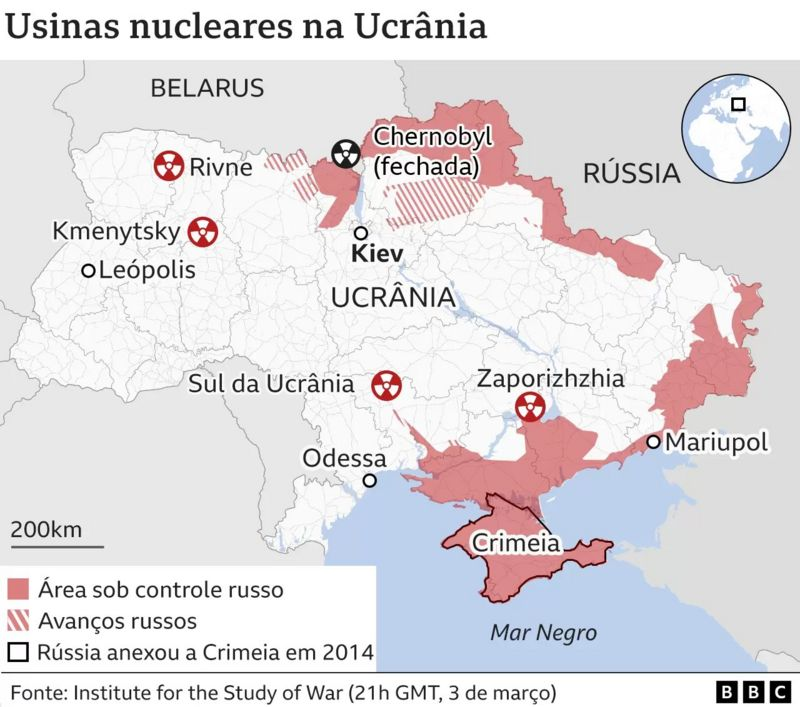
The risks are not small. The region where the plant is located continues to be a battleground. Any technical error, system failure, or military attack could result in a nuclear accident. The cooling system still relies on improvisations, and there is no guarantee that the spent fuel is being stored safely.
Experts warn that, in the event of an accident, the effects would not be local. A radioactive leak would affect not only Ukraine but also regions of Russia, Belarus, Poland, Romania, and even Turkey. Europe, already weakened by the war and the energy crisis, would face a scenario of environmental and humanitarian chaos.
A Bargaining Chip In Future Negotiations
As diplomats seek solutions, Russia is accelerating construction. Zaporizhzhia has become more than just a plant: it is a symbol of Moscow’s territorial and energy control. With every kilometer of cable installed, the chance of the plant being used as a bargaining point increases.
Even without having reconnected the reactors, Moscow has already shown that it intends to keep the plant as part of its energy system. This puts pressure on Ukraine and the European countries that depend on energy stability in the region.