






 Portuguese
  Spanish
 4 min of reading
  1 comment


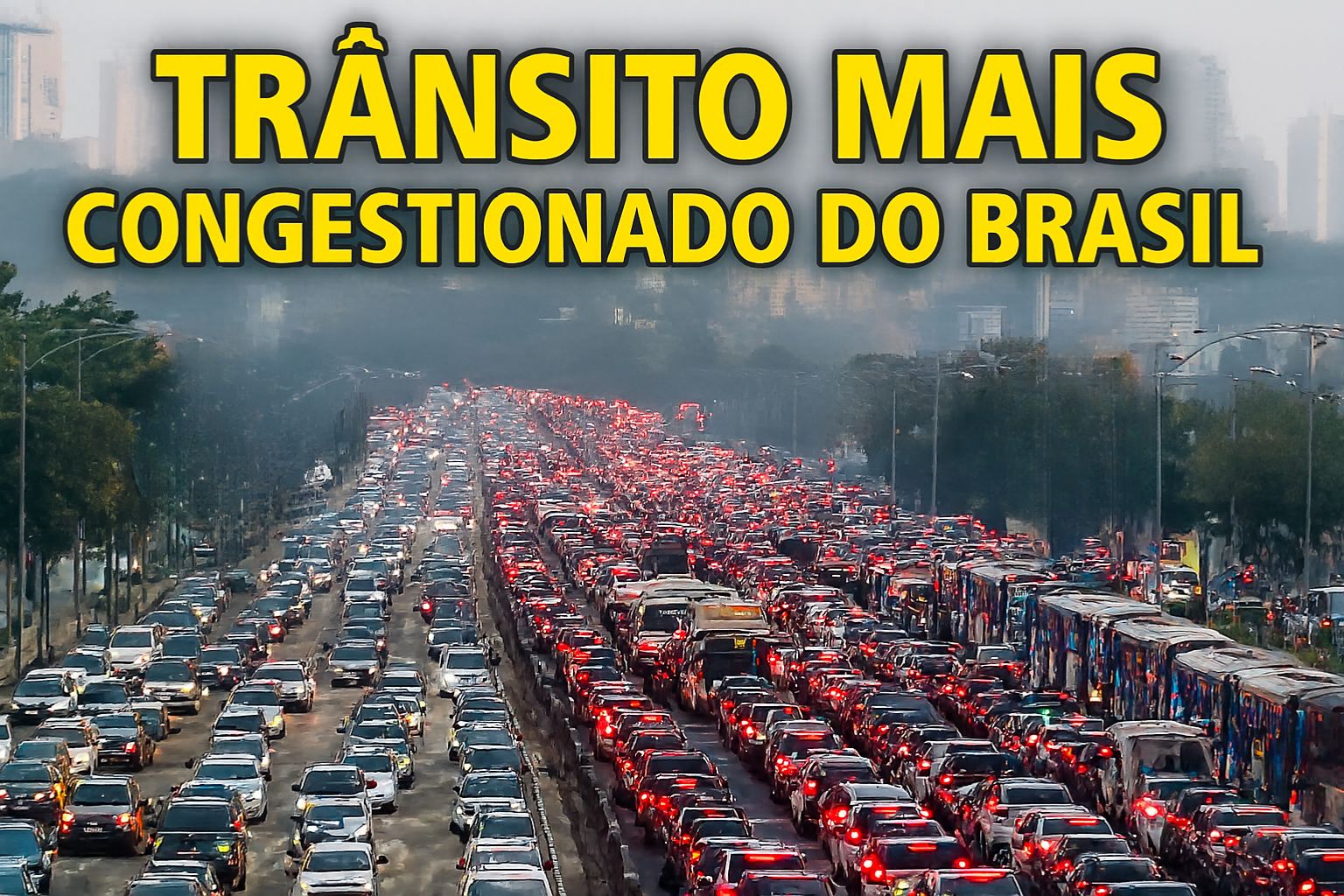


São Paulo Tops National Traffic Congestion Ranking and Is Among the Ten Cities with the Worst Traffic in the World, Where Drivers Lose an Average of 257 Hours Per Year in Traffic Jams.
São Paulo is both the economic heart of Brazil and one of the largest urban challenges on the planet. According to the TomTom Traffic Index 2023, the São Paulo capital leads the national traffic congestion ranking and ranks among the ten cities with the worst traffic in the world. On average, a resident of the metropolis spends 52 minutes per trip and more than 257 hours a year stuck in traffic jams. This data represents the equivalent of ten full days stopped in traffic, an alarming portrait of a city that drives the country but has faced a mobility collapse for decades.
São Paulo and the Fleet That Exceeds Urban Limits
Data from Denatran (National Department of Traffic) shows that São Paulo has over 9.2 million registered vehicles, a number that approaches the estimated population of 11.4 million residents, according to IBGE. This represents one of the highest vehicle densities on the planet. Streets designed in the last century can no longer accommodate the volume of cars, motorcycles, and trucks that circulate daily.

The Institute for Applied Economic Research (Ipea) estimates that traffic congestion in São Paulo generates annual losses exceeding R$ 40 billion, including lost productivity, wasted fuel, and increased logistics costs. For specialists, this invisible cost undermines economic growth, affects citizens’ health, and reduces the city’s competitiveness.
-
Survivor of 1966 SS Daniel J. Morrell Shipwreck in Lake Huron Recounts 38-Hour Ordeal in Extreme Cold

-
The Greatest Hoax in World Cup History? The Film That Denied Brazil’s 1958 Victory and Exposed How Fake Evidence Can Seem Convincing on TV
-
Fake South Korean Online Stores Offer Shopping Thrill Without Spending Money or Receiving Products
-
The War of Jenkins’ Ear: How a Severed Ear Sparked One of the 18th Century’s Most Unusual Conflicts


The Time Lost That Reveals the Mobility Crisis
According to the TomTom Traffic Index, the average commute time in São Paulo is 2.5 times higher than ideal. Trips that would normally take 20 minutes often exceed one hour during peak hours, especially between 7 AM and 10 AM and 5 PM and 8 PM. On critical days, the Traffic Engineering Company (CET) has recorded over 3,000 kilometers of accumulated congestion—the equivalent distance between São Paulo and the Northeast of the country.
This lost time has a direct impact on quality of life. A study by Fundação Getulio Vargas (FGV) indicates that São Paulo workers spend, on average, 1 hour and 45 minutes per day commuting, and in peripheral regions, the time reaches 3 hours daily. In a week, a city resident spends more time in traffic than in leisure activities.
The Economic and Human Cost of Traffic Congestion
Ipea estimates that every hour lost in traffic represents R$ 30 to R$ 50 in lost productivity per worker. The National Association of Cargo Transportation (NTC&Logistics) shows that delivery times in the urban area have increased by 40% in the last five years. For the transportation sector, delays impact not only revenue but the entire production chain, raising prices and operational costs.
There is also a human cost. Research from Fiocruz and the Hospital das Clínicas de São Paulo links excessive time in traffic to high levels of stress, insomnia, and cardiovascular diseases. Prolonged exposure to pollution generated by vehicles is another aggravating factor, responsible for thousands of annual hospitalizations due to respiratory problems.
Saturated Public Transport and Inequality in Commuting
Although São Paulo has the largest public transportation system in Latin America, it is still insufficient to meet demand. The city has seven metro lines and 13 urban train lines, which total approximately 377 km of tracks and transport over 8 million people daily. Despite this, the structure is not growing at the same pace as urban expansion, and dependence on individual transportation remains high.
Experts point out another problem: territorial inequality. While residents of the city center and the southern zone have access to multiple transportation options, workers from the eastern zone and periphery spend hours in daily commutes, which exacerbates social inequality.
Electric Mobility and New Solutions Being Tested
To tackle the issue, the municipal and state governments have been investing in electric and intelligent mobility solutions. The goal is to deploy 2,000 electric buses by 2026, reducing gas emissions and diesel consumption. Furthermore, private companies are betting on electric micromobility, such as shared bicycles and scooters, as well as digital platforms that optimize routes and rides.

Still, urbanism experts warn that the solution will not come solely from technology. It’s necessary to rethink urban occupation, decentralizing jobs and services to reduce dependency on long trips between the periphery and the center.
The Future of São Paulo and the Challenge of Moving
São Paulo is a symbol of a country that moves—but also of a model that has exhausted itself. The metropolis grew driven by industry and automobiles, but now faces the consequences of decades of highway-centered planning. The result is an urban paradox: the richest city in Brazil is also one that wastes the most time and energy.
Even with investments in public transport, exclusive lanes, and new modalities, the capital still suffers from chronic traffic that reflects the imbalance between economic growth and quality of life. The challenge now is to find the balance between mobility, sustainability, and urban development—so that the city that drives Brazil can finally move without stopping.


I must say this article is extremely well written, insightful, and packed with valuable knowledge that shows the author’s deep expertise on the subject, and I truly appreciate the time and effort that has gone into creating such high-quality content because it is not only helpful but also inspiring for readers like me who are always looking for trustworthy resources online. Keep up the good work and write more. i am a follower.