






 Portuguese
  Spanish


Published on June 9, 2026, in Energy & Environmental Science, a Cornell study describes the DEER method for used lithium-ion batteries, with direct electrode regeneration, recovery of up to 95% of capacity, and potential to reduce manufacturing costs of recycled cells by 56% without traditional grinding and refusion.
Used lithium-ion batteries may find a new path away from landfills and traditional processes of grinding, melting, and intensive acid use. Researchers at Cornell University have developed an electrochemical method that regenerates intact electrodes and can recover up to 95% of the original capacity.
The study was published on June 9, 2026, in the scientific journal Energy & Environmental Science. The research’s lead author is postdoctoral researcher Kiwon Kim, and it was led by Vibha Kalra, a professor of Chemical Engineering at Cornell. The method is named DEER, an acronym for direct electrode-to-electrode regeneration.
Method aims to shorten the recycling path
The Cornell team’s proposal addresses an increasingly urgent problem: the fate of lithium-ion batteries after use. These batteries power electric vehicles, energy storage systems, and electronic devices but rely on critical minerals like nickel and cobalt.
-
James Webb Telescope Uncovers Unexpected Clues on Mysterious Moon, Potentially Redefining Planetary Origins

-
$1.5 Billion Sleipnir Vessel Transforms Ocean into Floating Construction Site with 12 Hybrid Engines and Capacity to Lift 20,000 Tons

-
23 Years After Tragedy, Brazil’s Alcântara Space Center to Launch New Suborbital Rocket in 2026 with South Korean SEBIT Project Targeting Near-Space Tests
-
Entrepreneur Turns Neighbor’s Coffee Grounds Waste into Eco-Friendly Pellets, Earning Up to $40,000 Monthly in Brazil


According to the Cornell Chronicle, the United States needs to import resources like nickel and cobalt to manufacture this technology. This makes the recycling of used batteries an environmental, industrial, and strategic issue, as disposal also involves the risk of losing valuable materials.
DEER reuses electrodes without turning them into powder
In conventional methods, used batteries can be melted at high temperatures or crushed into a black mass, which then undergoes chemical steps to recover metals. The problem is that this path destroys the original structure of the electrodes.
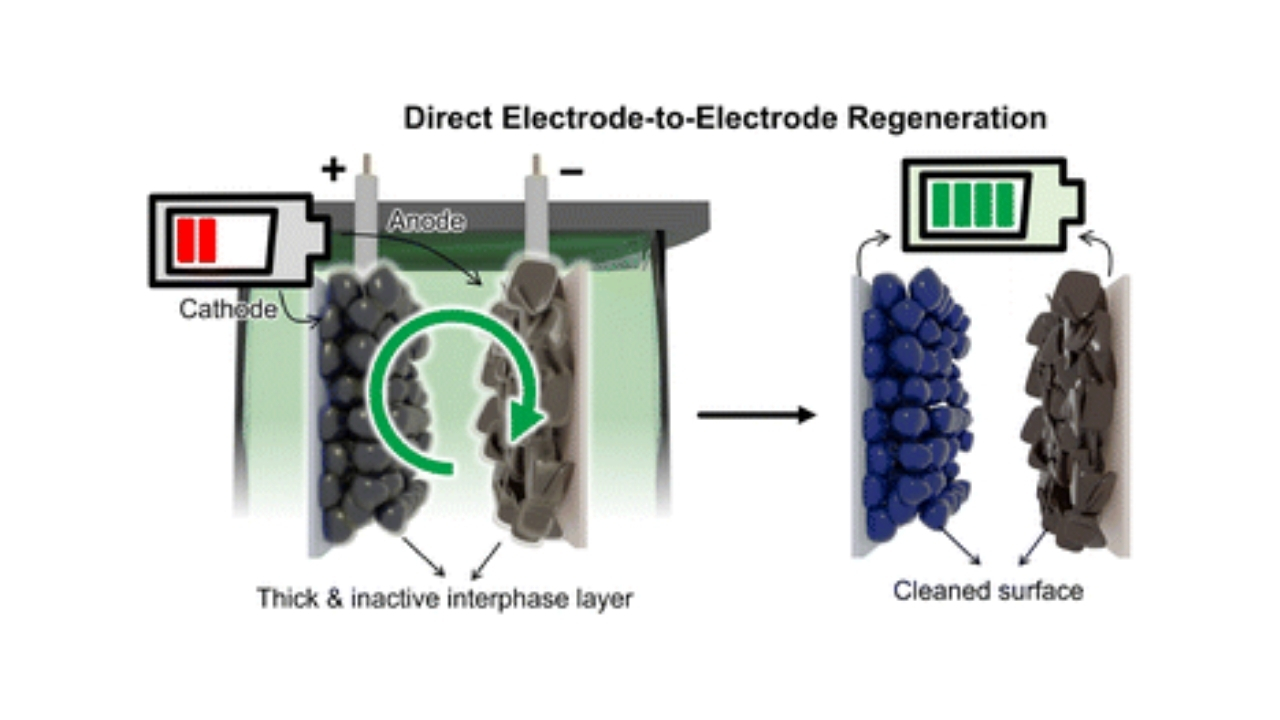
The DEER method follows a different logic. The individual electrodes of a spent battery are removed still intact and placed in a separate cell with an electrochemical solution. Instead of breaking everything down to recover metals, the technique tries to repair the electrodes as they are.
Electrochemical bath removes layer that locks the battery
The solution used by the researchers contains 1,3-dimethyl-2-imidazolidinone, also called DMI. It acts on an insulating layer that accumulates between the cathode and anode as the battery goes through charge and discharge cycles.
This layer, known in the study as the electrode-electrolyte interface, hinders ion transport and reduces the battery’s capacity over time. The so-called “electrochemical bath” dissolves this barrier and allows the electrodes to regain performance.
Batteries can recover up to 95% of capacity
In the tests reported by the team, the electrodes regenerated by the DEER method allowed recovery of up to 95% of the cell’s initial capacity. The scientific article also points to improved cycle stability compared to degraded batteries reassembled without the treatment.
This point is central because the technology not only seeks to extract metals from used batteries. It tries to restore function to the electrodes. If the process advances to an industrial scale, it could shorten the recycling cycle and reduce expensive remanufacturing steps.
Cost of recycled cells could drop by 56%
The technical-economic and environmental analysis conducted by the team indicated that the method could reduce the manufacturing cost of recycled cells by 56% compared to traditional routes. The study also points to lower energy use, reduced greenhouse gas emissions, and reduction of atmospheric pollutants.
The research included analyses made with open-source software developed by collaborators from the ReCell Center at Argonne National Laboratory. Argonne’s participation helps measure the potential impact of the method on cost, energy, and lifecycle.
Process avoids expensive steps of traditional recycling
Traditional recycling of lithium-ion batteries often involves pyrometallurgy, with high temperatures, or hydrometallurgy, with strong acids. After that, the recovered materials need to be resynthesized and remanufactured to become new components.
In DEER, the promise is to reduce this path. Since the electrodes are preserved, the process dispenses with part of the steps of breaking, separating, synthesizing, and manufacturing new electrodes. This is the difference that can make recycling faster and less costly.
Dependence on critical minerals weighs on research
Vibha Kalra highlighted that when lithium-ion batteries emerged, little thought was given to the limitation of minerals available in the Earth’s crust. Today, the expansion of electric cars and energy storage has made this limitation much more visible.
The issue is not just environmental. The critical minerals supply chain involves geopolitical vulnerabilities, especially for countries that rely on imports. Therefore, recovering used batteries can reduce pressure on mining, refining, and international trade of strategic inputs.
Technology still needs to advance for industrial batteries
Despite the results, the study does not mean that the technology is already commercially available. The team itself points out that the next step is to demonstrate the DEER method in industrial batteries and tackle other forms of degradation, such as lithium loss.
Kalra explained that the used batteries currently treated have a health state between 70% and 80%, typical of applications in electric vehicles. This indicates that there is room to expand the results if other wear mechanisms are also controlled.
Study involved Cornell and Argonne
Besides Kiwon Kim and Vibha Kalra, the article is co-authored by Chenlu Yang, Shuwen Yue, and Sabine M. Gallagher. Yue helped understand the solvation dynamics during the dissolution of the interface, while Gallagher is linked to Argonne National Laboratory.
Additional support came from the Pao-Wang Fellowship and the Atkinson Center for Sustainability at Cornell. The research combines chemistry, engineering, economic analysis, and environmental assessment to propose a shorter route for recycling used batteries.
Lithium-ion waste can become part of the solution
The advancement presented by Cornell shows that used batteries do not need to be seen only as hazardous waste. When treated with appropriate technology, they can become a source of recovered electrodes, repurposed critical materials, and reduce pressure on the global mining chain.
Industrial-scale feasibility still needs to be proven, but the study opens up a significant possibility: transforming technological waste into part of the energy solution itself.
Do you think methods like this can reduce dependence on critical minerals, or will the industry still remain tied to traditional mining? Leave your opinion in the comments.


