Portuguese
  Spanish


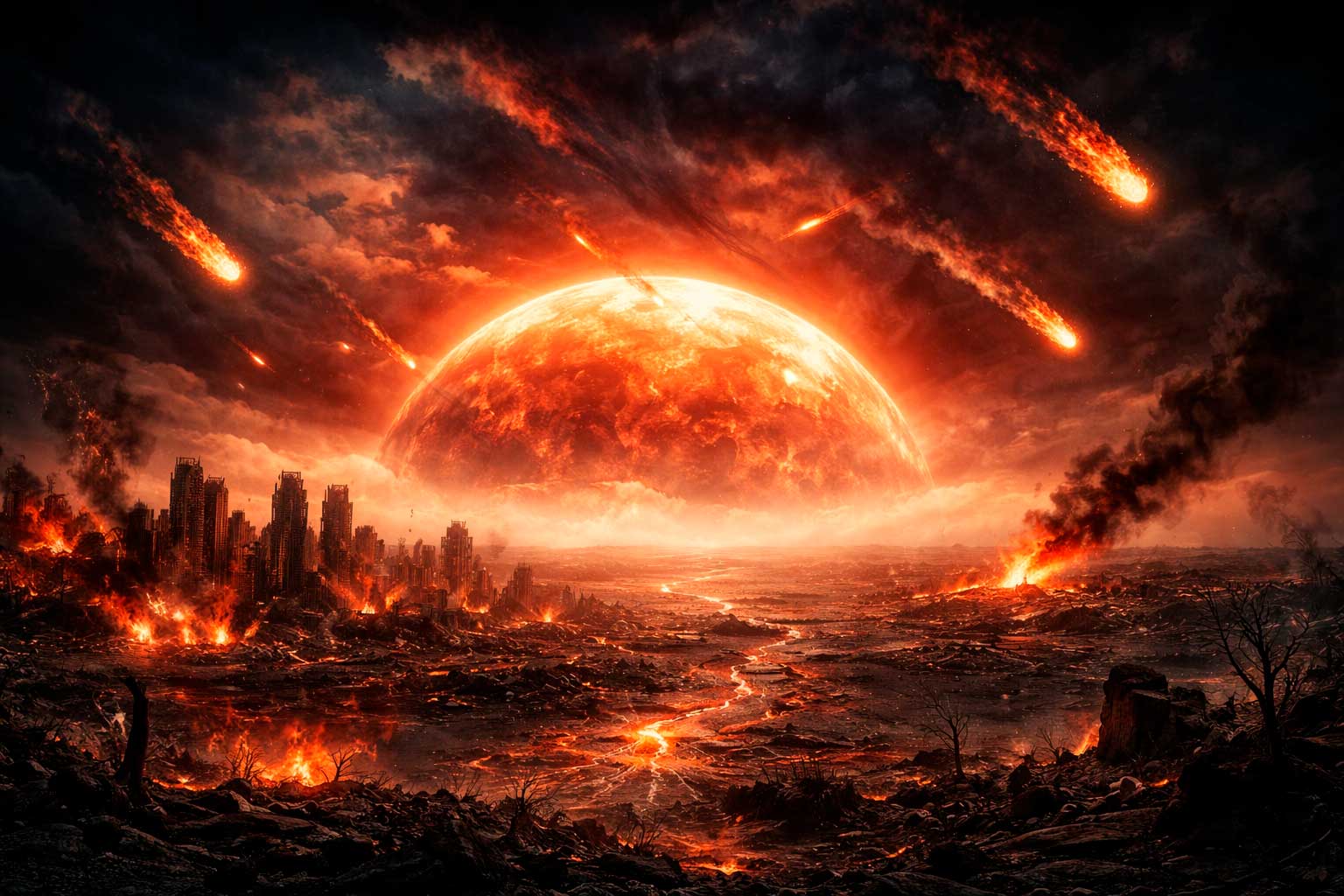

Research indicates that complex life on Earth has a biological limit before the physical disappearance of the planet and corrects a popular idea that mixes real science with immediate apocalypse.
The work published in the journal Nature Geoscience was conducted by Kazumi Ozaki and Christopher T. Reinhard and was partially supported by NASA’s Astrobiology program. The central point is that the current phase of Earth, with sufficient oxygen abundance to sustain complex life forms, is not expected to last until the final stage of the Sun as many people imagine.
According to the study’s calculations, a terrestrial atmosphere with oxygen levels above 1% of the current level is expected to persist, on average, for 1.08 billion years, with an uncertainty margin of 0.14 billion years.
Scientifically, this means that the oxygenated biosphere has a shorter lifespan than popular projections associated only with the moment when the Sun becomes a red giant.
-
Pennsylvania Mine Creates Ice in Summer Heat and Melts in Winter, Turning a Mountain Crevice into a Reverse Natural Refrigerator

-
China Accelerates Global Expansion of Robotics: From Smart Vacuums to Industrial and Humanoid Machines, Millions Exported to Over 150 Markets
-
Polar Air Mass to Hit Brazil: Temperatures to Plummet in Nine States, Near Freezing in the South with Frost Risk Until Monday
-
Chinese “dark factories” produce electric cars 24/7 with minimal human intervention, as Zeekr assembles 800 units daily, raising concerns in Brazil.




This helps explain why the topic has resurfaced so strongly, especially after the Artemis II mission. The study effectively discusses a limit of habitability of Earth for complex life, not the instantaneous destruction of the planet.
What the study really calculated
The researchers used a model that combines climate, biogeochemistry, and atmospheric evolution to estimate how long Earth will continue to have elevated oxygen levels. The work started from a robust statistical approach and tested around 400,000 simulations, filtering scenarios compatible with the current conditions of the planet before projecting the future.
This detail is important because the result did not come from a single isolated calculation. The model assessed different parameters related to the Earth’s interior, oceans, atmosphere, and the climate system’s response to the gradual increase in solar luminosity, seeking a more reliable picture of the longevity of the oxygenated atmosphere.
The strongest conclusion of the study is that the drop in oxygen is expected to occur before the so-called phase of wet greenhouse effect, a stage in which the atmosphere begins to retain more water vapor and the planet progresses towards a progressive loss of surface water. In other words, complex life dependent on aerobic respiration may face its major limit even before Earth reaches the extreme climate scenario that tends to appear in older forecasts.
The authors also emphasize that the research does not directly measure the future of human civilization. The focus is on the global viability of the biosphere over geological time, while human impacts, astronomical events, and other variables with much shorter timeframes are outside the main scope of the analysis.
Why Earth’s oxygen is expected to decline in the future
The explanation proposed by scientists involves the natural evolution of the Sun. As the star ages, it gradually becomes more luminous, which alters the planet’s chemistry and disrupts the cycles that help maintain Earth’s atmospheric balance.
With more solar energy reaching the planet, the carbonate and silicate cycle tends to reduce atmospheric carbon dioxide over geological time. This process directly affects photosynthesis and, consequently, oxygen production, paving the way for an abrupt atmospheric deoxygenation rather than a slow and linear decline.
In practice, the calculated scenario points to a future atmosphere more similar to that of primitive Earth, with very low oxygen, more methane, and the absence of an ozone layer comparable to the current one. This would make the surface much more hostile for animals and other complex organisms that depend on air as we know it today.
This point helps to dismantle a common misconception. The central threat is not the Sun “swallowing” Earth now or soon, but rather the loss of the biochemical conditions that sustain complex life long before this stellar outcome. NASA’s own material reminds us that the Sun’s red giant phase is expected to occur in about 5 billion years in the future, well beyond the biological limit indicated by the study.
Why this does not mean an exact clock for the end of humanity
Although the number of 1.08 billion years is impressive, it should not be read as a precise countdown to the end of the human species. The study works with averages, uncertainty ranges, and gigantic geological scales, in a horizon so distant that it completely escapes any serious prediction about society, technology, or future adaptation.
It is also important to separate what is a scientific projection. NASA itself describes the research as a study partly supported by its Astrobiology program, and not as an announcement of imminent destruction of Earth.
Still, the discovery has real scientific weight. It shows that a planet’s habitable window does not depend solely on it remaining physically intact, but also on maintaining an atmosphere capable of supporting complex organisms over time. This is an important shift in thinking about the future of life on Earth and other worlds.
What this projection changes in the search for life beyond Earth
One of the most interesting impacts of the study appears outside the apocalyptic debate. If Earth can lose its oxygen long before the physical end of the planet, then astronomers need to be cautious when using atmospheric oxygen as a definitive sign of life on exoplanets.
This is because a habitable world may go through phases with low oxygen and still harbor some type of biosphere. The research reinforces the idea that the search for life beyond the Solar System may need to consider other chemical indicators beyond the current terrestrial model.
In the end, the study does not deliver a prophecy of the “end of the world,” but a more sophisticated and perhaps even more unsettling message. The Earth does not just depend on continuing to exist in space. It depends on preserving, for a sufficient time, the rare combination of Sun, climate, carbon, and oxygen that made complex life possible.