Portuguese
  Spanish


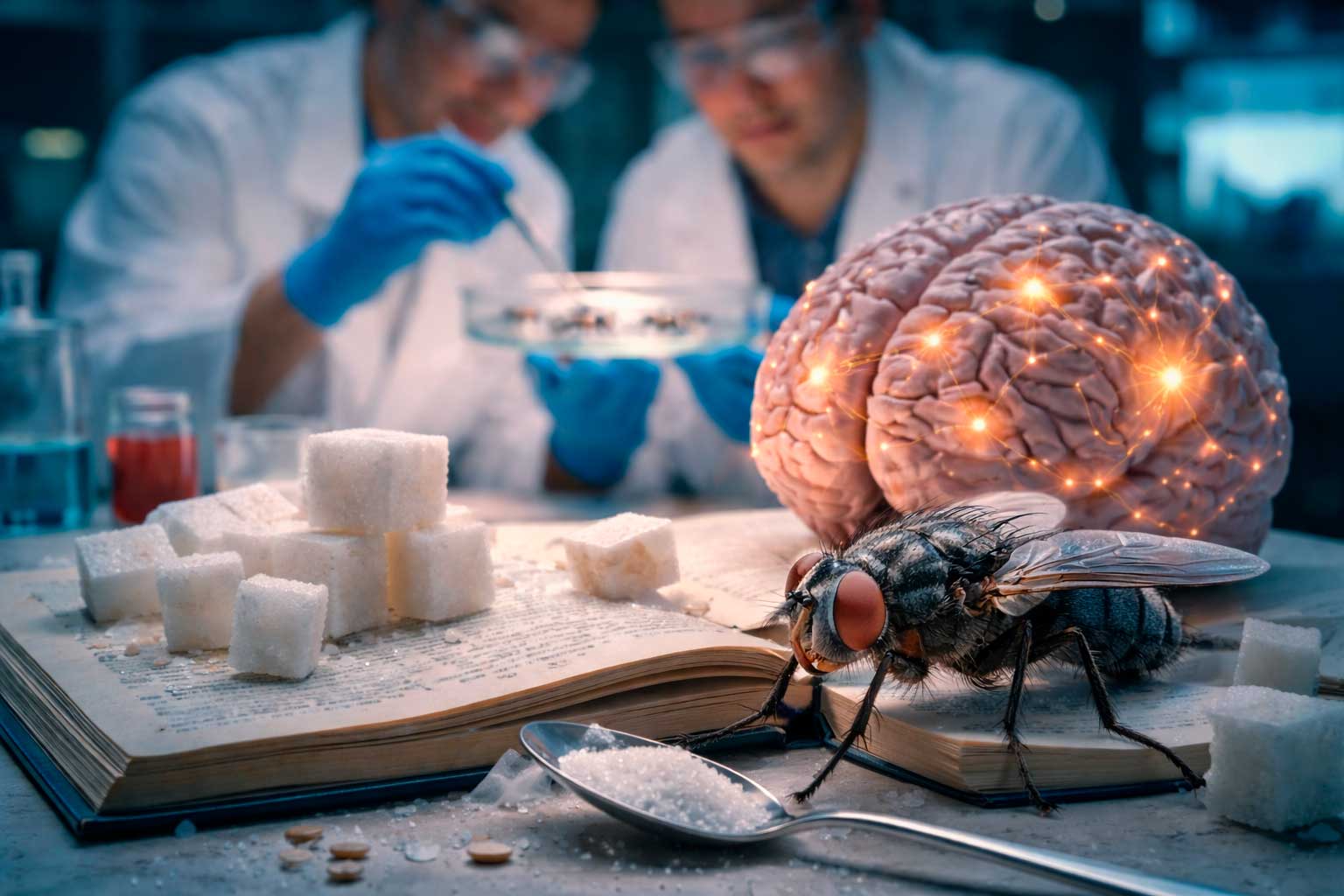


Recent research suggests that the timing of sugar may be more important than sugar itself. The finding appeared in fruit flies, helps explain how the brain links energy and memory, and reignites a discussion that has also been observed in studies with humans.
The brain consumes a lot of energy to function, and this expenditure becomes even more relevant when it needs to transform new information into long-term memory. It was at this point that a group of researchers found a curious clue while studying fruit flies subjected to an aversive learning training, in which a neutral stimulus becomes associated with something unpleasant.
The result drew attention because it does not point to a “magical” improvement in memory simply from consuming sweets.
What the work showed is something more specific. After learning, the brains of these animals entered a temporary state similar to hunger, and the intake of sugar right after this process acted as a biological signal to consolidate memory.
-
Australia deploys poisoned sausages and uses traps, shooting, and fences in a battle against invasive cats that kill over 1.5 billion native animals annually, threatening more than 200 species.

-
NASA Rover Captures “Tired Face” on Mars, Highlighting Human Brain’s Tendency to See Faces in Rock Formations

-
Ancient Stone City in the Desert, Once Home to 30,000, Puzzles Scientists with Nabateans’ Water Mastery 2,000 Years Ago

-
Ancient Creature Thought Extinct Since Dinosaur Era Reappears, Baffling Scientists




In the main study, published in the journal Nature, the authors describe that spaced sessions of learning, a condition known to favor lasting memory, “reprogrammed” sensory neurons for fructose in the brains of the flies, even when the animals were already satiated.
What the experiment with flies really showed
The scientists used a classic neurobiology model with Drosophila melanogaster, the fruit fly, to observe what happens when the brain needs to consolidate memories after cognitive effort. Instead of studying feeding alone, they analyzed the connection between learning, energy expenditure, and long-term memory.
According to the article, the spaced repetition of training led the fructose-detecting neurons to a functional state similar to fasting. When sugar was ingested after this learning, these neurons were activated and triggered the release of thyrostimulin, a glycoprotein hormone that acted as a decisive signal for memory consolidation.
The authors also observed a change in feeding behavior. After this type of training, the flies increased their preference and intake of sucrose, reinforcing the idea of a non-homeostatic hunger, that is, an impulse linked not to a real lack of energy in the body, but to the brain’s need to sustain the memorization process.
Why this finding is interesting beyond the laboratory
The value of the study lies less in the simplistic idea of “eating sugar is good for studying” and more in the mechanism it reveals. The research shows that the brain can associate energy availability with the biological cost of forming lasting memories, something central to understanding learning, attention, and memory consolidation.
This line of investigation did not emerge now. In 2017, researchers showed that flies can distinguish the sweet taste from the real caloric value of what they consume. In this work, the intake of zero-calorie artificial sweeteners led to the formation of what the authors called “caloric frustration memory,” indicating that the brain is not satisfied merely with the sweet taste when it expects real energy.
More recently, on November 29, 2024, another study in the same field indicated that a hormone similar to CRH in fruit flies diverts energy use from glial cells to supply neurons involved in memory formation.
In simple terms, the literature has been reinforcing the idea that long-term memory costs energy and depends on how the brain manages this fuel after the learning experience.
What is already known in humans about glucose and cognition
In humans, the story is more cautious and much less straightforward. Scientific reviews published in recent years indicate that glucose administration can produce transient improvements in certain cognitive aspects, especially in markers related to episodic memory and attention, without this meaning a universal or guaranteed gain in any situation.
The literature also records effects on tasks related to the hippocampus, a brain region essential for learning and memory. A 2015 study, for example, investigated improvements in tasks of object-location association, while another line of research highlights more consistent results in verbal episodic memory than in various other cognitive domains.
Still, turning this into simple advice would be an exaggeration. The findings in humans themselves are described as contextual, temporary, and dependent on metabolic profile, task, and dose. In other words, there is an interesting biological clue, but not a scientific authorization to conclude that more sugar always means more learning.
What students, exam candidates, and parents can take from this discovery
For those studying, the main message is not to swap learning strategies for sweets. What science reinforces, so far, is that the brain needs adequate energy, that the timing of intake may matter in some experimental contexts, and that memory consolidation also depends on rest, spaced repetition, and post-study retrieval.
This helps to understand why long and exhausting sessions, without breaks and without a sleep routine, often yield less than they seem. The work with flies relies precisely on the effect of spaced training, not on a continuous marathon of exposure to content. The safest practical message is to combine organized study, balanced nutrition, and sufficient sleep.
It is also worth remembering that public health recommendations remain firm regarding excessive sugar. The World Health Organization advises reducing the intake of free sugars to less than 10 percent of total daily energy intake, and suggests an additional reduction to below 5 percent when possible.
Therefore, this finding should not be read as a free pass for desserts after every study session. The truly relevant point is another. Energy and memory interact more intimately than previously thought, and science is beginning to map out more precisely when this biological dialogue favors the retention of what has been learned.
The idea of eating something sweet after studying may even sound tempting, but the controversy remains open. Do you think this type of discovery helps improve study habits or runs the risk of becoming an excuse for overeating? Leave your comment and let us know if, for you, science is clarifying the topic or complicating this conversation even further.