






 Portuguese
  Spanish
  4 min of reading
  0 comments


Study published in the journal Science revealed that natural blonde hair in part of the Solomon Islands population originates from a unique genetic alteration, without direct connection to European ancestry.
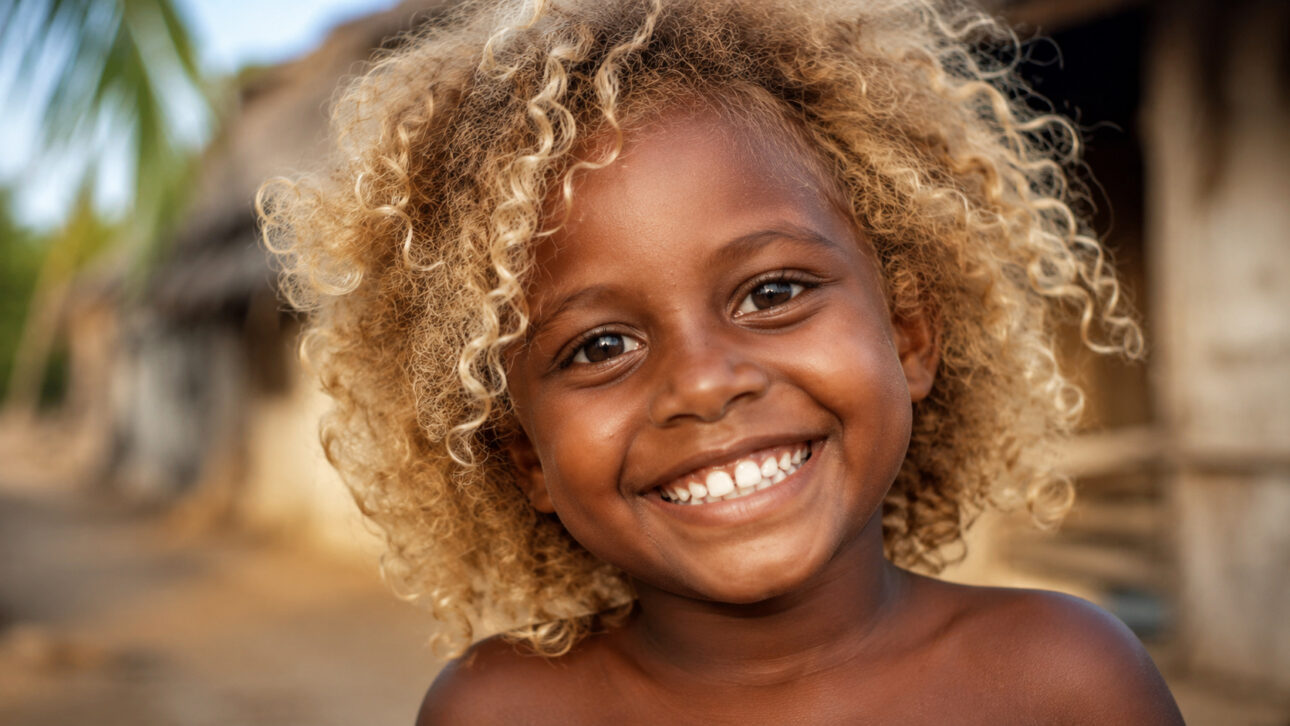
A rare genetic trait has attracted attention in the South Pacific for many years. In the Solomon Islands, an archipelago located in the Melanesia region, some inhabitants have dark skin and naturally blonde hair, a combination uncommon in other populations around the world.
For decades, this appearance sparked curiosity and was associated with popular explanations. Among the most repeated hypotheses were interbreeding with Europeans and the effects of strong sun exposure in the region.
However, a scientific study published in 2012 showed that the phenomenon has a much more specific explanation. According to the study published in the journal Science, the origin of the blonde strands is linked to a mutation in the TYRP1 gene, related to pigmentation.
-
At 25 years old, Vini Jr chose a ‘castle’ worth R$ 55 million, with a daily rate that can exceed R$ 78,000, to host his mother, father, and three siblings while he competes in the World Cup in the United States.

-
12-year-old prodigy graduates from school and college in the same week in the USA, delivers the valedictorian speech, and still finds time to play with Lego.
-
As historic droughts threaten crops and cities, Morocco accelerates a billion-dollar plan to transform ocean water into drinking water, build Africa’s largest desalination plant, and supply millions by 2030.

-
At the age of 7, Chase Poust swam alone for an hour in a Florida river to save his father and 4-year-old sister swept away by the current.




Discover the origin of blonde hair in the Solomon Islands
Although blonde hair is often associated with European populations, the case of the Solomon Islands follows another biological path. The research identified that the genetic alteration found in the local population is not the same responsible for the light strands more frequently observed in Europe.
Thus, even if the visual result is similar, the genetic cause is different. This discovery made the case even more relevant for the study of human diversity.
The variation found in the TYRP1 gene interferes with the hair pigmentation process. As a result, some residents are born with light hair while naturally maintaining dark skin.
This detail helped scientists dismiss simplified explanations. The presence of blonde hair does not depend solely on sun exposure, nor can it be directly attributed to mixing with European peoples.
2012 Research Revealed a Mutation Unique to the Local Population
In May 2012, the study “Melanesian Blond Hair Is Caused by an Amino Acid Change in TYRP1” was published in the journal Science. The research is also recorded in PubMed and was released by Stanford Medicine.
Scientists analyzed the characteristic in inhabitants of the Solomon Islands and identified a specific alteration linked to melanin production. Melanin is the pigment responsible for influencing the color of skin, eyes, and hair.
In the studied case, the genetic change primarily affects hair strands. Therefore, the population can naturally have blonde hair from birth, even without having fair skin.
Moreover, the discovery showed that similar characteristics can arise independently in different parts of the world. This process reinforces how human evolution can follow varied paths.
Why This Characteristic Draws So Much Attention
It is estimated that between 5% and 10% of the inhabitants of the Solomon Islands have naturally blonde hair. Despite not representing the majority of the population, the phenomenon stands out due to its global rarity.
The combination of dark skin and natural blonde hair has become an important example for human genetics. After all, it shows that physical appearance can have more complex origins than many popular explanations suggest.
Furthermore, the case demonstrates that different populations can develop similar traits through their own biological mechanisms. Therefore, the blonde hair of the Solomon Islands should not be understood as a simple common variation.
It is a regional genetic characteristic, scientifically documented and associated with a distinct mutation from that observed in European populations.
What the Discovery Teaches About Human Diversity
The discovery about the inhabitants of the Solomon Islands expanded the understanding of pigmentation, ancestry, and genetic diversity. The study showed that human biology is more diverse than many visual patterns indicate.
Thus, what was previously explained by assumptions gained a more precise scientific basis. The mutation in the TYRP1 gene has been identified as the main reason for the natural blonde hair in part of the local population.
In this way, the Solomon Islands have become a relevant case for science. The characteristic of its inhabitants shows how evolution can produce similar results through completely different paths.
The dark skin with natural blonde hair, therefore, is not just a visual curiosity. It is also evidence of human genetic complexity and the biological richness present in populations spread around the world.









Be the first to react!