Portuguese
  Spanish


To Learn More About the Training Program, Find the Nearest Senai-RN Unit or Access the Sinduscon-RN Website.
With the aim of boosting professional qualification and improving productivity on construction sites, Senai-RN will launch the program “Learning to Build” in August 2025, aimed at training workers in the civil construction sector.
The initiative, carried out in partnership with the Brazilian Chamber of Construction Industry (CBIC) and the Construction Industry Union of Rio Grande do Norte (Sinduscon-RN), aims to train knowledge multipliers within the companies in the sector.
The program is part of the National Training Plan for Civil Construction 2025 and represents a strategic response to the growing shortage of qualified labor in Brazil.
-
Giant Robots Build Entire Neighborhood of 100 3D-Printed Homes in the U.S., Showcasing Technology’s Impact on Construction Industry

-
Helsinki Residents Receive Water That Travels 120 Kilometers Through a Hidden Rock Tunnel from a Lake Before Treatment

-
Brazil’s Sertão Region Nears Completion of Latin America’s Longest Artificial River, Transforming Water Access in Drought-Prone Ceará
-
Pre-mixed stabilized mortar set to revolutionize construction in 2026: extends usability to 36 or 72 hours, boosts productivity, and minimizes waste in building projects.


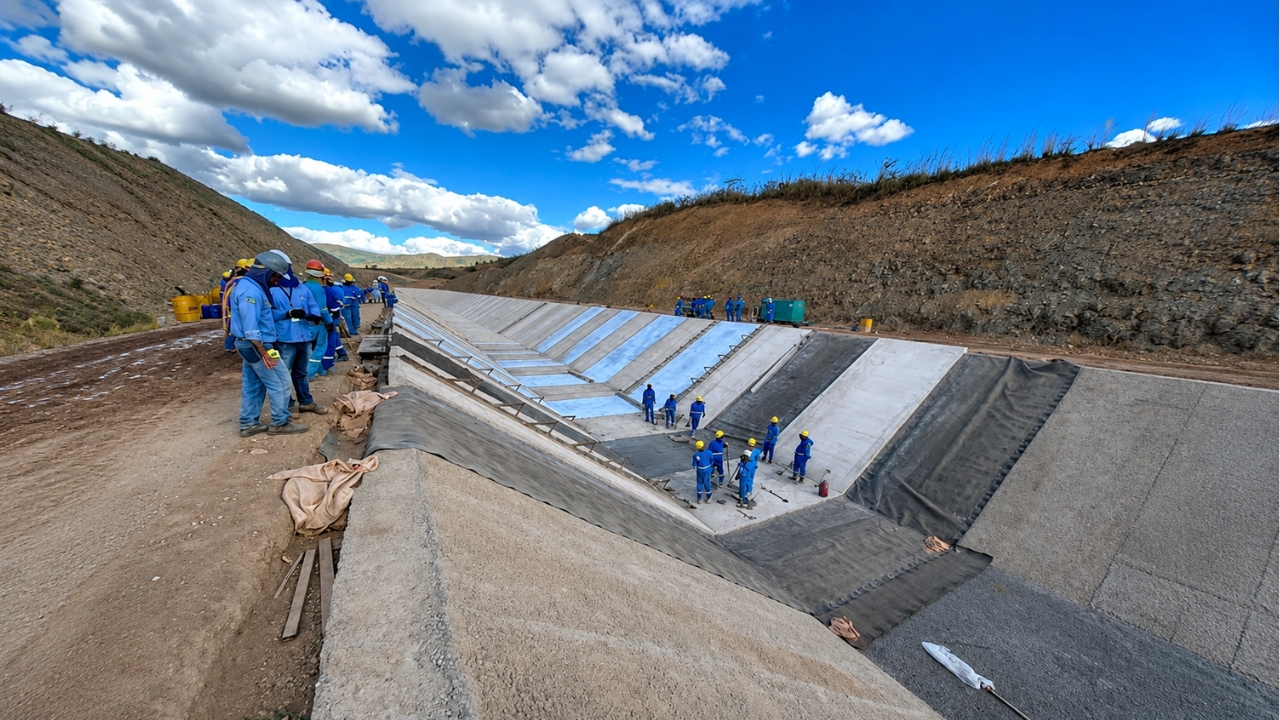

According to research commissioned by CBIC in 2024, 94% of construction companies face a lack of qualified professionals, which already forces 76% of them to revise delivery deadlines for projects.
Senai-RN Training Focused on Multipliers
The program’s differential lies in the training of multipliers: professionals already working in companies who will be trained to disseminate the knowledge acquired among their colleagues on-site.
“In practice, I qualify someone from the company to multiply access to information internally, with the possibility of having one or more people, per project and with different qualification profiles, participating in the program,” explains Rodrigo Mello, regional director of Senai-RN.
The first training sessions will be available at Senai units in the state and can also be accessed through Sinduscon-RN. The target audience includes low-income workers and newly hired individuals in roles such as:
- Reinforcement steel worker
- Construction carpenter
- Finishing workers with mortar
- Finishing mason
- Bricklayer
Free Courses with Practical Methodology
The average duration of the courses will be three months, with a daily workload of two hours. The methodology used is hybrid, combining:
- Digital books
- Video lessons
- Supervised practical activities
In addition to basic training, participants will have access to specific improvement content in areas such as:
- Wood forms for concrete
- Hydraulic, electrical, and sanitary installations
- Reading and interpreting projects
- Ceramic and porcelain tile installation
- Painting techniques for construction
Opportunities for Women in Civil Construction
One of the highlights of the program is the “They Build” axis, aimed at increasing female presence on construction sites, where women represent only 10% of the workforce.
“The activities we develop with this perspective have been successful in electrical work, where there is also a higher male presence. We are available for the formation of exclusive or mixed classes for women in the civil construction sector,” says Rodrigo Mello.
Training Steps: Step by Step
The “Learning to Build” program will be developed in five main phases:
- Company Engagement
Identification of the multiplier
Formation of the class - Lesson Planning
Preparation of the environment on-site
Definition of schedule
Access to materials - Multiplier Training (24h)
Technical and pedagogical training offered by Senai - Course Execution
Practical classes on-site
Development of technical and collaborative skills - Conclusion
Professional certification
Celebration event
Recommendation for complementary training
Civil Construction Needs to Qualify 100 Thousand People
Rodrigo Mello emphasizes that Brazilian civil construction needs to train around 100,000 professionals by 2025 to meet the demand.
Currently, turnover in the sector reaches 50% and, even so, 60% of workers have never participated in a formal training course.
Despite this, interest is high: 71% of professionals express a desire to qualify, according to data from CBIC.
For Mello, the initiative by Senai-RN adds to the sector’s efforts to enhance the attractiveness of civil construction professions.
“The sector needs to discuss the attractiveness of the professions that contribute to its development. In this sense, SENAI joins companies and the Federation of Industries, saying ‘I can provide training and am willing to participate in the discussion on attraction and retention of talents’.”
Brazil More Productive Program: A New Front for Companies
During the program presentation at the General Assembly of Sinduscon-RN, held at the Industry House on May 8, Rodrigo Mello also highlighted another opportunity: Brazil More Productive. The initiative offers:
Free consulting for micro and small businesses
Subsidy of 70% for medium-sized companies
The areas of action include:
- Diagnosis and management
- Lean manufacturing
- Energy efficiency
- Digital transformation
- Smart factory
In 2024, 62 companies in Rio Grande do Norte participated in the program, with an average productivity increase of 49.5%.
Registration for 2025 is open on the official website: https://plataformaprodutividade.com.br
Why Invest in Training?
For the president of Sinduscon-RN, Sérgio Azevedo, workforce training is urgent:
“Our problem is not just retention or training. It’s attracting this workforce. The SENAI Program fits perfectly with what the sector identifies as a pain point.”
The initiative demonstrates how the collaboration between institutions such as Senai-RN, companies, and unions can be the pathway to overcome historical bottlenecks in civil construction and prepare the sector for a new growth cycle.