





 Portuguese
  English
  Spanish
  4 min of reading
  0 comments


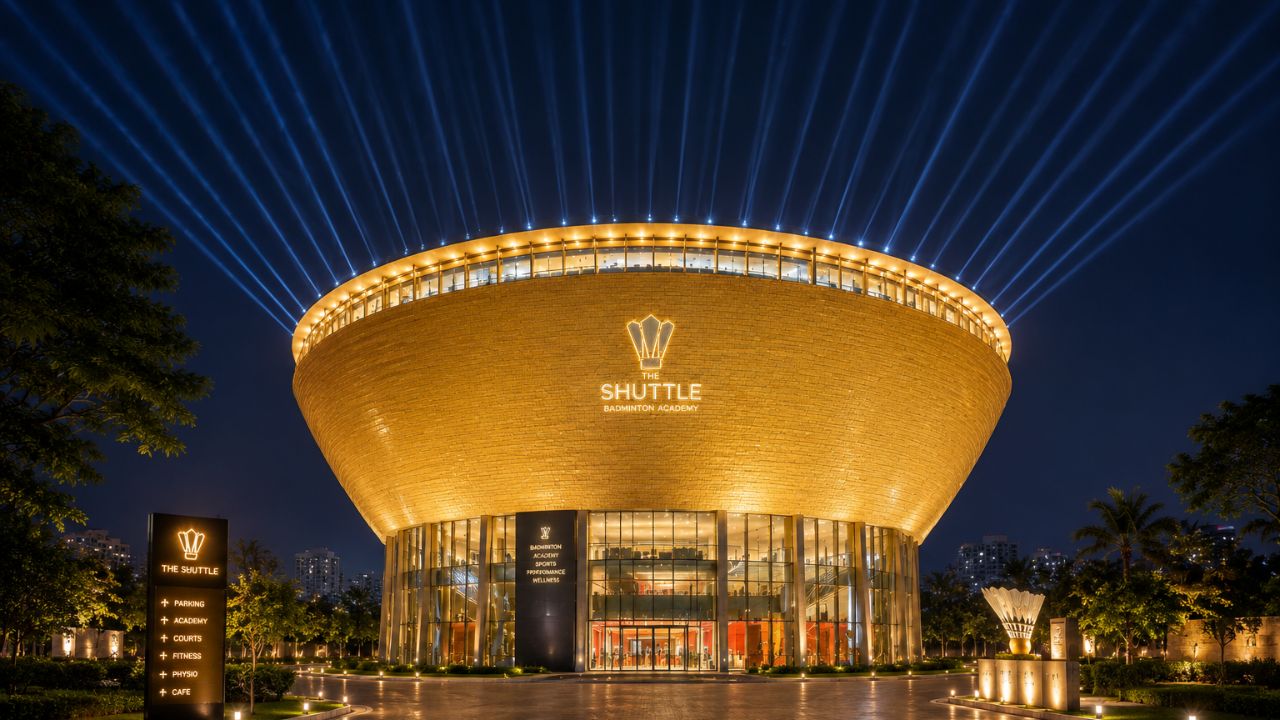
Discover The Shuttle: the shuttlecock-shaped building in India that combines study rooms, storm protection, and eight professional courts.
Eight professional badminton courts, dormitories for resident athletes, and a physical training gym form the heart of The Shuttle, a shuttlecock-shaped sports complex, with about 7,000 m² of constructed area in Bhubaneswar, India.
Designed by the Indian architecture firm Archohm under the guidelines of the Odisha government, the building was planned to function as a self-sufficient training village.
The initiative is part of a broad government strategy that has chosen badminton as a priority sport to put the region on the map of major world competitions.
-
In Brazil’s largest favela, cooking oil that clogged sewers and threatened the beach has turned into Sabão do Morro: a project in Rocinha collected 14,400 liters, generates income for women, and transforms household waste into a local ecological solution.

-
A professor warned that it wouldn’t work, but father and son planted 660 African mahoganies on a depleted plot in Lontras in 2009, and today they have a forest with trunks up to 50 cm and six water springs where the land was previously dry.

-
A fishing boat left Amapá, disappeared more than 400 km off the coast in an area that the Navy itself acknowledges as lacking sufficient surveillance and that the PCC and Comando Vermelho have already chosen as a corridor to transport cocaine to Europe.
-
Autonomous sugarcane truck carries up to 20 tons within the farm, replaces tractors in transshipment, and operates in the middle of the sugarcane field without a driver controlling every meter of the operation.




To symbolize this ambition, the architects transformed the central element of the game into a physical reality, creating an innovative building that perfectly mimics the shape of a shuttlecock.


The internal structure and focus on athlete development
Behind the innovative thematic facade, the internal engineering of the building was designed to provide comprehensive support for both the physical and intellectual preparation of future champions.
The space aims to attract and retain new talents in the sport, offering infrastructure that goes far beyond traditional playing areas.
The internal mapping of the building includes the following facilities:
- Study spaces and library for the educational development of athletes;
- Dormitories structured to comfortably accommodate the lodged athletes;
- Living area with a cafeteria and a shop focused on sports goods;
- Stands integrated directly into the large sports pavilion;
- An accessible terrace with a panoramic view of the city’s urban landscape.
The technical rigor in the isolation of professional courts
To ensure that athletes achieve maximum performance, the court environment requires absolute precision and total isolation from the forces of nature.
In badminton, air control and lighting quality are critical factors that determine the precision of each play.
The project addressed these technical requirements in two specific ways:
- Seals against drafts: A simple gust of wind can divert the shuttlecock’s trajectory and compromise the match’s progress. Therefore, the main hall of the building received a completely sealed envelope and a mechanical air conditioning system. The air is distributed in a controlled manner, preventing the emergence of cross flows over the playing floor.
- Linear and homogeneous light: Unregulated reflections, shadows in wrong positions, or excessive contrasts impair athletes’ visibility. The luminaires were strategically positioned to generate linear clarity over the courts, eliminating any risk of visual glare during competitions.
Aerodynamic engineering to face severe cyclones
If the interior emphasizes total isolation, the exterior area of the building was designed to interact intelligently with the hostile climate of Bhubaneswar, a region frequently battered by severe cyclonic winds.
The choice of the rounded shuttlecock shape, therefore, fulfills a civil safety function that goes far beyond aesthetic appeal.
In conventional square or rectangular constructions, flat walls retain the wind’s force, generating dangerous pressure peaks concentrated at the corners and edges of the structure.
In the case of The Shuttle, the curved geometry allows air currents to flow smoothly around the facades.

This uniform distribution of the forces of nature reduces localized mechanical stresses, giving the building a much more stable and secure structural behavior during extreme storms.
From the anatomy of the game to architectural design
The design team at Archohm drew inspiration from the very structure of a badminton shuttlecock — traditionally composed of a spherical cork head and a skirt of synthetic or goose feathers.
This same logic was replicated in the division of the building:
- The spherical base: The lower portion of the building resembles a large bowl, symbolizing the firm base of the object. This robust structure ensures mechanical support and visual balance of the foundation.
- The luminous feathers: At the top of the roof, engineers installed a system of radial lights. At night, these illuminated points reinforce the silhouette of the “feathers,” making the outline of the building recognizable even from miles away.
By refocusing on internal efficiency, the design of The Shuttle proves that a themed building, like this shuttlecock-shaped building, can offer high performance for athletes, safety against natural disasters, and a historical symbol of cultural identity.
Source: EngSette





-

-

-

4 people reacted to this.