Portuguese
  Spanish


Called ATEM and led by Fu Jingcheng’s team, the system was primarily designed for civilian uses, such as mining and water mapping. The military use is merely potential, based on a 2012 simulation, and the Chinese structure still tilts more than 20 degrees when the helicopter accelerates.
The Chinese structure that could change submarine hunting is neither a missile nor a ship, but a set of giant coils hanging from a helicopter. According to the report, China tested an airborne electromagnetic detection system, named ATEM, capable of mapping what is buried or submerged below the surface. In the test, the Chinese structure, consisting of three huge coils about 25 meters long, overcame its main flight obstacle, which is to remain stable in the air.
According to the material, the main function of the equipment is civilian, aimed at mineral exploration, mapping underground waters, and geological surveys. The military use, such as locating hidden nuclear submarines, appears only as potential, supported by previous studies and a 2012 simulation with a scale model. Even so, it was the performance of the Chinese structure in controlling oscillation that drew attention.
What is the Chinese coil structure
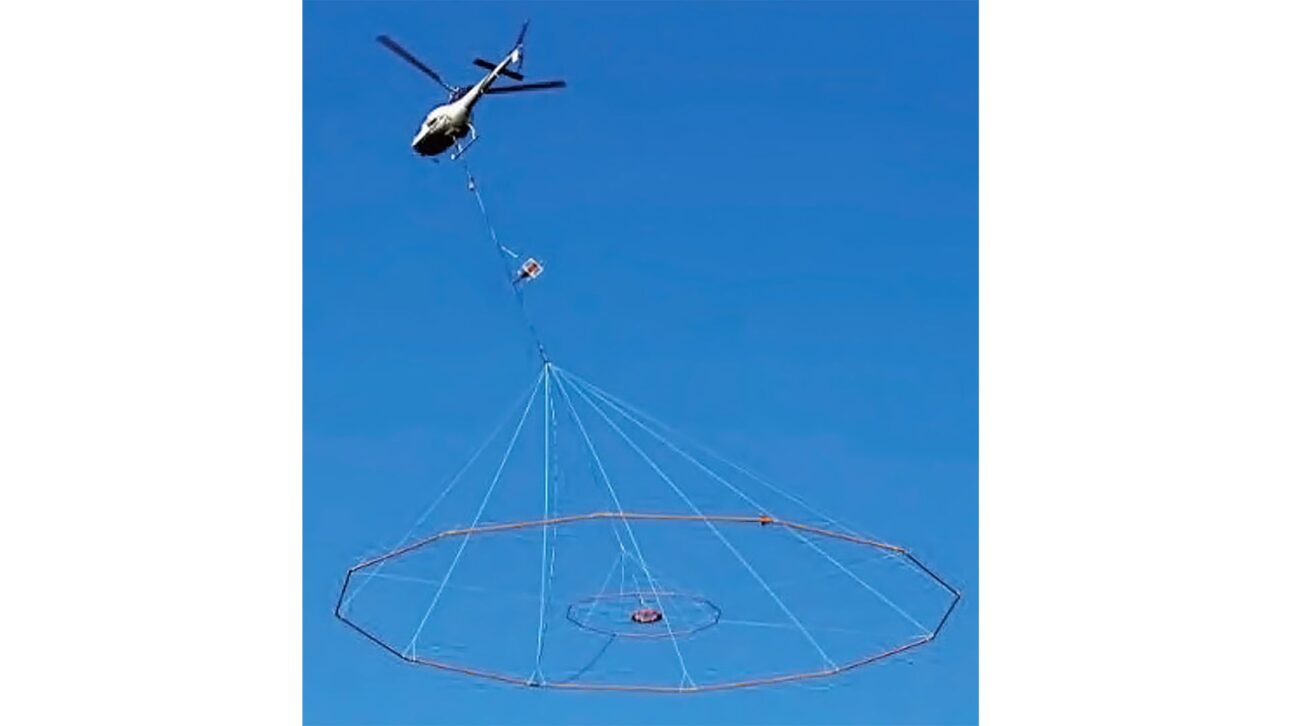
The Chinese structure is described as an imposing system, with three dodecagonal coils, each measuring about 25 meters in diameter. According to the South China Morning Post, cited in the report, the coils function as a transmitter, compensation unit, and receiver, and are suspended under a helicopter by a network of cables. The research is led by Fu Jingcheng, an associate professor at Beihang University and the Institute of Geology and Geophysics of the Chinese Academy of Sciences.
-
World Cup Ball Chip Uses Technology to Detect Invisible Touches, Confirms Offside, Secures Portugal’s Victory Over Croatia

-
36-Meter Hydrogen-Powered Superyacht Arrives in Brazil to Debut German Engines and Showcase Future of Clean Navigation

-
Indian Students from Jaipur Win Top Prize at World’s Largest Science Fair with EcoFog, an Affordable Mesh to Harvest Fog Water Without Energy

-
Italy Sinks Massive 11-Story Concrete Structures in the Ligurian Sea to Create a 6.2 km Barrier, Clearing the Way for 400-Meter Ships in Genoa



The operation of the Chinese structure is based on pulses of electricity sent by the transmitting coil, which generate a brief electromagnetic field. When the pulse ends, the conductive materials below the surface return secondary electromagnetic signals, captured by the receiving coil. By analyzing how these signals dissipate, researchers can identify buried or submerged objects and estimate their depth and composition.
What it is for, according to the research
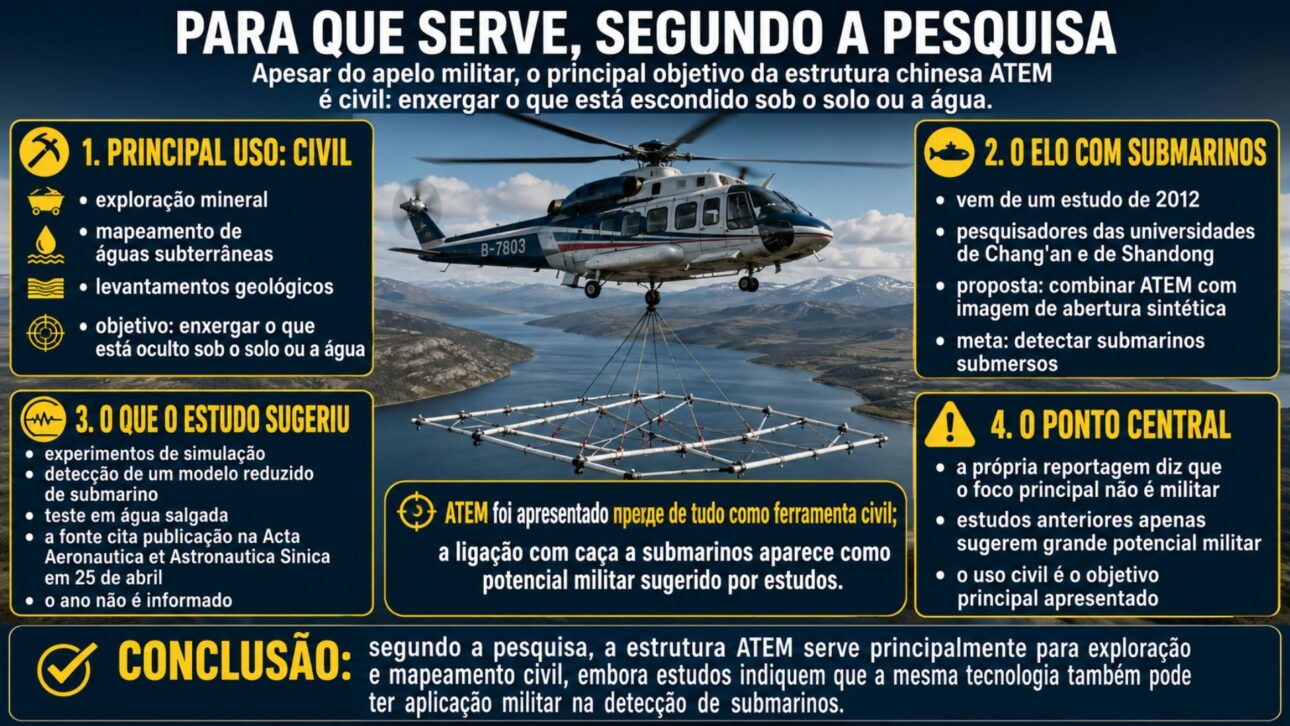
Despite the military appeal, the main objective of the Chinese structure is civil, according to the material. The applications mentioned are mineral exploration, groundwater mapping, and geological surveys, all related to seeing what is hidden beneath the soil or water. The report itself states that previous studies only suggest that the same approach would have great military potential.
The link to submarine hunting comes from a 2012 study by researchers from Chang’an and Shandong universities. This work proposed combining ATEM systems with synthetic aperture imaging techniques to detect submerged submarines, and, according to the source, simulation experiments successfully identified a scaled-down model of a submarine in saltwater. The source also mentions a publication in the journal Acta Aeronautica et Astronautica Sinica on April 25, without specifying the year.
The great obstacle, keeping the structure stable in the air
The biggest challenge of the Chinese structure is not detection, but maintaining stability during flight. According to the material, large suspended coil arrays can tilt and oscillate due to wind, helicopter rotor turbulence, and aircraft maneuvers, and these movements impair data accuracy. The problem is so sensitive that, according to the report, even moderate helicopter acceleration caused the structure to tilt more than 20 degrees. The results of this innovative flight test were revealed in an article published in the Chinese journal Acta Aeronautica et Astronautica Sinica on April 25.
This detail helps to gauge the real progress announced, which is more about taming the oscillation than about finding submarines. A matrix of coils that tilts or swings in the air collects distorted data, which would compromise any precision reading, whether for mining or military use. Therefore, keeping the Chinese structure level became the central point of the test.
How the team tried to solve it
To stabilize the Chinese structure, Fu Jingcheng’s team developed a computer model that calculated the ideal lengths and tensions of the cables. Based on this, according to the material, the researchers identified a flight configuration that kept the coils level during inspections. The idea was to treat the set as a system that needs to be balanced, not just hung.
The researchers also attached a flexible aerodynamic film to the back of the main coil, functioning as a passive stabilizer. According to the report, this film exerts a force that helps contain violent oscillations, and a seven-minute flight confirmed the ability to maintain an almost level orientation. Even so, the test itself showed that rapid accelerations and sharp turns cause the load to swing strongly again.
What still weighs against the technology
The result is promising, but it’s worth separating the test from a war-ready capability. By the source’s own description, almost perfect stability only appears in slow and smooth flight, with the pilot reducing speed before turns, completing each turn gradually, and accelerating only afterward. In more aggressive flight, the Chinese structure continues to oscillate, which limits its use in real situations.
There is still a gap between detecting and hunting real nuclear submarines. The supposed military potential is based on a 2012 simulation with a scale model, not on a demonstration against a real submarine at sea, while the declared function of the system remains civil. In other words, the Chinese structure has advanced in stability, but the promise of locating invisible submarines is still, above all, a hypothesis.
In the end, the Chinese three-coil structure represents a real advancement in a difficult technical problem, which is keeping a giant sensor stable hanging from a helicopter. The leap to hunting hidden nuclear submarines, however, still depends on proof outside the laboratory, and the research itself prioritizes civil uses. It is worth watching if the technology moves from slow and controlled flight to the real world.
And you, do you believe that systems like this will really change submarine hunting, or are they still far from it? Share your opinion, respecting different views on the topic.