






 Portuguese
  Spanish


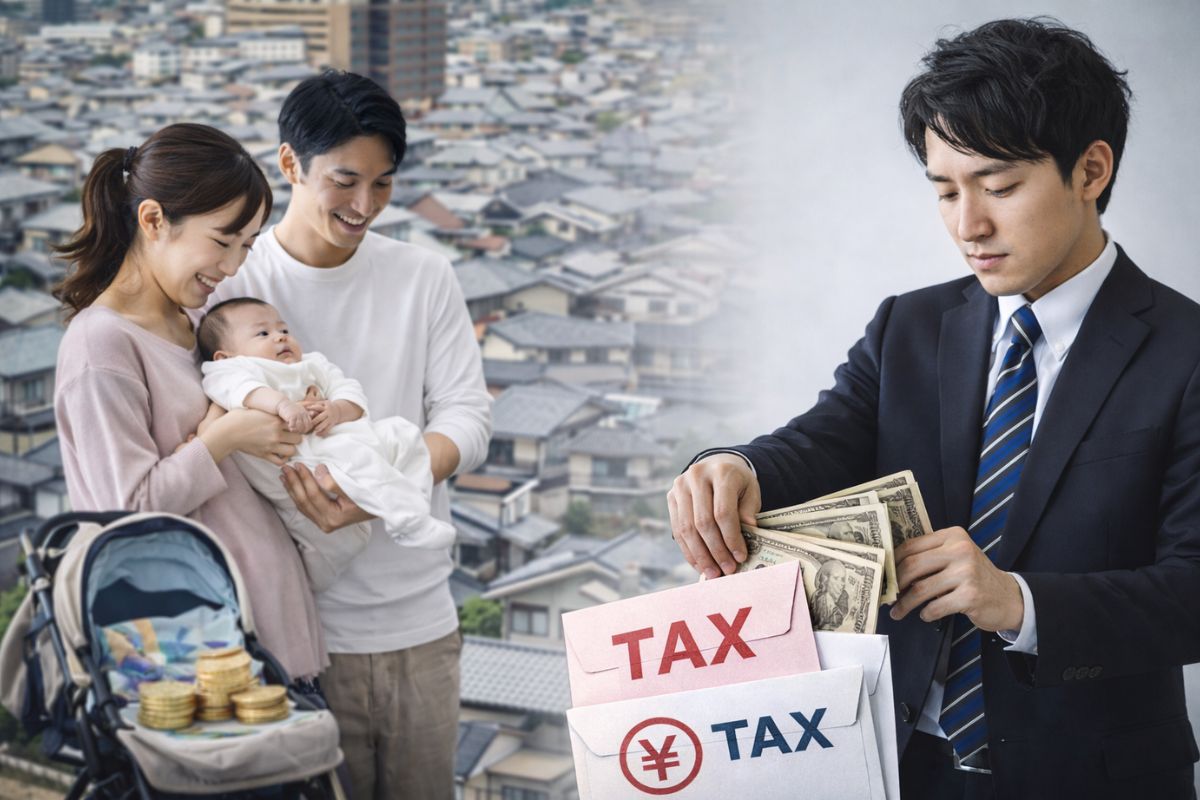

Since April 2026, all workers in Japan pay an additional fee on health insurance to finance childcare and assistance for single childless parents. Single individuals without children call the charge a “single tax” because they bear the cost without receiving any direct benefit, and the controversy has already gone viral globally.
The Japan has just entered a debate that seems absurd at first glance, but reveals a real dilemma faced by countries with declining populations: who should pay to encourage childbirth? Since April 2026, a new additional contribution is deducted directly from the health insurance of all Japanese workers to finance the Child and Child-Rearing Support System. The problem is that the fee is charged to everyone, including single individuals without children who will never use childcare or receive child assistance, which has generated the viral nickname “single tax” (shokushin-zei) and a wave of indignation both inside and outside Japan.
The reaction is not just emotional. In Japan’s tax system, the disadvantage for singles is twofold. In addition to the new fee in 2026, married individuals already benefit from historical tax exemptions such as the Spouse Deduction (Haigusha Kojo), which allows a couple to pay less income tax when one partner earns below a certain threshold. In practice, two citizens with identical salaries pay different taxes: the married one receives deductions, while the single one pays the full amount. The sum of these layers creates what many in Japan call an invisible tax against those who choose not to marry.
What is the “single tax” and why did Japan implement it
According to information from the portal Xataka, officially, there is no exclusive tax for singles in Japan. What exists is the new Child and Child-Rearing Support System (Kodomo Kosodate Shien-kin Seido), approved by the National Diet, Japan’s parliament. The measure instituted an additional contribution proportional to the worker’s income, deducted from health insurance, with the aim of financing policies that encourage childbirth and support childcare infrastructure. The nickname “single tax” arose because the fee applies to everyone, regardless of marital status or having children.
-
Billionaire says the most valuable skill will help overcome job elimination caused by AI, following Bill Gates’ fears

-
A Dutchman created a ‘box’ that makes trees grow in the desert almost without water and without irrigation: the invention has already brought seedlings to dozens of countries and achieves up to 90% survival where common planting did not exceed 10%.

-
Abandoned warehouse hid a giant collection of rare computers, with over 2,000 artifacts from the 1930s to the 1980s.
-
Scientists warn that melting ice is triggering an alarming chemical transformation in preserved areas, and the first signs are already concerning researchers worldwide.




The Japanese government justifies the widespread charge with a long-term argument: a society with a declining birth rate threatens the sustainability of the entire social security system, affecting the future pensions even of those who are single today. The logic is that everyone benefits from a population that does not age without replenishment, even if the direct benefits such as childcare and assistance are not utilized by all taxpayers. However, for those who pay and do not use, the argument sounds too distant to justify a concrete monthly charge.
How much more do singles pay in Japan with the new fee
The fee is not fixed but proportional to the worker’s income. According to the Ministry of Health, Labor and Welfare of Japan, the estimated average amounts for 2026 are approximately 450 yen per month (about R$ 14) for those earning 4 million yen annually, and between 950 and 1,000 yen (about R$ 31) for incomes of 10 million yen annually. In absolute terms, the amounts seem modest, but for singles who already pay more taxes for not having access to spousal deductions, the accumulation generates frustration.
The perception of injustice is amplified by the context. Many singles in Japan are not single by frivolous choice, but due to economic pressures that include long working hours, stagnant wages, and a cost of living that makes it difficult to form families, exactly the problems that the fee aims, indirectly, to help resolve. The irony does not escape critics: the government charges those without children to finance policies that, in theory, should make it easier to have children, but do not address the reasons why people choose not to have them.
The historical fiscal disadvantage of singles in Japan
The “single tax” of 2026 is not the only mechanism that penalizes those living alone in Japan. The Japanese tax system offers the Spouse Deduction (Haigusha Kojo), which reduces the income tax of couples when one partner earns below a specific limit. This means that two workers with the same gross salary can have different net taxes: the married one pays less, while the single one pays the full amount.
This disadvantage, which has existed for decades, is what many in Japan call the “invisible tax.” Combined with the new contribution in 2026, it creates a scenario where being single in Japan is, objectively, more expensive than being married, even without considering the shared costs of housing and household expenses that couples naturally divide. For proponents of the system, the deductions are legitimate incentives for family formation. For critics, they are a tax punishment for a lifestyle that should be a free choice.
Why the controversy went viral outside Japan
The debate over the “single tax” has crossed Japan’s borders and gone viral globally because it touches on issues that other countries also face. The demographic crisis is not exclusive to Japan: South Korea, Italy, Spain, and dozens of other countries are dealing with declining birth rates and aging populations without replenishment. The idea that the government can charge more from those without children to finance those with children generates intense reactions in any culture.
On social media, the discussion has divided between those who consider the measure an injustice against singles and those who argue that the survival of public systems depends on collective contributions. Japan, by implementing the fee so directly, has made explicit a mechanism that in other countries exists in a disguised form in tax deductions, labor benefits, and subsidies that favor families with children. The difference is that Japan has placed a visible monthly price on everyone’s bill, and singles have noticed.
What the “single tax” reveals about the future of Japan
Behind the fiscal controversy lies an existential problem for Japan. The country has one of the lowest birth rates in the world, with a rapidly aging population that is not replenishing at the necessary speed to sustain the pension system, the labor market, and public services. The new fee is an attempt to finance short-term solutions, such as childcare and assistance, while the structural problem remains unanswered.
Critics argue that taxing singles more does not solve Japan’s demographic crisis because it does not address the real causes: inhumane working hours, wages that do not keep up with the cost of living, a corporate culture that penalizes motherhood and fatherhood, and the lack of affordable housing for young couples. The fee may raise funds for childcare, but it will not convince anyone to have children. And as long as this contradiction remains unresolved, the “single tax” will continue to be more of a symptom than a solution.
Japan charges more taxes from singles to finance child assistance that they will never use. Do you think this charge is fair or is it a punishment for personal choices? Could something similar happen in Brazil? Leave your opinion in the comments.





