Portuguese
  Spanish




American University Project Studies The Possibility Of Removing Carbon Dioxide, Also Known As CO2, From The Oceans
The world must halt climate change to avoid terrible consequences for the environment. Most experts argue that to curb global warming and its accompanying harms, the removal of carbon dioxide, also known as carbon gas or CO2, from the atmosphere is necessary.
However, this is a difficult mission, as around 37 billion metric tons is emitted annually on the planet. Now, a team of researchers from the University of California (UCLA) has brought to light a new path that could extract billions of tons of carbon dioxide from the atmosphere. The idea would be to extract CO2 from seawater, as water retains about 150 times more dioxide than air.
The process being developed is similar to a shell at the bottom of the ocean, capturing carbon dioxide. Various startups are seeking alternatives to remove carbon dioxide from the atmosphere. The process studied by UCLA is inspired by the natural world, being called “carbon capture and storage in a single step, or sCS.”
-
Giant Batteries Take Center Stage in Chile Auction as Company Offers 960 GWh of Solar Energy for Nighttime Use, Aiming to Stabilize Solar Power Supply

-
After a Year of Success in Switzerland, Solar Railway Attracts Italy’s Interest for Clean Energy Transformation
-
Robots Clean Solar Panels in Desert Power Plants Without Water, Preventing Energy Losses
-
Brazil’s Offshore Wind Energy Potential Worth $1 Trillion Stalled by Long-Delayed Agreement





Gaurav Sant, author of the study, stated in a press release: “To mitigate climate change, we need to remove carbon dioxide from the atmosphere at a level between 10 billion and 20 billion metric tons per year.” He emphasized the need to draw inspiration from nature to meet such an ambitious CO2 target.
The ocean acts as a kind of sponge for CO2 from the atmosphere. However, the ocean is already saturated and cannot handle any more neglect. The idea of the company is to remove CO2 from the seas, allowing it to absorb even more CO2 from the atmosphere. This is the main idea of the project being studied. The proposal is to accelerate the transformation of carbon dioxide into minerals.
Climate Change: Revolutionary Method Can Help The Environment, But Is Very Expensive
In laboratory tests, scientists developed a tool that pulls seawater, creating limestone and magnesite, which are the same materials that mollusks use to form shells. The machine could be positioned on land, collecting water, completing the entire process, and returning it to the ocean. See an example below of the project that could halt climate change.
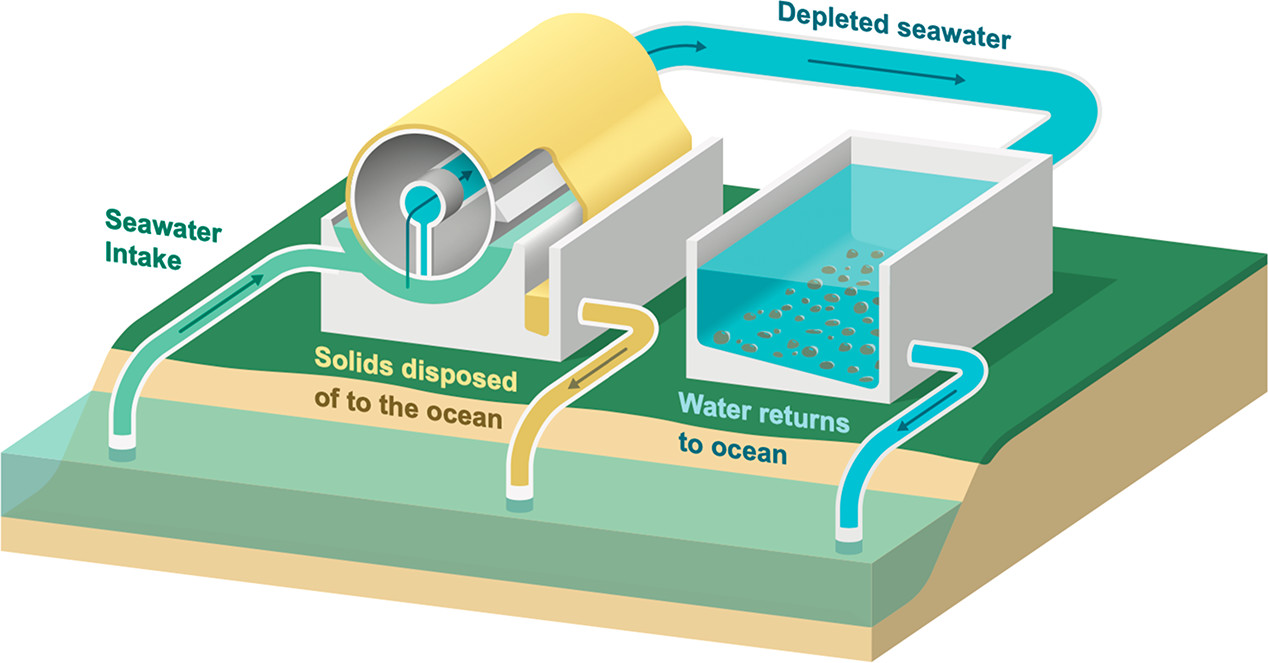
Since seawater retains up to 150 times more CO2 than air, any method involving water will be much more efficient. Additionally, the sCS project can produce hydrogen as a byproduct, which can be used to power the machine itself or even sold as fuel to power hydrogen vehicles.
However, first, it is essential to study the economic feasibility. The study indicates that about 1,800 of its cells would be needed to extract roughly 10 billion tons of CO2 per year. This project would be financially unfeasible today, as it would cost trillions of dollars.