






 Portuguese
  Spanish
  4 min of reading
  1 comment


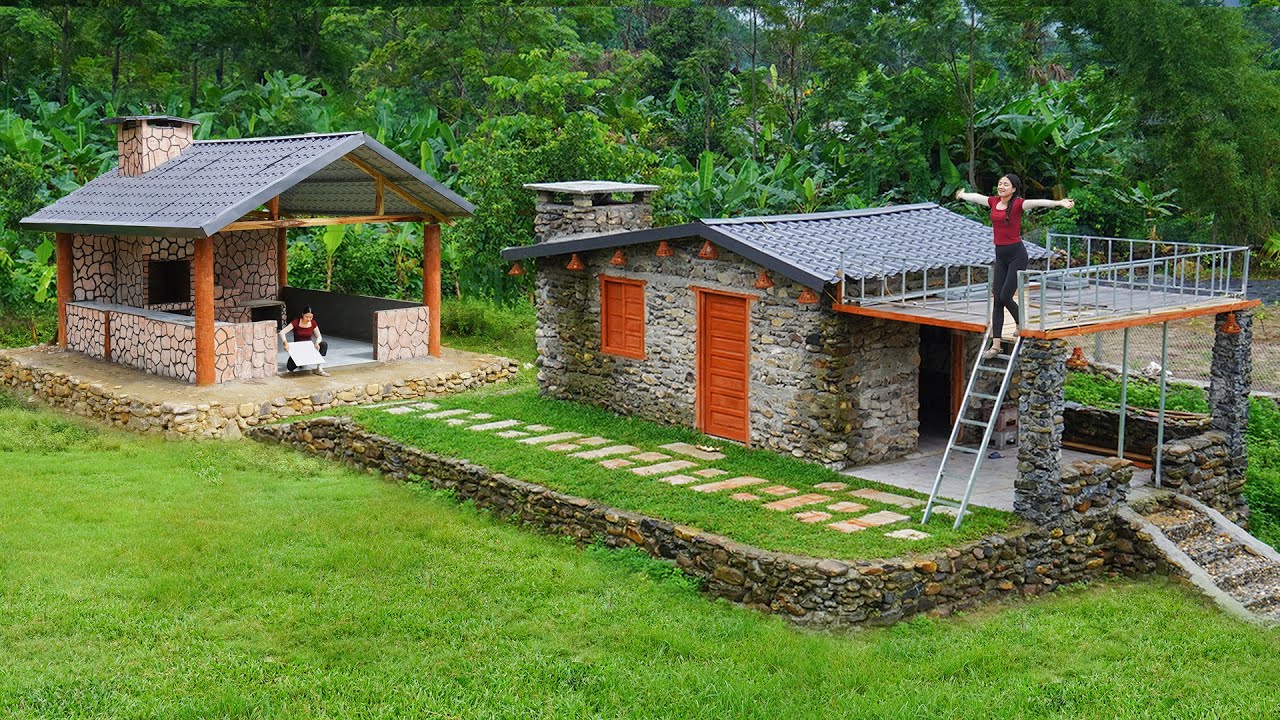


Young Builds Stone House in 60 Days in Nature, Without Heavy Machinery, Showing Physical Strength, Manual Logistics, and Craftsmanship.
How is it possible to raise an entire stone house in a remote area, without heavy machinery, without professional help, and within a short span of 60 days? The project, documented step by step, shows no special effects, stunt doubles, or romanticization. It showcases physical labor, manual logistics, architectural choices, and planning.
The construction begins long before the first wall. The collection of stones already sets the tone for the project. In one scene, the back of a small vehicle is filled with irregular blocks of various shapes and weights. Even with transportation to the site, nothing happens on its own: each stone must be carried, fitted, and repositioned multiple times, something unimaginable for those used to mechanized urban construction.
Logistics and Weight: When the Body Sets the Pace
The stone imposes a rhythm that has nothing to do with modern schedules. There are no quick cuts with circular saws, standardized stacking, or lightweight stacking. There’s weight, volume, and friction. Therefore, unlike industrial wood or concrete blocks, stone requires an almost artisanal approach, evaluating each piece for its shape, stability, and fit.
-
Bolivian Female Construction Workers Form Association to Combat Discrimination and 38% Pay Gap in the Industry

-
Near Amsterdam, residents buy land and discover they must also build streets, manage drainage, handle waste, and grow food on half their plot.
-
Brazil’s WEG to Open New Factory in China by 2027, Expanding Production of Large Rotating Electric Machines and Low to Medium Voltage Motors in Rugao

-
Chinese Shipyard Secures $1 Billion in Orders for Low-Carbon Container Ships Amid Global Fleet Renewal Efforts


As we follow the video, it becomes evident that the limit is not technical, but physical. Even when mortar appears to give body and adherence to the walls, manual effort continues to be the engine of the work. There are no cranes, no industrial concrete mixers, and no powered tools.
The Elevation of the Structure and the Principle of Compression
As the rows of stones grow, the outline of the walls emerges. This method, seen in historical rural constructions in the Mediterranean, the Caucasus, and the Andes, operates based on compression. The wall is not just filled: it is locked by weight and geometry.

It is important to highlight that the video does not serve as a construction instruction. Real stone constructions depend on factors such as soil stability, drainage, wall tying, and structural safety, in addition to regulations and inspections that vary by country and region. In the audiovisual context, what we observe is a record of a phenomenon, not a manual.

Roof, Enclosure, and Habitable Interior
With the structure ready, the young person is seen carrying long metal profiles on her shoulders, balancing with a simple ladder to access the roof. The transition from masonry to the roof marks the point where the house becomes a shelter.
The enclosure with metal tiles makes the objective clear: to protect from rain, sun, and humidity. Soon after, the interior finishing appears, with a smooth floor replacing the uneven ground. It is a practical and hygienic decision, creating a contrast between the rusticity of the walls and the functionality of the interior.

The interesting thing is that this contrast is also architectural: from the outside, the house appears to be a traditional stone shelter; from the inside, it resembles a small contemporary residence.
Outdoor Area and Project Expansion
The construction does not end with the main house. The young person begins a second structure nearby, with a stone base, pillars, and a simple roof.
The site transforms into a covered area that can serve as a cooking, storage, or gathering space. The scene where she paints the outer walls with a pattern that simulates stone joints shows aesthetic awareness and finishing intention, something rare in videos of this genre.

At the end of the video, the ensemble consists of:
• The closed main house
• A functional covered annex
• Pathway and lawn surrounding
• Visual integration with the landscape
It is enough to transform a rustic work into a small habitable system, something that draws attention precisely because it avoids improvisation and seeks spatial coherence.
For the urban audience, the impact comes from the distance between digital life and the primal act of building shelter. For architecture, engineering, and design students, the interest lies in understanding why ancestral techniques remain relevant in the 21st century.

Without glamour, the video delivers something essential: the documentary proof that it is possible to transform raw material into habitable space using knowledge, strength, and time.
It is the record of a constructive logic that precedes machines and still sparks fascination—not because it is replicable in everyday life, but because it reminds us that the world was once like this.





Trabalho espetacular