






 Portuguese
  Spanish


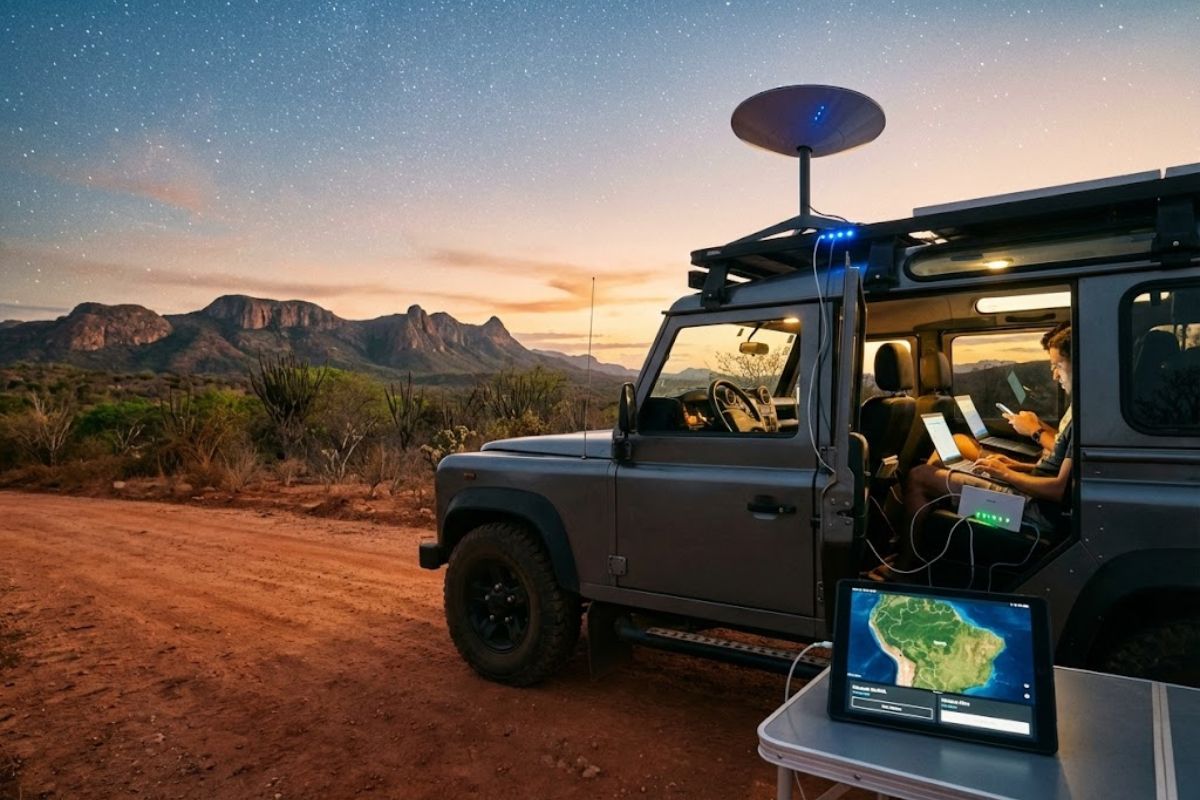

In Brazil, Starlink Turns the Vehicle Into Constant Connection: Satellite Internet with Travel Plans 50GB, Unlimited Travel, and Global Mobility. The Mini Antenna Costs R$ 1,799 and Can Operate in Motion Up to 160 km/h, While the Standard V4 is More Indicated for Stops, with a Kit Costing R$ 2,400.
In Brazil, Starlink’s promise in the car is simple and aggressive: satellite internet that follows the driver on routes where 4G and 5G disappear, turning any vehicle into a hotspot and maintaining stable connectivity during stops and, in certain configurations, also while in motion.
The shift in 2026 comes from the combination of travel plan options and the arrival of Starlink Mini, which reduces installation and power barriers. The focus shifts from “finding a signal” to “choosing the plan and the kit”, with costs that can compete with expensive mobile plans throughout the year.
What Changes When the Car Becomes a National Hotspot with Satellite Internet

With Starlink in the car, connectivity stops depending on the mobile tower map and is made possible by satellite internet, with coverage focused on land travel and areas with low cellular infrastructure.
-
Toyota Shifts from Hybrid Cars to Electric Air Taxis with Joby’s 6-Rotor Aircraft, Capable of 322 km/h, Aiming for Mass Production to Electrify Urban Skies

-
Ferrari Unveils Limited Edition 12Cilindri Manuale: 6.5-Liter V12, 830 HP, 0-100 km/h in 2.9 Seconds, Top Speed Over 340 km/h, Only 1,499 Units Available

-
Discover the 2021 Fiat Cronos 1.3: Affordable Maintenance, Reliable Mechanics, and Fuel Efficiency of Up to 15.6 km/l
-
Cummins Unveils Hydrogen-Powered X15H Engine with Over 800 km Range and 15-Minute Refueling, Challenging Electric Truck Dominance


The practical effect is the ability to maintain navigation, messaging, maps, and remote work in areas with signal “shadows.”
The hotspot logic is operational: the kit provides integrated Wi-Fi, and its use is designed for long routes, expeditions, and travel between states, from North to South of the country, with connectivity available even on deserted roads, rural areas, and remote coastlines.
Plans Available in Brazil and What Each Monthly Payment Delivers

Starlink in the car uses different plans from residential ones considering portability, and in some cases, use in motion.
In Brazil, the approximate values and each category’s proposal are organized as follows:
Travel Plan 50GB
Approximate Monthly Price: R$ 315.00
Franchise: 50 GB
Profile: moderate use, such as emails, maps, and messaging
Unlimited Travel Plan
Approximate Monthly Price: R$ 576.00
Franchise: unlimited data, with caveats
Profile: motorhomes, streaming, and heavy remote work
Operational Note: there may be speed reduction after excessive consumption in congested areas
Global Mobility Plan
Approximate Monthly Price: R$ 1,283.00
Franchise: unlimited with priority
Profile: critical professional use and constant international travel
The cost assessment changes based on usage. Occasional travelers may find the monthly fee heavy, while those living on the road tend to compare the package with the annual sum of multiple mobile plans and the cost of being without a connection.
Equipment, Kit Price, and What Differentiates Mini and Standard V4

Besides the monthly fee, there is the investment in hardware. For cars, Starlink Mini is the most recommended option due to its compact size and simpler power requirements, while the Standard V4 antenna can function with adaptations but is described as more suitable for stationary use.
Starlink Mini
Base Kit Price: R$ 1,799.00
Operational Features: portable, fits in a backpack, integrated Wi-Fi, and supports use in motion up to 160 km/h, powered via USB C
Standard V4 Antenna
Kit Price: R$ 2,400.00
Operational Features: higher power, requires an inverter to connect in the car, and is indicated for stationary use, such as camping
There is also the variable of promotions: the Mini kit may appear in price ranges between R$ 800.00 and R$ 1,000.00 during promotional periods, which completely alters the entry cost for those who want to test before committing to a high recurring expense.
Is It Possible to Use with the Car in Motion and What Are the Caveats

Yes, with clear conditions.
The Starlink Mini was designed for use in motion and can be powered directly in the car, even via the cigarette lighter, focusing on navigation and streaming for passengers during the journey.
The technical point is that the solution combines mobility and simplified power requirements, reducing the need for a fixed structure.
The Standard V4 antenna is positioned as intended for stationary use.
Although there are adaptations made by users, this path carries two direct risks: violates warranty terms and may compromise signal stability at high speeds.
In practice, the choice becomes a trade-off between kit robustness and compliance with use.
Coverage, Flexibility, and Speed in the Routine of Those Who Live on the Road
The main operational advantage is coverage where the cellular signal does not reach.
On long trips, rural areas, and routes with few urban centers, satellite internet becomes a redundancy that enhances safety and productivity: communication remains available when cell service fails.
Flexibility also plays a role: the service can be paused. If there is no travel in a given month, there is the option to suspend charges on Roam plans, which reduces waste for those not using the vehicle on continuous expeditions.
In terms of performance, the reference provided is averages of 100 to 200 Mbps, considered sufficient for video calls and 4K streaming in isolated locations.
The real gain appears when speed and stability replace the lottery of mobile coverage, with the caveat of possible reductions in congested scenarios on the unlimited plan.
When the Bill Makes Sense and When It Does Not Justify the Investment
The investment tends to make sense for three profiles: those who work on the road, those with motorhomes, and those who frequent isolated areas like sites and rural regions with low coverage.
In these cases, Starlink in the car positions itself as a communication security rather than just a convenience.
On the other hand, if the use is rare and limited to areas with some cellular signal, the cost of the kit plus the monthly fee may exceed the alternative of mobile plans.
A conservative strategy within the data itself is to start with the Travel Plan 50GB and the Mini antenna to test adherence to the routine before moving to unlimited.
Would you install satellite internet in your car to travel across Brazil, or would you prefer to rely on 4G and 5G and accept being without signal in remote stretches?


