Portuguese
  Spanish


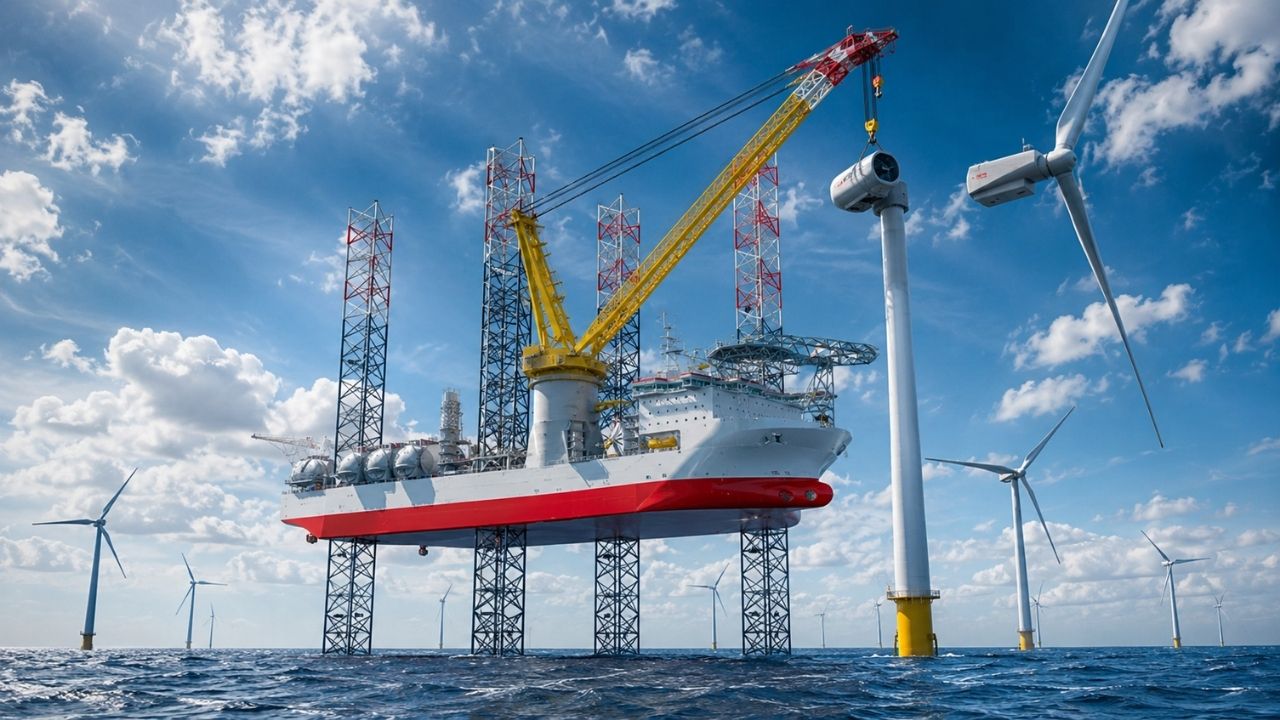


The Voltaire ship, from the Jan De Nul Group, arrived in the United Kingdom to install 277 Haliade-X turbines at the Dogger Bank wind farm, using a lifting capacity of over 3,000 tons and ultra-low emission technology in a decisive project for offshore wind energy in the North Sea in a historic industrial campaign.
The Voltaire ship arrived at the British port of Able Seaton in June 2023 to begin its first major mission: installing offshore wind turbines at the Dogger Bank wind farm in the North Sea. The vessel belongs to the Jan De Nul Group and was prepared to operate in all three phases of the project.
According to the Dogger Bank Wind Farm, the operation involves 277 Haliade-X turbines from GE Renewable Energy, planned for phases A, B, and C of Dogger Bank. The wind farm, developed in the United Kingdom, is considered the largest in the world in its category and relies on installation vessels capable of handling increasingly larger components.
Voltaire ship was created to install giant turbines at sea

The Voltaire is described as the largest self-elevating offshore platform ever built for installation at sea. This type of ship uses lifting legs to support itself on the seabed and create a stable base during heavy lifting operations.
-
Farmer in Ireland Discovers Intact Bronze Age Tomb While Moving Stone on His Land

-
AI Deciphers 1.4 Meters of Text from a 2,000-Year-Old Scroll Carbonized by Mount Vesuvius Without Unrolling It
-
Ferrari, BMW, Tesla, and Chinese Automakers Shift from Copper to Aluminum Wiring to Reduce Weight and Costs in Electric Vehicles
-
Brazilian Researcher Unveils Innovative Intraocular Lens for Cataract Treatment with High-Precision Optics, Enhancing Vision at Multiple Distances and Reducing Unwanted Visual Effects





When in operation, the elevated structure surpasses the height of the Eiffel Tower, a detail that helps to gauge the size of the vessel. In the case of Dogger Bank, this scale is necessary because modern offshore turbines have grown in power, height, and complexity.
Dogger Bank will have 277 Haliade-X turbines in the North Sea
The Dogger Bank wind farm will be served by the Voltaire in all three phases of the project: Dogger Bank A, B, and C. In total, the ship is expected to install 277 Haliade-X turbines, a model developed by GE Renewable Energy for large-scale offshore wind generation.
The turbines planned for the project include units of more than 13 MW and 14 MW. This power demonstrates how offshore wind energy has come to require a new generation of vessels, as larger components demand stronger cranes, more stable bases, and more sophisticated maritime logistics.
Crane has capacity over 3,000 tons
One of the main differentiators of the Voltaire is its crane with a lifting capacity of over 3,000 tons. This strength allows it to handle enormous structures used in offshore wind farms, including turbine parts and other heavy industrial components.
The lifting capacity is essential because the work takes place in a maritime environment, where wind, waves, currents, and operational precision make each step more sensitive. It’s not enough to lift the load: it must be positioned with control in an exposed and technically challenging area.
Vessel arrived in the United Kingdom before the first campaign
The Voltaire ship was delivered at the end of 2022 and underwent preparations before its mission at Dogger Bank. In June 2023, it arrived at the port of Able Seaton in the United Kingdom to begin the installation campaign scheduled to start at the beginning of July that year.
This movement marked the practical entry of the vessel into one of the most watched offshore wind energy projects. For the sector, the start of operation was a way to test, on a real scale, the capability of a ship designed for the next generation of turbines at sea.
Ultra-low emission became part of the technical differential
Besides its size, the Voltaire was introduced as the first navigable installation ship to receive an ultra-low emission classification. The vessel features an advanced exhaust gas filtration system, selective catalytic reduction, and a diesel particulate filter.
This characteristic is relevant because the wind sector also faces scrutiny over the environmental footprint of its own construction chain. Even in clean energy projects, installation depends on ships, ports, steel, heavy logistics, and equipment with high energy consumption.
Dogger Bank requires more robust vessels
The arrival of the Voltaire in the United Kingdom shows a shift in the offshore wind industry standard. As turbines increase in scale and power, projects need ships capable of reaching greater heights, lifting heavier parts, and working in complex maritime conditions.
According to project representatives, this technological growth requires more robust vessels to meet engineering challenges. Dogger Bank fits exactly into this scenario, as it combines high-power turbines, open sea installation, and the ambition of global-scale generation.
Project brings together Jan De Nul, GE Renewable Energy, and Dogger Bank developers


The Voltaire belongs to the Jan De Nul Group, the company responsible for the installation vessel. The Haliade-X turbines are from GE Renewable Energy, while the Dogger Bank project involves major industry names such as SSE Renewables, Equinor, and Vårgrønn.
This combination shows that offshore wind farms depend on an international chain. The construction of a plant at sea involves not only turbines but also manufacturers, installers, ports, vessels, marine engineering, and long-term planning.
Largest offshore wind farm depends on extreme logistics
The Dogger Bank is regarded as the largest offshore wind farm in the world, and its scale helps explain the arrival of a ship like the Voltaire. To install hundreds of turbines in the North Sea, the operation needs to combine lifting capacity, stability, precision, and repetition.
Each installed turbine represents a step within a prolonged campaign. Therefore, the efficiency of the ship influences deadlines, costs, safety, and the pace of project advancement. In offshore megaprojects, the vessel becomes as strategic a piece as the turbine itself.
Voltaire ship shows the real scale of the energy transition
The image of a ship larger than the Eiffel Tower in operation, lifting giant turbines in the North Sea, shows that the energy transition also depends on heavy engineering. Offshore wind energy may seem simple when viewed from the coast, but its construction requires colossal machines and high-precision operations.
Now the question remains: do megaprojects like Dogger Bank show the future of clean energy or reveal that the energy transition still depends on huge and expensive structures to advance? Do you think ships like the Voltaire will become increasingly common in the construction of offshore wind farms? Share your opinion.