Portuguese
  Spanish


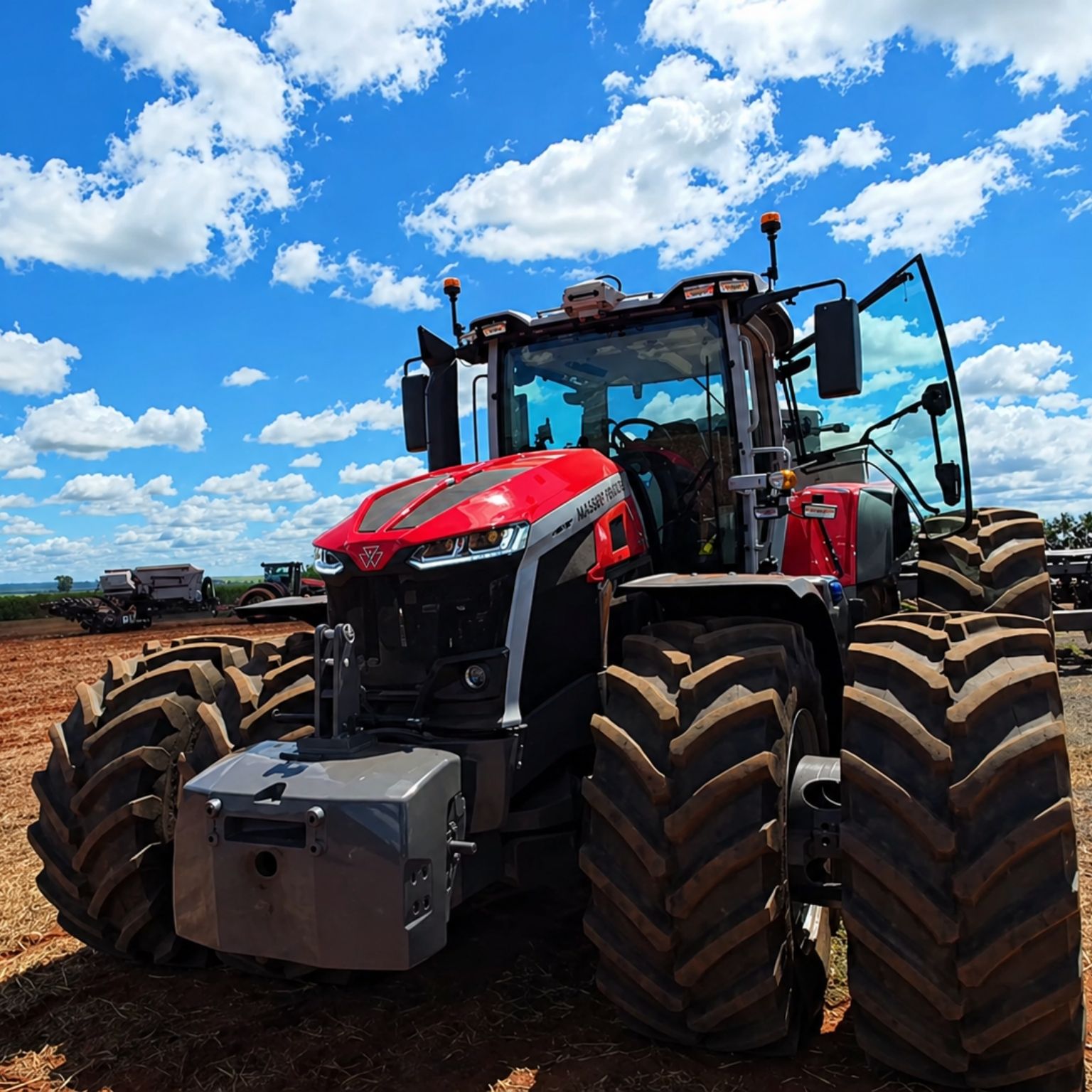


Massey Ferguson 9S tractor arrives in Brazil as the largest model ever produced by the brand worldwide, combining power, CVT transmission, hydraulic lift, the quietest cab, and a technology package focused on planting, maneuvering, and high hydraulic capacity.
The new Massey Ferguson 9S tractor has just arrived in Brazil and is already drawing attention for a combination that is hard to ignore: 425 hp, large size, and a focus on heavy-duty operations. Unveiled in Bebedouro, in the interior of São Paulo, the model was shown attached to a 30-row planter and reinforces the entry into the country of the largest tractor ever produced by the brand on a global scale.
The launch gains traction because it is not limited to size. The tractor is part of the 9S line, which includes the 345, 375, and 425 hp models, and features a CVT transmission, a 12-ton hydraulic lift, a flow rate of up to 420 liters per minute on the remote control, and a cab with only 62 dB of noise. In practice, the proposal combines strength, operational comfort, and onboard technology to increase work capacity in high-demand activities.
What makes this tractor the largest ever produced by the brand

The main highlight of the 9S is the fact that it is the largest tractor ever produced by Massey Ferguson in the world. The machine arrives in Brazil at the top of the line and positions itself as a showcase of evolution in power, structure, and features geared for heavy-duty work.
-
Brazilian Agribusiness Sets Record with $169 Billion in Exports in 2025

-
Solar-powered irrigation transforms agriculture, boosts family income, and enhances food security in Uganda.

-
Brazil Supplies 70% of the World’s Orange Juice, Prices Double Due to Pest Outbreak

-
Brazilian Scientists Develop World’s First Tropical Wheat for Biscuit Production, Yielding Up to 150 Bags per Hectare and Highly Resistant to Common Crop Disease





This symbolic weight is increased because, according to the presentation, models of this size used to take much longer to reach the Brazilian market. Now, the gap between what is launched abroad and what arrives in the country has narrowed, putting the new tractor in sync with the latest from the brand’s global family.
The numbers that explain the size of the new tractor
The spec sheet presented during the demonstration helps to understand the equipment’s size. The model shown is the 425, with 425 horsepower, within a line that also includes 345 and 375 hp versions. The engine is an 8.4-liter, 6-cylinder with electronic injection.
On the hydraulic side, the tractor has a 12-ton lift. The hydraulic flow is 340 liters per minute at 1,650 engine rpm and can reach 420 liters per minute in the 1,900 to 2,000 rpm range on the remote control. The front assembly includes a 1,500 kg counterweight, in addition to another 820 kg mentioned on the support.
What changes in practice with the two-module CVT transmission
The CVT transmission is one of the central points of the project. According to the presentation, the tractor works with two modules, one for operation and the other for transport. In operational use, the proposal is to prioritize traction and heavy work. In transport, the equipment can reach 50 km/h.
In practice, this means a smoother ride, without traditional gear shifting. The operator sets the desired working speed, and the system maintains this setting, which helps in activities that require consistency, precision, and a quick response in the field.
Why the hydraulic system puts the tractor on another level

The hydraulic system is one of the strongest arguments for the 9S. In addition to the 12-ton lift, the model features several remote control valves, a hydraulic third point, and Power Beyond lines, designed for the direct supply of oil to implement systems.
This package expands the capacity to work with large and demanding equipment. In the case of the presentation, the tractor was shown attached to a 30-row planter, which helps to demonstrate how the model was designed for large-scale operations, where flow, power, and hydraulic response make a direct difference in performance.
The 62 dB cab and operational comfort that stand out

Another highlight of the new tractor is its internal environment. The cab has a noise level of just 62 dB, a result associated with the Protect-U system, a space created between the engine and the cab to reduce vibration and noise.
The practical effect of this is seen in the operator’s daily routine. The tractor features a large glass area, with 6.6 m² of glass, a single-piece windshield, good front and rear visibility, electric mirrors, side and front blinds, as well as a seat with multiple adjustments. The result is an operator station designed for long workdays with more comfort and less fatigue.
What the lighting, visibility, and electronics reveal about the design

The 9S has received LED lighting in several areas, including the cab, front headlights, and service lights. The hood with its upper air intake is also part of this technical package, as it aims to draw in cooler air with less dust, separating the ventilation system’s intake from the main cooling area.
The model also features integrated electronic resources, such as headland management without the need for external software, electronic hydraulic lift, push-button differential lock, push-button PTO, and front-wheel drive also controlled by a button. In practice, the onboard electronics reduce manual steps and expand control of functions directly from the operator station.
Structural details that reinforce its heavy-duty profile
The tractor comes with front suspension, dual wheels on the front, and large tires. At the front, the set uses 650/60 R34 tires. At the rear, the model comes with 710/75 R42. The size of the tires helps to define the machine’s purpose and its suitability for high-demand operations.
At the rear, the equipment also features a drawbar, abundant hydraulic outlets, a power take-off (PTO), and connections geared for use with high-demand implements. This reinforces that the design was not intended just to attract attention for its size, but to deliver real work capacity in the field.
Why the arrival of this tractor in Brazil is attracting so much attention


The arrival of the 9S in Brazil is significant because it shows a change in the national market’s access time to the industry’s newest machines. The presentation itself highlights that the equipment took about three years to arrive in the country, a much shorter interval than in past decades.
This changes the perception of the Brazilian agricultural machinery market. Instead of receiving equipment only long after its international launch, the country is now more quickly approaching the technological standard available abroad, which increases the level of competitiveness and modernization of operations.
What this tractor indicates about the advancement of mechanization in the field
The 9S shows that the advancement of mechanization is no longer restricted to increased power. The new tractor combines power, hydraulics, visibility, a quiet cab, electronic features, and integration with large implements, all within a framework focused on operational efficiency.
In practice, this means that today’s performance leap involves both the ability to pull and the ease of operating, programming, maneuvering, and keeping the machine working with less operator effort. It is this combination that helps transform a large tractor into an even more strategic production tool.
Do you believe that a tractor of this size and with this technological package tends to change the standard of heavy operations in the Brazilian fields?