Portuguese
  Spanish


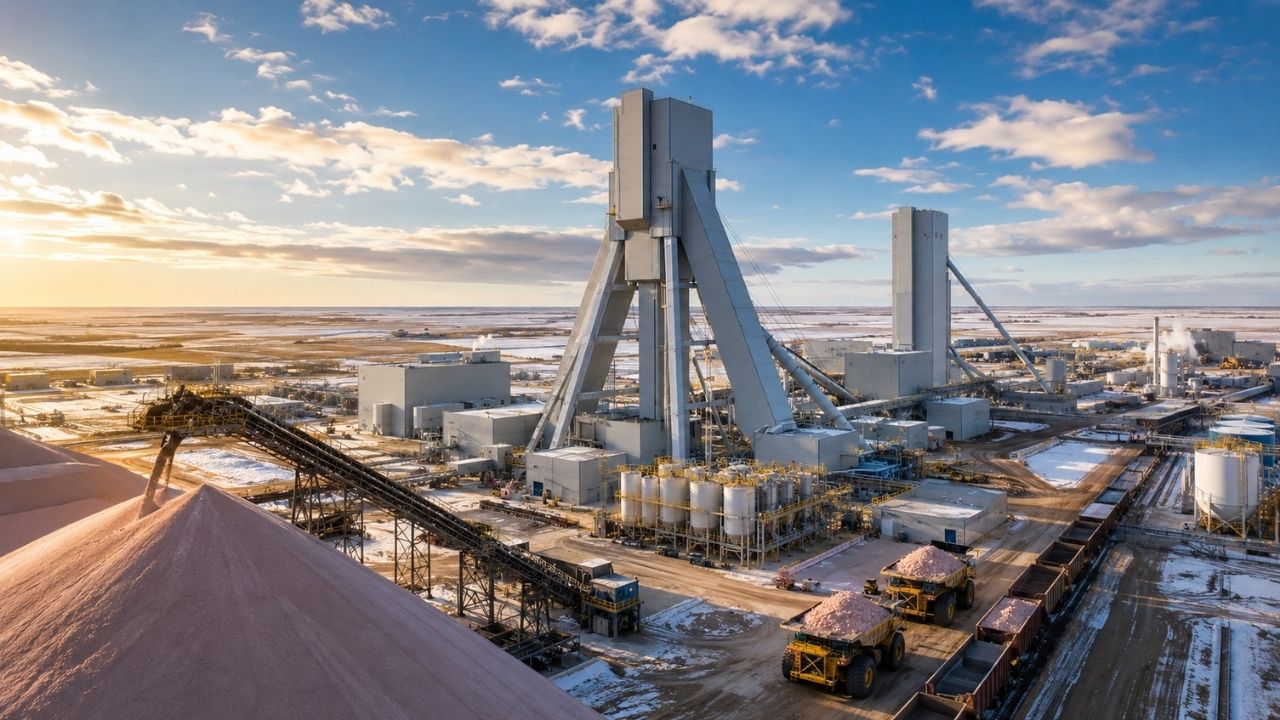

In Canada, the Jansen potash mine received an investment of CAD$ 14 billion, about US$ 10.5 billion, and aims for production by mid-2027. After phase 2, BHP projects 8.5 million tons annually, jobs, local contracts, and strategic weight for global fertilizers from Saskatchewan.
The Jansen potash mine, by BHP, in Saskatchewan, Canada, has become central to the company’s strategy for fertilizers and long-term resources. The project totals an investment of CAD$ 14 billion, equivalent to about US$ 10.5 billion, with production expected by mid-2027.
According to information from the mining company BHP, the plan is to transform Jansen into an operation capable of reaching approximately 8.5 million tons of potash per year after the completion of phase 2. If this scale is achieved, the enterprise could account for up to 10% of global production, according to data presented by the company itself.
Jansen Project places BHP in the global fertilizer market

BHP treats potash as its latest commodity and as part of a strategy focused on resources considered essential for the future. The mineral is used in the production of fertilizers, a sector directly linked to agricultural productivity and food security.
-
Brazilian Scientists Develop World’s First Tropical Wheat for Biscuit Production, Yielding Up to 150 Bags per Hectare and Highly Resistant to Common Crop Disease

-
El Niño may boost corn and soybean harvests in Brazil and Argentina, offering potential relief for global food prices.

-
Japanese Wagyu Gains International Fame for Its Intense Marbling, Tender Cuts, and High Prices in Brazil
-
Brazilian Farmers with Basic Education Create Backyard Machines That Win National Invention Contest, Beating 242 Projects


In this context, the Jansen potash mine gains importance because it places the company in a market different from its traditional assets. The investment is not just mining: it connects mining, agriculture, global food chains, and demand for agricultural inputs.
The project is located approximately 140 kilometers east of Saskatoon, a city that serves as BHP’s Canadian operational headquarters. The company’s presence in Canada dates back to the late 1990s, with activities including potash, copper exploration, and remediation of deactivated areas.
The choice of Saskatchewan is also strategic. The province is a region known for its potash potential, and BHP claims to hold exploration licenses covering about 9,400 square kilometers in different local areas.
Phase 1 is under construction and production is expected by 2027
The construction of phase 1 of Jansen is underway, with production expected to begin in mid-2027. This stage is decisive because it marks the transition of the project from a major mining work to an industrial operation aimed at supplying potassium.
The initial phase lays the foundation for the potassium mine to start delivering commercial volume. Although the final capacity depends on expansion, the advancement of stage 1 already puts Jansen on the radar of investors, suppliers, and companies related to the fertilizer sector.
BHP also approved an additional investment of US$ 4.9 billion, or C$ 6.4 billion, for the second phase of the project. This expansion is expected to raise the total capacity to about 8.5 million tons annually.
The size of the operation explains why Jansen is presented as the largest investment in Saskatchewan’s history. The combination of billion-dollar capital, future production, and regional economic impact transforms the project into a milestone for the Canadian province.
Mine can supply up to 10% of the world’s potassium production
After the completion of phase 2, BHP projects that Jansen will be able to produce approximately 8.5 million tons of potassium per year. The company itself states that this capacity would be enough to supply 10% of the world’s production.
This number is the main factor that gives the project global scale. A potassium mine with this potential does not only affect the local economy; it can influence international fertilizer chains, export logistics, and agricultural planning in different markets.
Potassium is one of the essential nutrients used in agricultural fertilizers. Therefore, large projects in this sector tend to attract attention beyond mining, especially at a time when countries and companies are carefully observing the supply of inputs for food.
The strength of Jansen lies precisely in its scale. Even before reaching full capacity, the project is already treated as a relevant piece in BHP’s strategy to diversify its portfolio and expand exposure to a commodity linked to agriculture.
Saskatchewan is expected to receive jobs, contracts, and economic impact

A BHP estimates that Jansen will generate more than 5,500 job opportunities during construction. When the operation is up and running, the expectation is for 900 full-time positions directly linked to the company.
In addition to the jobs, the project is expected to open more than CAD$ 1 billion in contract opportunities for local and Indigenous businesses in Saskatchewan. This point broadens the impact of the work, as part of the economic movement can circulate within the province itself.
The presence of local and Indigenous contracts also shows that the potash mine is not just an isolated industrial structure. It relies on suppliers, services, logistics, specialized labor, and long-term regional relationships.
In projects of this scale, the economic effect usually goes beyond the construction site. Accommodation, transportation, food, maintenance, engineering, security, and specialized services can be mobilized by the construction and future operation.
BHP sees potash as a resource linked to the future and decarbonization


The company associates its presence in Canada with resources it considers important for sustainable development and decarbonization. Although potash is directly linked to agriculture, it appears within a broader BHP strategy for long-term commodities.
In Canada, the company’s portfolio also includes copper and nickel exploration activities. These metals are cited as aligned with the strategy of resources geared towards the future, especially in sectors related to energy transition.
The Jansen potash mine, however, occupies a different role. It brings BHP closer to the fertilizer market and gives the company a significant presence in a chain that depends on volume, predictability, and large-scale supply.
The project also reinforces a shift in perception about mining. Increasingly, large mining companies seek assets connected not only to heavy industry but also to agriculture, energy, infrastructure, and supply security.
BHP’s Canadian presence goes beyond Jansen
BHP’s operations in Canada are not limited to the Jansen project. The company maintains its Canadian operational headquarters in Saskatoon and develops metal exploration activities in regions such as the Canadian Arctic and Labrador.
In addition, the company manages a portfolio of legacy assets in provinces such as British Columbia, Nova Scotia, Ontario, and Quebec. These locations involve historical areas acquired mainly through mergers and acquisitions, focusing on responsible recovery and closure management.
This context helps to understand why Jansen has become the main highlight. While other fronts involve exploration or remediation, the potash mine represents a major productive investment, with a construction schedule, future operation, and announced capacity.
BHP also claims to be proud of being present in Saskatchewan for over a decade. With exploration licenses spread across the province, the company signals that its bet on Canadian potash should not be limited to a single stage.
A billion-dollar project in a sensitive chain for the world

The advancement of Jansen occurs in a sensitive chain: fertilizers. Agricultural countries depend on these inputs to maintain productivity, and potash is an important part of this system. Therefore, a new large-scale operation may attract attention outside the mineral sector.
BHP’s entry into this market with a large-scale potash mine can also change how the company is viewed in the long term. Traditionally associated with other commodities, the company reinforces its presence in an input linked to food production.
The project still needs to go through stages before reaching its full capacity. Phase 1 is expected to start production in 2027, while Phase 2 will be responsible for elevating the operation to the projected level of 8.5 million tons annually.
Even so, the numbers already explain the relevance of Jansen. Billion-dollar investment, thousands of jobs, local contracts, and potential for 10% of global production form a rare set even within global mining.
What’s at stake in BHP’s bet on Canadian potash
The BHP’s bet on Jansen brings together three strong elements: scale, location, and future demand. The scale appears in the projected 8.5 million tons annually. The location is in Saskatchewan, a strategic region for potash. The demand comes from the role of fertilizers in global agriculture.
If the project progresses as planned, the mine could transform BHP’s presence in Canada and expand its influence in a chain that goes from the underground to the fields. The potash extracted in Saskatchewan could become part of agricultural decisions in different regions of the world.
At the same time, the scale of the investment shows the size of the risk and expectation. Projects of this magnitude require capital, time, engineering, labor, and operational stability. Any change in schedule, cost, or demand can alter the economic outlook of the operation.
And you, do you think a potash mine of this size can become one of the most important bets in mining for the future of fertilizers, or do billion-dollar projects like Jansen still carry risks that are too great? Share your opinion.