






 Portuguese
  Spanish


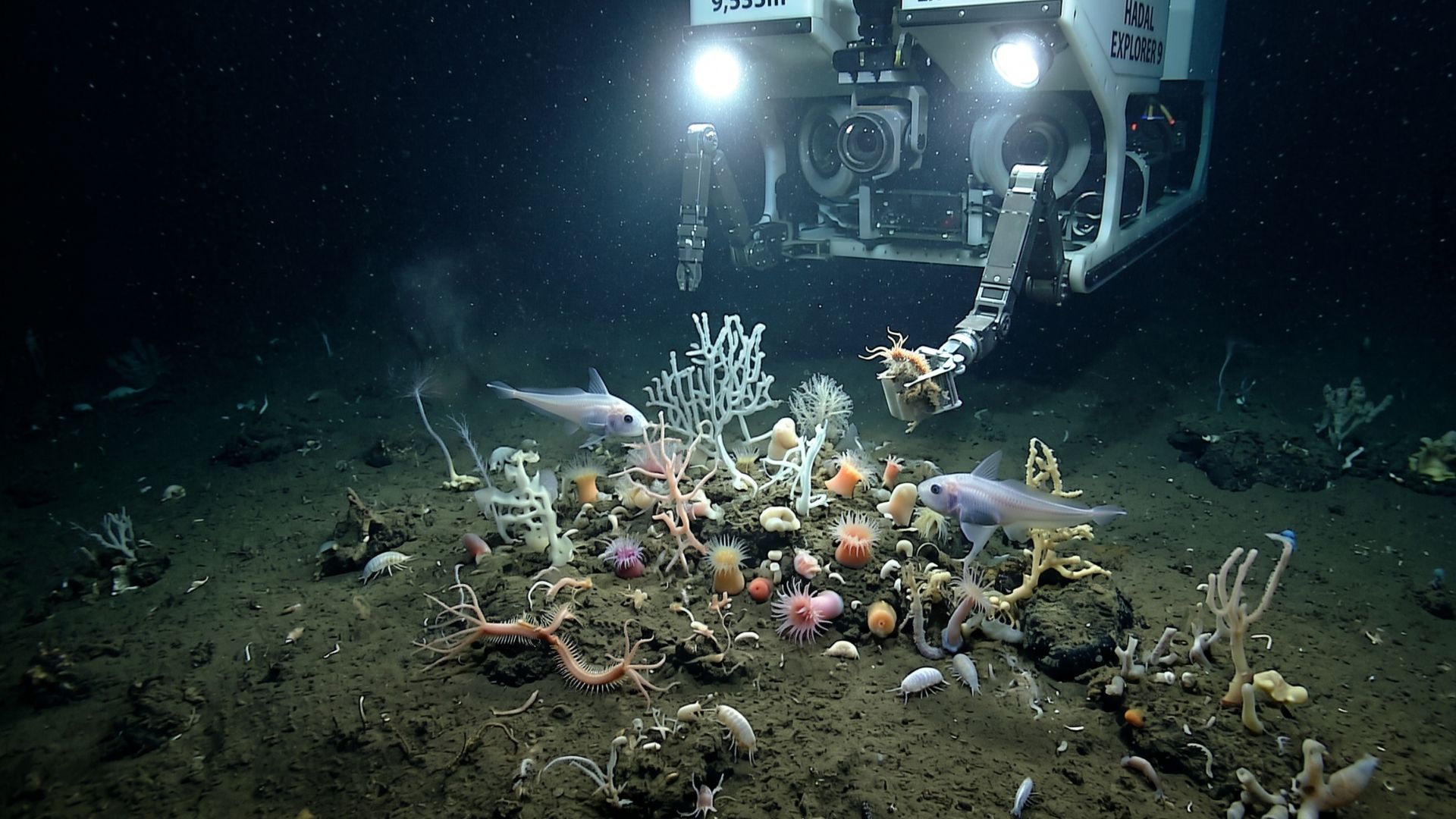
Study reveals complex life at 9,533 meters in the Kuril-Kamchatka Trench and describes the deepest animal ecosystem ever documented on the planet.
According to Nature, geochemist Mengran Du, a researcher at the Institute of Deep-Sea Science of the Chinese Academy of Sciences, was in the final phase of a diving mission in the Kuril-Kamchatka Trench when she used the final 30 minutes of the submersible’s operation to explore an unexamined section of the ocean floor. What she found at a depth of 9,533 meters was described by her with a single word: unbelievable.
The study, co-led by Du and Russian researcher Vladimir Mordukhovich, was published in the journal Nature on July 30, 2025 and revealed communities of complex life distributed over 2,500 kilometers along two Pacific trenches, between 5,800 and 9,533 meters deep. According to the work, this is the deepest animal ecosystem ever documented, in an environment with a pressure of about 1,000 atmospheres.
Hadal zone harbors complex life where science once saw a biological desert
The hadal zone, the name given to oceanic regions below 6,000 meters, has always been seen as one of the most hostile environments on Earth. There is no sunlight, the temperature is just above freezing, and the pressure is so extreme that for decades many biologists doubted that forms of complex life could survive there.
-
In the World’s Most Densely Populated Desert, Families Dig Funnel-Shaped Underground Cisterns to Capture Rare Rainfall and Store Drinking Water for Up to Eight Months

-
Smart Glass Revolutionizes Privacy: Touch-Activated Opacity Transforms Windows into Connected Home Features with App and Voice Control

-
Young Innovators from Brazil Turn Discarded Plastic into Eco-Friendly Bricks Using Coconut Fiber, Offering a Sustainable Alternative for Construction
-
Brazilian Scientists Among Team Proposing to Turn Ocean Depths into Giant Gravity Battery Using Cargo Ships and Subsea Cranes





Until the late 1970s, the idea prevailed that the entire food chain ultimately depended on photosynthesis.
The discovery of hydrothermal vents in 1977 shook part of this concept by revealing organisms living off chemosynthesis, but these communities were at depths of 2,000 to 3,000 meters, well above the hadal zone. The region below 6,000 meters was still treated as an ecological void.
What the team found in the Kuril-Kamchatka Trench breaks this limit. Along 2,500 kilometers, researchers repeatedly recorded communities with tubeworms, clams, snails, and symbiotic bacteria, forming a true deep-sea life belt. These were not isolated pockets but a continuous ecological structure along the trench.
Tubeworms and mollusks survive at 9,533 meters using methane and chemosynthesis
The mechanism that sustains these organisms does not depend on sunlight but on chemosynthesis. Methane escapes through fissures in the trench floor, a result of geological processes in the marine subsoil. Specialized bacteria oxidize this methane and transform the released chemical energy into organic carbon, which serves as food for the ecosystem.

The tubeworms and clams found do not have a conventional digestive system. Instead, they harbor an organ called a trophosome, full of symbiotic bacteria responsible for chemosynthesis.
It is a relationship where the animal provides structure and access to the chemical environment, while the bacteria provide the necessary energy for survival.
The extreme depth imposes another challenge: the pressure of about 1,000 atmospheres. According to Mengran Du, analyses showed that these organisms developed specific cellular adaptations, especially in the cell membranes, which maintain the necessary fluidity for material exchange even under pressure that would destroy surface organisms.
Submersible Fendouzhe allowed exploration of Earth’s deepest animal ecosystem
The discovery was only possible thanks to the Fendouzhe, a Chinese manned submersible with certified capacity to dive more than 10,000 meters.
The vehicle is one of the few in the world capable of reaching the greatest depths of ocean trenches and took the team to an environment practically out of reach of direct science.

The crew chamber of the Fendouzhe is a titanium sphere with an internal diameter of about 2.1 meters, smaller than a queen-size bed. Three people remain confined there during dives of seven to ten hours, while using robotic arms and cameras to collect samples and record images of the ocean floor.
Mengran Du led 25 dives throughout the expedition and, according to the text, entered this trench 30 times on different missions.
Throughout the mapping, the repetition of the same biological communities along the trench confirmed that it was not an isolated occurrence, but a consistent and extensive ecological system.
Global deep-sea life corridor may connect Pacific trenches
The discovery in the Kuril-Kamchatka Trench led the team to propose an even larger hypothesis. In March 2026, Mengran Du concluded a joint expedition between China and Chile in the eastern Pacific, within an exploration program endorsed by the UN in June 2025.
The results of this new stage reinforced the idea of a global deep-sea life corridor, a connected network of chemosynthetic ecosystems distributed along the Pacific trenches. If the hypothesis is confirmed, these trenches will no longer be seen as deserts dotted with oases, but as a continuous ecological system, linked by deep currents that transport larvae and organic matter over thousands of kilometers.
This interpretation radically expands the understanding of life in extreme environments. What seemed to be absolute isolation may, in fact, be part of a deep and interconnected biological mesh in the largest ocean on the planet.
Discovery in the Kuril-Kamchatka Trench expands debate on life beyond Earth
The implications of the study go beyond oceanography. The existence of complex ecosystems fueled by chemistry, not sunlight, in an environment at 9,533 meters and under 1,000 atmospheres of pressure, expands the range of conditions in which life can exist.
The text relates this discovery to worlds like Europa, Jupiter’s moon, and Enceladus, Saturn’s moon, which have oceans beneath ice layers and possible geochemical activity at the bottom.
For a long time, the absence of sunlight was treated as a decisive obstacle for complex food chains, but Mengran Du’s work directly weakens this argument.
In other words, the discovery of the Earth’s deepest ecosystem not only changes marine biology. It also changes how science thinks about the habitability in hidden oceans of other bodies in the Solar System.
Mengran Du became a central name in science after revealing the deepest ecosystem ever seen
The impact of the discovery elevated Mengran Du to the center of international science. The magazine Nature included her among the 10 people who shaped science in 2025, alongside the creator of the artificial intelligence model DeepSeek.
In 2026, she also received the China’s May Fourth Youth Medal, one of the main honors awarded to young people in the country.

According to the text, the recognition rewards not only the study published in July 2025, but a trajectory of 12 years of deep-sea research, with more than 30 manned submersible dives.
The data reinforces that the discovery was not the result of pure chance, but of a long routine of exploration in one of the planet’s most extreme environments.
Even so, the decisive moment came from a simple choice: to use 30 extra minutes of diving to observe a section that no one had examined.
This decision revealed that the bottom of the Pacific trenches is not a biological void, but a dark forest, cold, compressed by extreme pressure and fueled by methane, almost 10 kilometers below the surface.


-

-

3 people reacted to this.