Portuguese
  Spanish


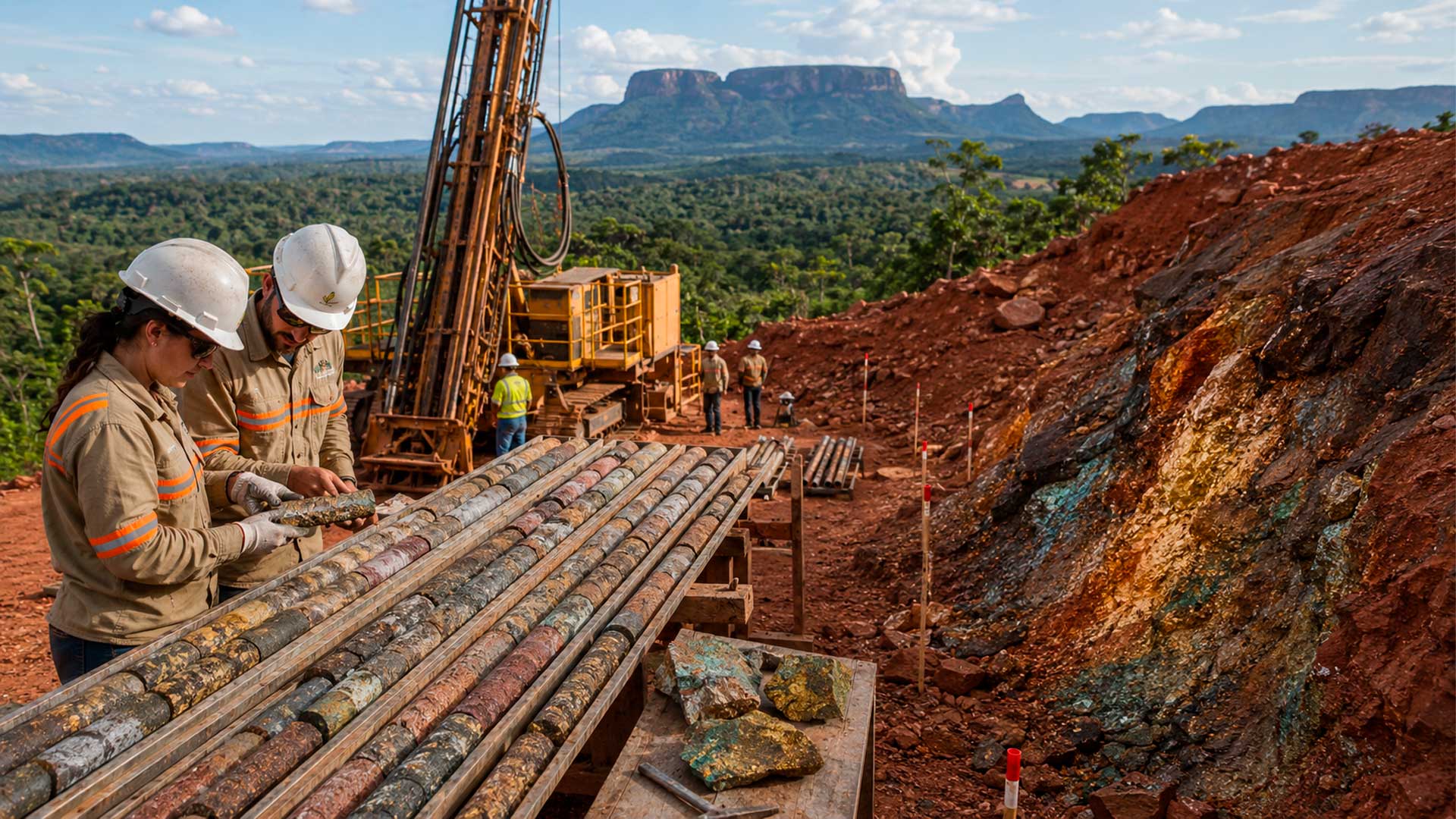


New drillings indicated that the Furnas mineralization continues in depth and along the deposit, expanding the potential of a project estimated at US$ 1.3 billion in Pará
The Canadian mining company Ero Copper confirmed, in June 2026, new extensions of copper, gold, and silver in the Furnas Project, developed in partnership with Vale Base Metals in the Carajás Mineral Province, in Pará. The results came from a new round of analyses involving approximately 24 thousand meters of exploratory drillings.
The drillings crossed mineralized zones beyond the limits used in the current resource estimate. In some points, the company found ore hundreds of meters below the already known areas, while other holes expanded laterally the southeast zone of the deposit.
The update increases interest in Furnas because the project already has a preliminary economic assessment that foresees an initial lifespan of 24 years and an average annual production of approximately 108 thousand tons of copper equivalent during the first 15 years.
-
Ancient Mines in Spain Reveal Tools and Metals That May Explain Bronze Age Trade with Scandinavia

-
XCMG Launches 240-Ton Mining Truck in Brazil, Promising Increased Productivity with Lower Fuel Consumption
-
Canadian Investment Transforms Remote Brazilian Amazon Town into Copper Hub for Global Electric Vehicle and AI Data Center Markets

-
Brazilian Company in Minas Gerais Innovates by Using Electric Currents to Extract Critical Metals from Industrial Waste


This, however, does not mean that a new mine is ready to start operating. The enterprise continues in the stages of drilling, technical studies, environmental licensing, and economic evaluation, processes that can still alter costs, production, dimensions, and even the final decision to build.
Drillings reveal ore beyond the already known limits
According to a statement from Ero Copper released on June 10, 2026, more than 75 thousand meters of drillings had been completed in Furnas by the end of May. The company had laboratory results for about 52 thousand meters and maintained ten drills working simultaneously on the project.
One of the main results occurred in the southeast zone. The hole identified as FURN-DD-00357 crossed an interval of 90 meters with an average grade of 0.74% copper, 0.50 grams of gold, and 3.18 grams of silver per ton, expanding by approximately 115 meters the known limit of the mineralization in that direction.
Another relevant result appeared in the so-called central zone, located between the mineralized corridors of the southeast and northwest. A drilling found 41 meters with 0.94% copper and 0.44 grams of gold per ton, approximately 220 meters below the current resource estimate and more than 1.1 kilometers west of the main high-grade area of the southeast zone.
What the found grades really mean
When a mining company reports a 90-meter interval with 0.74% copper, it means that samples from that section showed, on average, about 7.4 kilograms of copper for each ton of rock. This number does not yet consider all the losses that may occur during extraction and processing.
Gold appears in much smaller quantities, measured in grams per ton. Even so, it can contribute significantly to financial viability because it has high value and can be marketed as a byproduct of copper concentrate.
The results are also presented in copper equivalent, or CuEq. This indicator converts the estimated value of gold and silver into a comparable amount of copper, using metal prices and forecasted industrial recovery rates.
Therefore, 108 thousand tons of copper equivalent do not represent 108 thousand tons of metallic copper. It is an economic measure that combines the value of the different metals projected in the project.
The intervals found by the drills should also not be automatically confused with blocks ready for mining. Before that, the data needs to be incorporated into geological models, classified by confidence level, and analyzed in engineering studies.
Furnas can combine open-pit and underground mines
According to information published by CNN Brazil in February 2026, the first preliminary economic assessment of Furnas projected an average annual production of approximately 70 thousand tons of copper, 111 thousand ounces of gold, and 532 thousand ounces of silver during the first 15 years. Economically combined, these metals would correspond to the 108 thousand annual tons of copper equivalent.
The initial investment was calculated at about US$ 1.3 billion. The study estimated a net present value, after taxes, close to US$ 2 billion and an internal rate of return of 27%, considering long-term prices set by the company for copper, gold, and silver.
The initial plan foresees a combination of open-pit mines and two underground mines in the southeast and northwest zones. The ore would be sent to a central processing facility with a projected capacity to process 13.5 million tons per year.
The assessment also includes inferred mineral resources, a category that presents greater geological uncertainty. For this reason, the volumes presented are not proven mineral reserves and there is no guarantee that the projected financial or productive results will be achieved.
Agreement may deliver 60% of the project to Ero
The partnership was formalized in July 2024 through an agreement that allows Ero to acquire a 60% stake in Furnas. For this, the mining company needs to finance and complete exploration, engineering, and development programs defined in the contract with Vale Base Metals.
The company reported that it intends to complete the three contractual drilling programs by the end of 2026, approximately two years ahead of the originally established deadline. Once the technical obligations are fulfilled, the planned structure is 60% for Ero and 40% for Vale Base Metals.
Furnas occupies an approximate area of 2,400 hectares and is located about 70 kilometers southeast of Salobo operations. The land is close to paved roads, a power substation, a cement industrial unit, and railway infrastructure, factors that may reduce the need to build entirely new structures.
Carajás concentrates almost all Brazilian copper reserves
The importance of the project increases when considering Pará’s position in national mining. According to the 2025 Mineral Summary by the National Mining Agency, the state concentrates approximately 95.5% of Brazil’s proven and probable copper reserves.
Brazil produced about 384 thousand tons of contained copper in 2024, equivalent to 1.7% of the world’s production that year. Pará, Goiás, Bahia, Alagoas, and Mato Grosso emerged as the main producing states.
In February 2025, Vale announced R$ 70 billion in investments for the Novo Carajás Program between 2025 and 2030. The broader strategy foresees a 32% expansion in the company’s copper production in the region, reaching approximately 350 thousand tons annually, although this does not mean that all this investment is destined for Furnas.
The interest in the metal is also related to the expansion of electrical networks, renewable energies, electric vehicles, civil construction, and electronic equipment. The International Energy Agency estimates that, considering only the projects already announced, the global copper supply could be about 30% below the projected demand for 2035.
Licensing and studies will still decide the future of the mine
Ero intends to submit the Furnas Preliminary License application by the end of 2026. This stage is important to assess the location, environmental feasibility, and conditions that must be met before the following phases.
The pre-feasibility study is scheduled for 2027. It should deepen cost calculations, extraction methods, infrastructure, schedule, metal recovery, and the amount of resources that can be converted to more reliable geological categories.
Simultaneously, metallurgical tests, geotechnical drilling, hydrogeological studies, and environmental surveys are being conducted. The company has already obtained authorizations related to exploratory activities, such as fauna management, water use, and vegetation suppression, but these permissions do not equate to authorization to build and operate the future mine.
One of the alternatives studied is to use magnetic separation in the flotation process tailings. The technique could generate a magnetite concentrate with high iron content and, at the same time, reduce the final amount of tailings, if the solution is proven technically and economically viable.
The expansion of Furnas could strengthen Brazilian production of strategic minerals and boost jobs, services, revenue, and suppliers in Pará. At the same time, the size of the enterprise will require oversight, transparency, and rigorous measures to protect water resources, communities, and ecosystems in Carajás.