Portuguese
  Spanish


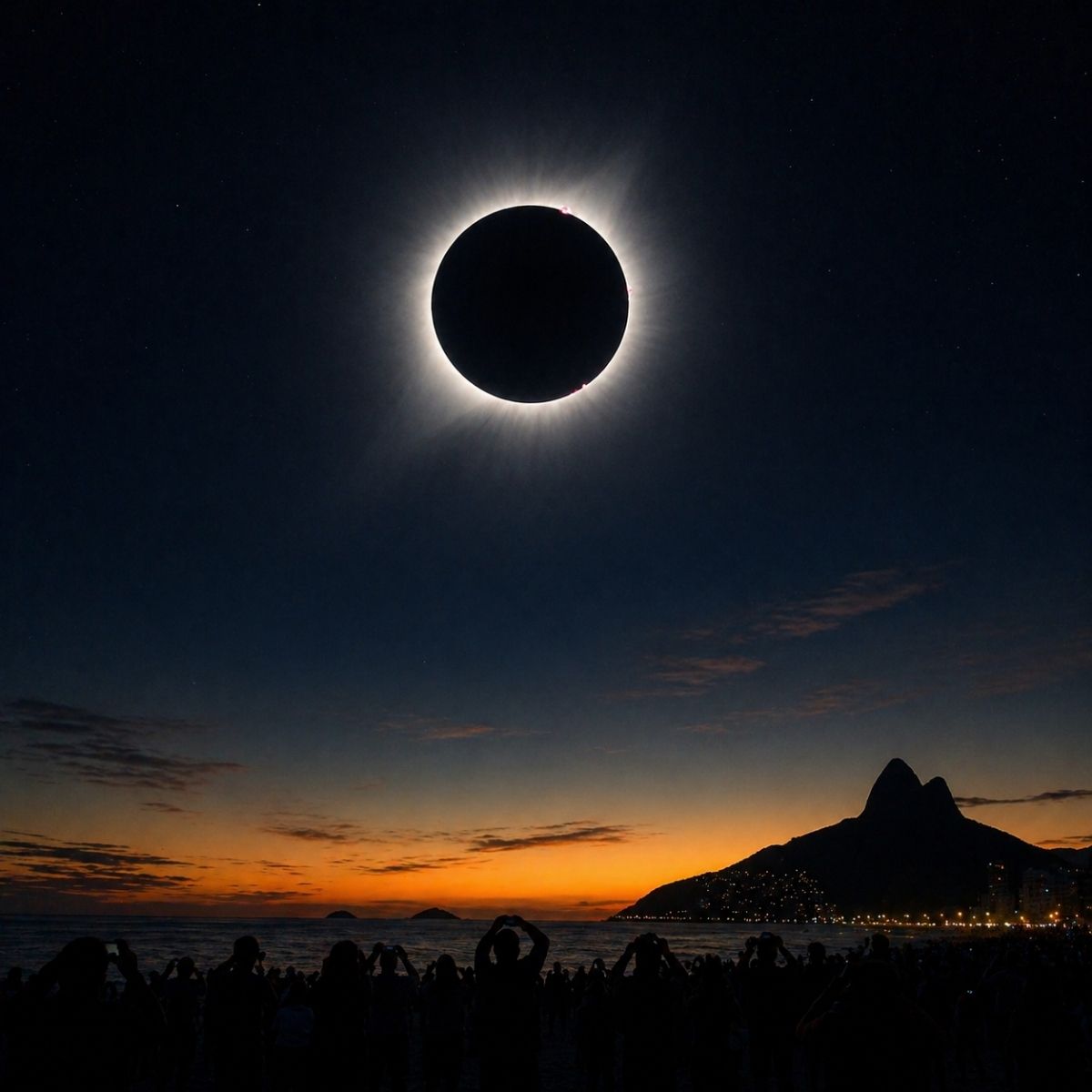

The solar eclipse of August 2, 2027 will have up to 6 minutes and 23 seconds of totality when the Moon will completely block the Sun, plunging regions of Greenland, Iceland, Spain, and the Middle East into darkness that allows stars to be seen in broad daylight, a phenomenon that will not be repeated for 157 years.
The longest eclipse humanity will see this century already has a date and time to turn day into night for more than six consecutive minutes. On August 2, 2027, the Moon will position itself between the Earth and the Sun with such precise alignment that it will completely block sunlight for up to 6 minutes and 23 seconds, an exceptional interval that makes this eclipse the longest since modern astronomical records have been kept and one that will not be repeated with similar characteristics for approximately 157 years. During the peak of the phenomenon, specific regions of the planet between Greenland, Spain, and the Middle East will experience complete darkness in the middle of the afternoon, a condition that will allow stars, planets, and visual effects such as Baily’s Beads and the Diamond Ring to be seen with the naked eye.
The rarity of the 2027 eclipse is not only in its duration but in the combination of astronomical factors that produce it. For the totality phase to exceed six minutes, the alignment between the Sun, Moon, and Earth needs to achieve a geometry that occurs with infinitesimal frequency: the Moon must be at the right distance from Earth to completely cover the solar disk, Earth needs to be in the proper orbital position, and the shadow path must cross locations where observers can record the phenomenon. When all these elements converge, the result is an eclipse that marks generations and that astronomers worldwide prepare to document years in advance.
What will happen in the sky during the 2027 eclipse

The totality phase is the moment when the eclipse reveals a spectacle impossible to reproduce under any other circumstances. When the Moon completely covers the solar disk, the sky abruptly darkens and the temperature drops noticeably, creating a sensation of sudden dusk that confuses animals and alters the behavior of birds and insects that respond to the darkness as if night had fallen. In this interval of up to 6 minutes and 23 seconds, well-positioned observers can see the solar corona, a halo of superheated plasma that is normally invisible because the brightness of the solar disk obscures it, but which during the eclipse appears as a luminous aureole around the dark silhouette of the Moon.
-
Dog Walker in English Forest Uncovers 3,400-Year-Old Bronze Age Axe

-
Texas Blackout Inspires Student to Develop Bionic Leaf Catalyst for Converting Sunlight, Water, and Bacteria into Fuel

-
Brazilian Students Develop Process to Turn Styrofoam Waste into Water-Purifying Charcoal

-
Study Warns: Wi-Fi Routers Can Act as Invisible Radars, Identifying People with 99.5% Accuracy Without Cameras or Wearable Devices



The most anticipated visual effects of the eclipse are Baily’s Beads and the Diamond Ring. Baily’s Beads appear in the moments preceding and succeeding totality, when solar rays pass through valleys and craters on the irregular surface of the Moon and create bright points along the edge of the lunar disk, like pearls strung on a cosmic jewel. The Diamond Ring appears when only one point of sunlight remains visible on the Moon’s edge, creating an effect resembling a ring with a sparkling precious stone in the darkened sky. Both phenomena last seconds and are considered the most photogenic moments of any eclipse.
Where it will be possible to observe the eclipse in its totality
The path of total visibility for the 2027 eclipse will be narrow and will cross specific regions of the globe. The Moon’s shadow will travel a path that passes through Greenland, Iceland, Spain and part of the Iberian Peninsula, North Africa, and the Middle East, locations where observers positioned within this path will experience the full 6 minutes and 23 seconds of darkness. Outside this zone, the eclipse will be partially visible with intensity decreasing with distance from the central axis of the shadow, meaning that residents of other regions of Europe and Africa will see the Sun partially covered but without the transformative experience of totality.
For those planning to travel to the path of totality, Spain is highlighted as the most accessible destination. The Iberian Peninsula combines consolidated tourist infrastructure, a climate with a high probability of clear skies in August, and a geographical position that allows observers to experience the eclipse without facing the logistical difficulties of destinations such as Greenland or remote regions of North Africa. Spanish cities along the path of totality are already beginning to prepare to receive thousands of astronomical tourists who are expected to fill hotels and observation points, a movement that transforms the eclipse into an economic as well as a scientific event.
Why this eclipse is the rarest in the next 157 years
The duration of 6 minutes and 23 seconds is what sets the 2027 eclipse apart from all others predicted for the rest of the century and beyond. Most total solar eclipses have a totality phase that ranges between two and four minutes, and exceeding the six-minute mark requires such specific orbital conditions that celestial mechanics will not reproduce them with comparable characteristics until the mid-22nd century. This means that no one alive today will have another opportunity to witness an eclipse of this duration: the 2027 eclipse is a unique experience for the entire current generation.
The alignment that produces such a long eclipse depends on variables that rarely combine. The distance between the Moon and Earth varies along the lunar orbit, and when the Moon is closer, it casts a larger shadow that covers a more extensive area of the Earth’s surface for a longer time; the Earth’s orbital speed and axial tilt also influence the duration, and when all these factors converge in the ideal configuration, the result is a prolonged totality that astronomers classify as exceptional. The 2027 eclipse brings together this rare convergence, and every minute of the 6 minutes and 23 seconds is a product of cosmic geometry that will not be easily repeated.
How to observe the 2027 eclipse without harming your vision
Excitement about the eclipse should not make anyone forget that looking directly at the Sun without protection causes permanent eye damage. Experts and NASA recommend the use of certified eclipse viewing glasses during all phases of the phenomenon, except at the exact moment of totality when the solar disk is completely covered and the corona can be observed without risk. Protection is necessary both in the partial phases that precede totality and in those that follow it, because even a partially covered sun emits enough radiation to irreversibly burn the retina in a few seconds of direct exposure.
Improvised solar filters such as X-rays, ordinary sunglasses, or darkened glass do not offer adequate protection for observing the eclipse. Only equipment with ISO 12312-2 certification guarantees sufficient solar radiation filtering, and the advice is to acquire these filters in advance because demand in the months leading up to an eclipse of this magnitude tends to deplete available stock. For those who cannot obtain certified filters, the safest alternative is to watch the eclipse via live broadcasts that observatories and space agencies will provide in real-time, an experience that does not compare to being there in person but preserves the vision of those who cannot take the risk.
What comes after the 2027 eclipse in the astronomical calendar
Even if the 2027 eclipse is unrepeatable on the scale of a human lifetime, other astronomical phenomena are predicted for the following years. A partial eclipse is scheduled for January 26, 2028, an event that will offer incomplete coverage of the solar disk and will be visible from regions different from those that will witness totality in 2027. None of these subsequent phenomena, however, will have the duration or visual impact of the century’s longest eclipse, which will remain a benchmark for comparison with any similar astronomical event for decades to come.
The 2027 eclipse will mark an entire generation of observers. Anyone positioned in the path of totality on August 2nd and experiencing the 6 minutes and 23 seconds of darkness with stars shining in the afternoon sky will tell this story for the rest of their lives, because the next person to witness something equivalent has not yet been born and will only be able to do so in 157 years. Astronomy rarely offers such definitive timelines, and this is one of them.
And you, do you plan to follow the 2027 eclipse? Have you thought about traveling to the path of totality? Leave your opinion in the comments.