Portuguese
  Spanish


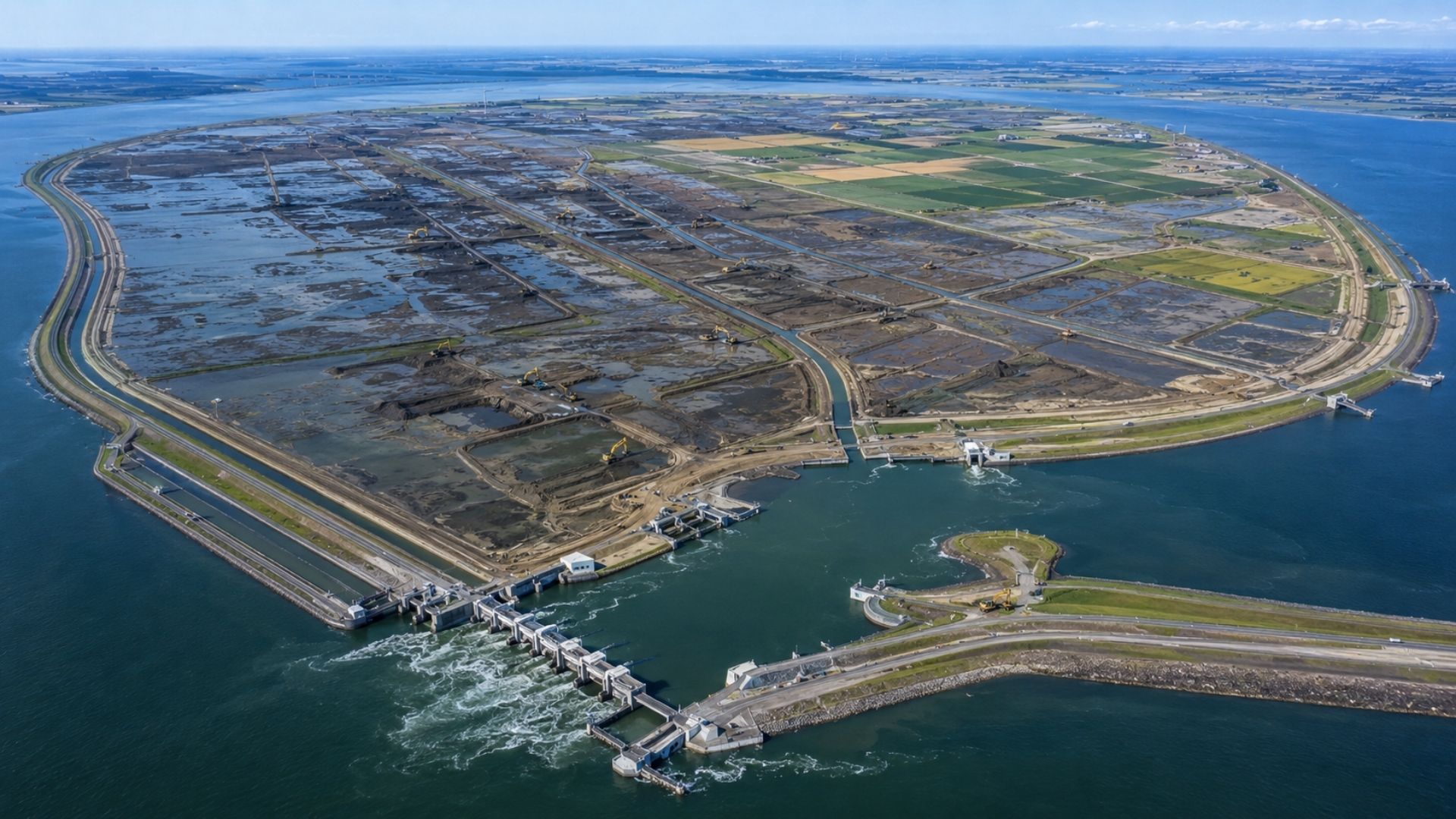

Flevopolder, in the Netherlands, is the largest artificial island in the world: 970.5 km² raised over the former Zuiderzee sea. As a result of the largest drainage project ever undertaken, it became a Dutch province in 1986 and hosts entire cities living several meters below sea level.
There is a place in the north of Europe where the solid ground was actually taken from the bottom of the sea. According to the Guinness World Records, the largest artificial island in the world is Flevopolder, in the Netherlands, with an impressive 970.5 km², almost a thousand square kilometers of land that, a century ago, was still submerged.
According to Guinness, this artificial island was born from the gigantic Zuiderzee system, a combination of dams, dikes, landfills, and drainage executed between 1919 and 1986. Now completely surrounded by freshwater lakes, Flevopolder is proof that, with enough engineering, it is possible to literally create land where there was only water.
The largest artificial island in the world
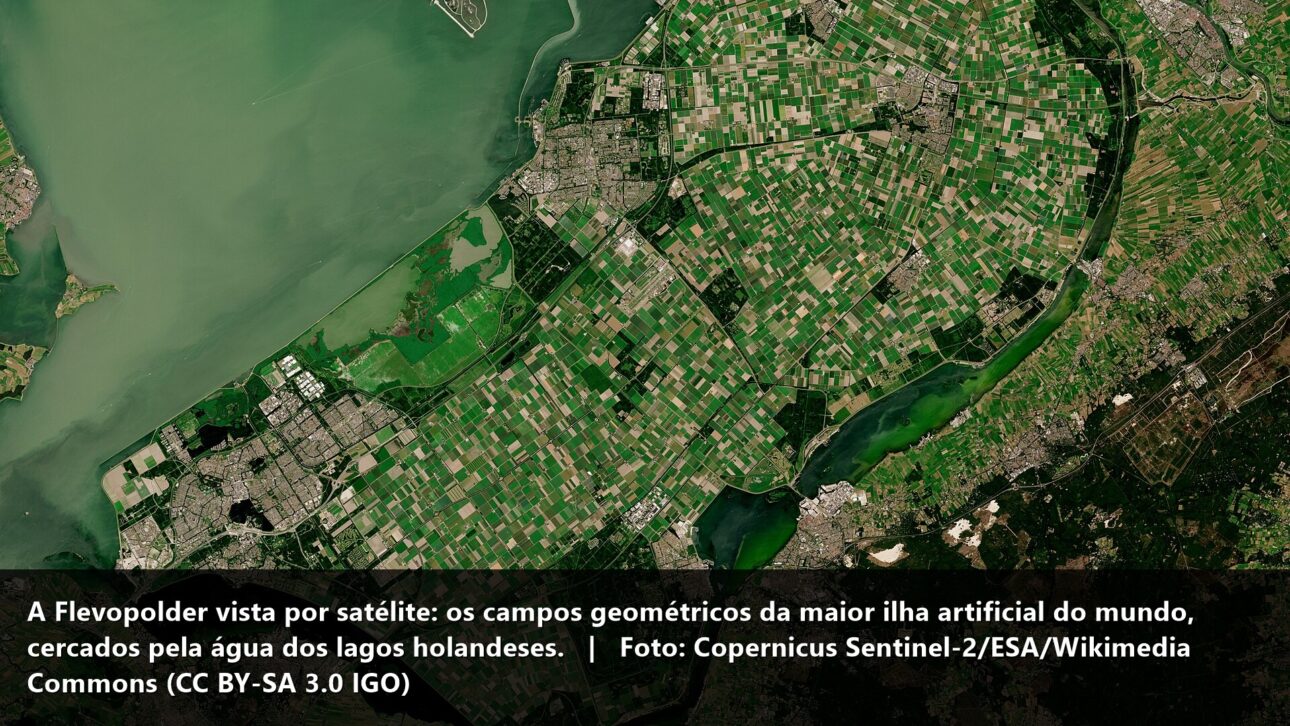
The numbers help to understand the feat. With 970.5 km², Flevopolder is by far the largest artificial island ever built, completely surrounded by the Gooimeer, Ketelmeer, and Veluwemeer lakes. It is not just any piece of land in the middle of the water: it is an entire province that humans designed, drained, and raised, in one of the most daring episodes of Dutch engineering.
-
It seems fragile, but a 38-meter sphere for a thousand people rests on four mega-columns and uses eight isolators to reduce the force of earthquakes.

-
Farmers removed volcanic stones from the fields, stacked 22,000 kilometers of mortarless walls, and created a barrier that allows air to pass through, reduces erosion, and protects crops for over a thousand years.
-
Instead of gradually digging a tunnel under a busy railway, engineers built a 155-meter curved structure next to the tracks and pushed 11,000 tons of concrete at just 1.5 meters per hour.
-
They lived four people in an eight-square-meter van until a new pregnancy gave them a nine-month deadline: the 20-square-meter tiny house they built fits two bedrooms, a kitchen, and a living room in a carpentry puzzle.


And it’s not an empty desert. The island hosts cities like Lelystad and Almere and a population of over 400,000 inhabitants, many of whom live several meters below sea level, protected by dikes. On January 1, 1986, this newly created land officially became Flevoland, the 12th and youngest province of the Netherlands.
An inland sea that killed thousands
To understand why someone would drain a sea, one must go back to the problem. The old Zuiderzee, an open bay to the North Sea, was a constant threat: coastal storms caused increasingly frequent floods and killed thousands of people over the centuries. Taming that water ceased to be an ambition and became a matter of survival.
According to information released by euronews and Guinness portals, this is where engineer Cornelis Lely came in, who gained immortal fame with his plans in 1891 to drain the Zuiderzee. The idea was so grand that it became law: on June 14, 1918, the Official Gazette announced the Zuiderzee Closure and Drainage Act, the starting shot for what is remembered as “the greatest land reclamation project of all time”.
Closing the sea with a dike in the middle of the water

The recovery of the future artificial island began in 1924, with the closure of the Amsteldiepdijk, a 2.5-kilometer dike between North Holland and the island of Wieringen.
It was just the warm-up for the work that seemed impossible: to erect a giant dike in the middle of the open sea, the Afsluitdijk.
Against all doubts, it worked. In 1932, the Afsluitdijk was completed and transformed the inland sea Zuiderzee into the freshwater lake IJsselmeer.
By replacing saltwater with a controlled lake, the Dutch created the conditions for the next and most audacious stage of the plan: to dry the seabed and transform it into habitable land.
The day the island of Urk ceased to exist
The first large piece of land to emerge was the Noordoostpolder, and its completion even had a symbolic date and scene.
On October 3, 1939, the mayors of Urk and Lemsterland shook hands exactly where the last breach of the dike had just been closed. At that moment, the former island of Urk ceased to be surrounded by water and became part of the mainland.
The symbolism was enormous, but the work continued even in dark times. The Noordoostpolder was officially declared dry on September 9, 1942, in the midst of World War II a reminder that while the world burned, the Dutch continued to steal land from the sea, meter by meter.
New land for an overcrowded Netherlands
With the technique mastered, came the economic and social reason to continue. The Randstad region, in the west of the country, was becoming increasingly crowded, and accelerated urbanization demanded space for housing and leisure. The obvious answer was to use the land that was being created from scratch in the former Zuiderzee.
Thus were born the two halves of the island itself. Eastern Flevoland was completed in 1957 and Southern Flevoland in 1968, completing the Flevopolder. Less than two decades later, in 1986, all this territory risen from the water gained the status of a province, something no other “invented land” had achieved.
Living below sea level
Living on the largest artificial island in the world has a peculiarity that scares outsiders: a good part of the soil is below sea level, and it is only thanks to the dikes and a constant pumping system that everything remains dry. Just one oversight in this mechanism and the water could reclaim what was once its own.
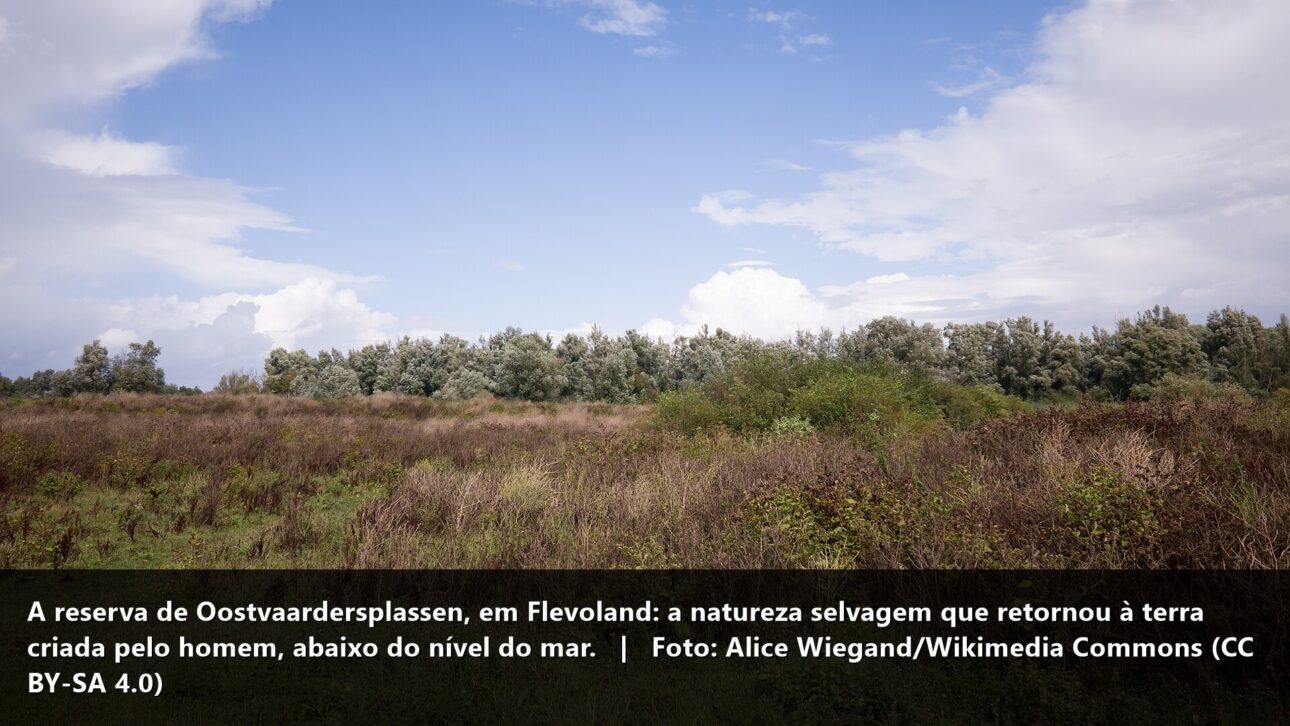
Curiously, this artificial land also became a refuge for wildlife. Areas like the Oostvaardersplassen reserve show how a ground completely planned by humans can, over time, be reclaimed by nature. The Flevopolder is, at the same time, an engineering triumph and a living experiment on the relationship between people, water, and territory a balance that needs to be maintained every day.
And you, would you live on an artificial island below sea level?


A sea closed by a dike, almost a thousand square kilometers drained, and an entire province built on the former ocean floor: the Flevopolder is the most extreme proof that the Netherlands does not wait for land, it manufactures it.
Would you have the courage to live on an artificial island several meters below sea level, relying on dikes and pumps? And do you think such projects are the future in the face of the lack of space in cities? Leave your opinion in the comments.