






 Portuguese
  Spanish


Researchers from UFRN and IFPB replaced water with manipueira, the effluent that poisons rivers with cyanide, and patented a soil-cement brick within Brazilian standards at INPI
The manipueira brick seems like a contradiction: taking the most feared liquid from the flour houses of the Northeast, the one that kills fish and contaminates groundwater, and using exactly this poison to mold a construction block. This is what researchers from the Federal University of Rio Grande do Norte (UFRN) did in partnership with the Federal Institute of Paraíba (IFPB), who replaced the water in the formula with manipueira and secured a patent at INPI.
The result is a brick where water is replaced, partially or completely, by manipueira, with compressive strength above 2 MPa and water absorption below 20%. In other words, the effluent that was discarded as waste has become the liquid ingredient of a construction material approved under ABNT technical standards.
From river poison to construction material
For decades, manipueira was treated as the valueless byproduct of flour and starch. Each flour house in the countryside separated the roots, pressed the mass, and let the milky liquid drain into the backyard, ditch, or directly into the nearest stream. What Brazilian civil engineering has just shown is that this same liquid can become the base of a quality-standardized brick.
-
Brazil’s Busiest Port to Triple Soybean Loading Speed with $1.1 Billion Investment in Paraná Terminal, Reaching 8,000 Tons per Hour

-
Cost of Installing Subflooring in 2026: The Importance of Proper Slope to Prevent Water Damage and Costly Repairs
-
New Offshore Borehole Mining Technique Extracts Lithium and Cobalt Without Damaging Ocean Floor
-
Vale Doubles Copper Drilling in Brazil’s Carajás, Plans to Drill 120 Kilometers of Rock by 2026


The shift is conceptual before it is technical. Instead of asking how to treat and neutralize the effluent before disposing of it, researchers asked if it could enter the production process as a raw material. The answer was yes, and it shifts manipueira from the list of environmental liabilities to the list of inputs.
According to Por Dentro do RN, the product was developed within UFRN’s postgraduate programs and resulted in prototyping on a laboratory and semi-industrial scale. It is not a loose bench idea: the blocks were subjected to mechanical resistance, absorption, and durability tests before any announcement.
What is manipueira and why it haunts the countryside
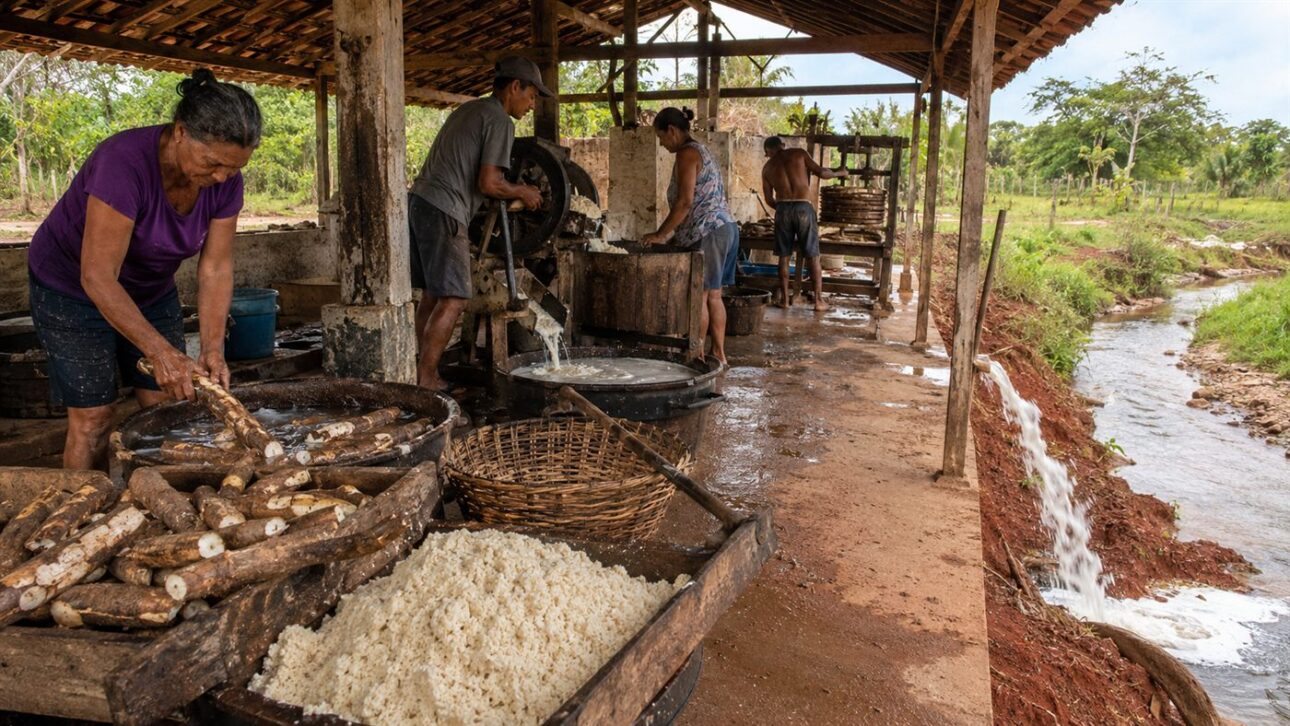
To understand the magnitude of the problem being solved, one must look at the numbers of cassava effluent. For every ton of root processed, a flour house generates 300 to 600 liters of manipueira, a volume that quickly multiplies in regions where cassava is the backbone of the rural economy.
The liquid is not only abundant, it is aggressive. Manipueira contains a very high organic load and a real poison within it. According to Sebrae, the effluent carries cyanogenic glycosides like linamarin, which transform into cyanide, in addition to a Biochemical Oxygen Demand that can reach thousands of milligrams per liter. When it falls into the river, it consumes the oxygen in the water, suffocates aquatic life, and threatens supply.
This is why manipueira is, at the same time, a sanitary, environmental, and economic problem in the hinterland. It forces the small producer to live with a toxic residue that has nowhere to go, in a cycle that has been repeated for generations in thousands of flour houses spread across the Northeast and other producing regions.
How the manipueira brick is made
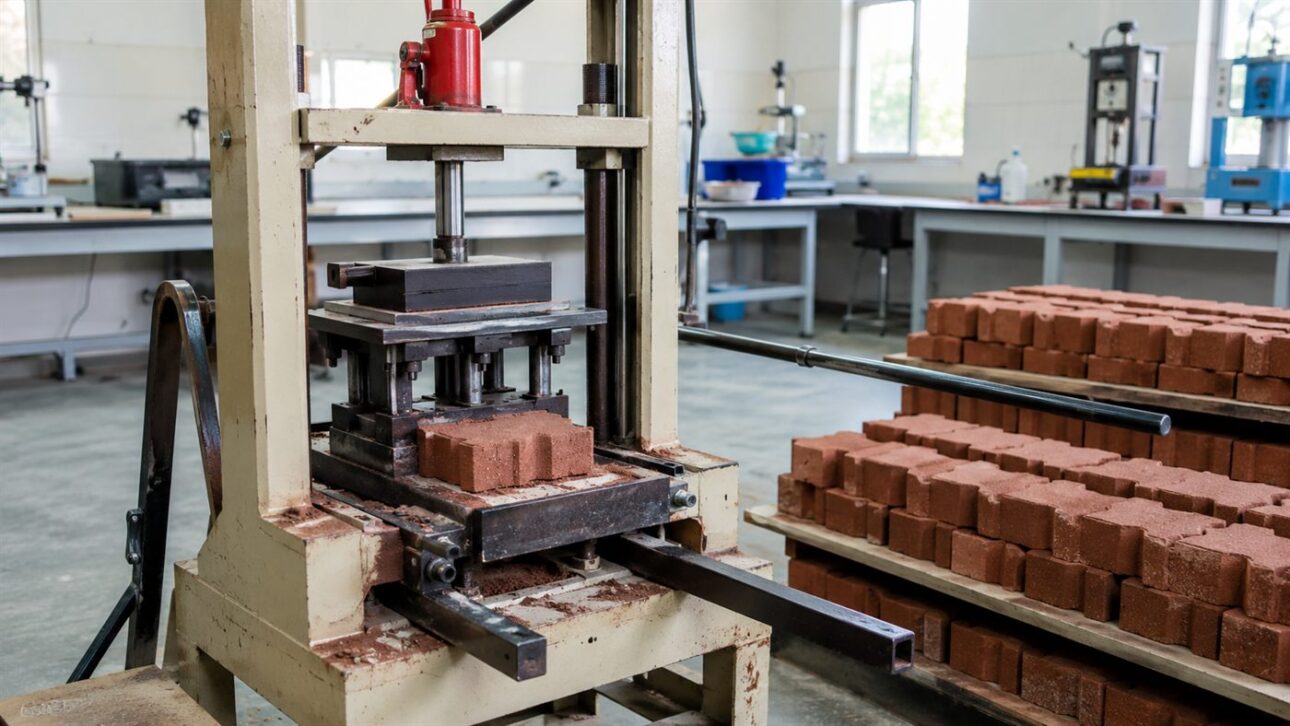
The engineering behind the manipueira brick is elegant precisely because it is simple. The base remains soil-cement, the same established technology of the pressed ecological brick, made from selected earth and Portland cement and cured without firing in a kiln. The difference is in the mixing liquid.
In the traditional process, the soil and cement powder is moistened with water to the point of pressing. In the patented version, this water is replaced by manipueira, partially or totally. The soil is classified by the HRB-AASHTO system, Portland cement acts as a binder, and the organic effluent takes the role that was previously clean water.
The most surprising detail of the tests is that blocks made only with soil and manipueira, without cement, achieved results similar to conventional mixtures of soil, cement, and water. This suggests that the organic matter in the effluent interacts with the block’s structure in a way that aids performance, something still being studied in depth, but which opens a huge door to reduce cement consumption, the most expensive and most polluting item in the recipe.
The numbers that made the block pass in ABNT
It would be pointless to reuse the effluent if the brick didn’t stand upright. That’s why performance numbers are the heart of the story. The formulations showed compressive strength greater than 2 MPa, water absorption less than 20%, and mass loss less than 7% in durability tests.
These three indicators are not random. They are exactly the parameters required by the ABNT NBR 8491 and ABNT NBR 13553 standards, which govern soil-cement bricks and blocks in Brazil. Exceeding the minimum required by the standard is what separates an academic curiosity from a material that can, in fact, go on the wall of a house.
Being within the standard is also the key to commercial viability. A standardized block can be specified by engineers, accepted in projects, and, in the future, compete for space in public housing purchases, something unthinkable for an informal product without a technical report.
The patent at INPI and who is behind it
Official recognition came with the patent granted by the National Institute of Industrial Property (INPI), which protects the manufacture of solid or hollow bricks with the substitution of water by cassava wastewater. Registering the innovation is a strategic step: it ensures that the technology born in Brazil has an owner, can be licensed, and reaches the market in an organized manner.
The work has a name and surname. The research was conducted by Jônatas Macêdo de Souza, under the guidance of Professor Wilson Acchar, a reference in ceramic materials, with the collaboration of researchers Luciana Lucena, Vamberto Monteiro, and Sóstenes Rêgo. It is the science of public universities transforming a local problem into national intellectual property.
The choice to patent, instead of simply publishing, shows the intention to take the cassava wastewater brick beyond the scientific article. The stated goal is to advance from the bench to field validation and then to industrial-scale production.
Why this matters for Brazil
Brazil is among the largest producers of cassava in the world, and the root supports the flour, starch, and tapioca that are part of the country’s diet. This prominence has a hidden cost: the more flour, the more cassava wastewater, and the more pressure on the interior rivers.
This is where innovation gains a dimension that goes far beyond the construction site. A brick that consumes cassava wastewater transforms each flour house into a potential supplier of raw material, instead of a source of pollution. The same liter of effluent that is currently dumped into the stream could, tomorrow, be binding the wall of a low-income house in the semi-arid region.
The fit with the reality of the hinterland is almost perfect. The raw material is abundant and cheap, production does not require a kiln or high energy consumption, and the effluent is already there, next to the flour factory. It is a solution designed from the inside out, based on the resources and problems that already exist in the region.
Sustainable construction and a new cycle for waste
The manipueira brick fits into a larger wave of sustainable construction that bets on transforming waste into materials. Ashes, rubble, plastic, tire rubber, and now agricultural effluent: the logic of the circular economy is making a strong impact on the sector that consumes the most natural resources in the world.
The specific advantage of this case is tackling two problems with one stroke. On one hand, it reduces pollution from manipueira, which overloads rivers and forces producers to deal with a toxic liability. On the other, it offers a low-cost, low-emission building material, made without burning, for a population in need of decent housing. Few innovations manage to be both sanitation and housing at the same time.
The challenges up to your wall
None of this means that the brick is already for sale at the corner store. The team itself acknowledges that the project is in the phase of refinement and field validation, a stage considered necessary before commercial and industrial application. It is the always delicate interval between the laboratory and the market.
There are legitimate questions to answer: how to standardize the manipueira, which changes with each type of cassava and each flour house process? How to transport and store a perishable effluent without it fermenting? What is the real durability of the block after years exposed to the weather? These are engineering and logistics challenges, not conceptual ones.
Even so, the direction is set. A waste that only caused headaches has gained a patent, a report within the standard, and a clear path to becoming a product. If the manipueira that today flows into the river can one day raise walls, how many other poisons from our waste are just waiting for a good engineering idea to become a solution?


