Portuguese
  Spanish


New Chapter Of The Judicial Battle
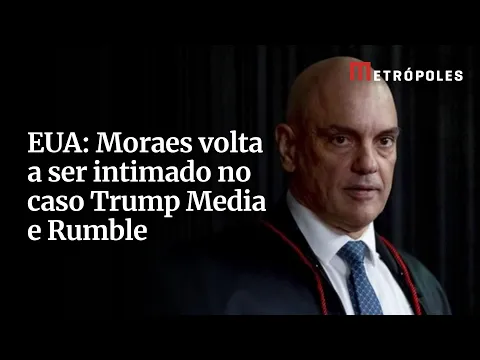
In yet another move that reinforces the political and legal tension between Brazil and the United States, the U.S. Justice system summoned Alexandre de Moraes again in July 2025.
He is a minister of the Supreme Federal Court (STF).
This action directly stems from a case opened by former President Donald Trump.
Trump insists on questioning the conduct of foreign authorities during the Brazilian elections.
The basis is official documents from the case pending in the U.S. Supreme Court.
History Of Conflicts Strengthens Trump’s Strategy
To understand the scenario, it is essential to highlight that Donald Trump, since 2022, has been using U.S. courts as a platform to amplify his contestation narrative.
He questions electoral results outside the United States.
Although his claims have not been accepted in other arenas, in 2023, the first summons to Moraes signaled the beginning of this international strategy.
By March 2024, the Brazilian minister ignored the summons.
He stated that U.S. jurisdiction does not override Brazilian institutions.
Despite this, Trump remains politically active since his defeat in 2020.
He intensified the pressure in 2025 after announcing his candidacy for the 2026 U.S. presidential election.
Moraes Reacts And Points Out Unconstitutionality
On the other hand, Moraes remains firm in his stance.
Since April 2025, when rumors of a new summons arose, the minister made it clear in an STF statement that he does not recognize its validity.
He does not accept a foreign summons without diplomatic backing.
Brazilian jurists, such as Professor Vera Chemim, an expert in constitutional law, emphasized this in interviews.
They explained that this type of action violates principles of national sovereignty and independence among nations.
Even with the progress of the process in the U.S., the Supreme Court is not expected to comply with the request.
There will be no compliance without a formal legal cooperation agreement.
-
European Parliament Approves Digital Euro, Aiming to Challenge Visa and Mastercard’s Dominance and Transform Payments Across Europe by 2029

-
Israel finds Hezbollah militarized tunnel over 200 meters long under village, with 4 missile launch shafts, 12 chambers, anti-tank missiles, drones, and weapons depots at a depth of 25 meters.

-
Ukraine launches largest drone attack on Moscow since 2022, Russia claims to have intercepted nearly 200 aircraft near the capital, Kapotnya refinery targeted again, and offensive reignites alert about war reaching the Russian energy heart just a few kilometers from the Kremlin.

-
Truck drivers, freight, and fines from 2022 take center stage in politics: Chamber approves MP with amnesty, mandatory tracking by CIOT, million-dollar penalties, and new minimum wage for those who spend more than 24 hours on the road.




Political Pressure Intensifies International Discourse
In addition to the legal battle, the case strengthens polarized political narratives.
Trump’s allies, as reported by Fox News on July 2, 2025, celebrate the new summons as a show of strength.
They denounce what they call “foreign judicial authoritarianism.”
Critics claim that the strategy aims to create a political fact to energize his conservative electoral base.
The electoral calendar is tight.
Since early 2025, analysts like Brian Winter, editor of Americas Quarterly, have reinforced this.
Trump attempts to export the rhetoric of fraud beyond borders.
He aims to influence discussions about democracy in allied countries.
The Scenario Remains Undefined And Reinforces The Need For Caution
Meanwhile, the Itamaraty reported on July 6, 2025, through an official statement, that it is monitoring the entire situation.
Furthermore, the agency has not received a formal request for cooperation involving Alexandre de Moraes.
However, the expectation, according to diplomatic sources, is that the Supreme Court will ignore the summons until there is legal backing.
Even so, experts assess that despite Trump’s insistence, the practical impact will be limited.
Consequently, the case serves more as a political instrument to reinforce narratives and mobilize electoral bases in the United States.