





 Portuguese
  English
  Spanish
  4 min of reading
  0 comments


How X-Rays Generated By Nuclear Explosions Could Be The Solution To Deflect A Killer Asteroid And Save Earth From An Imminent Catastrophe? Understand This Amazing Technology
The threat of an asteroid on a collision course with Earth is an apocalyptic scenario that has sparked fears for centuries. However, a Nuclear Bomb, a technology that was once designed to cause mass destruction, could ironically be the key to our survival, averting the end of the world.
A recent study suggests the use of a nuclear bomb, specifically through its powerful X-rays, could be used to deflect asteroids threatening our planet, preventing the end of the world.
This innovative approach could become a fundamental tool in planetary defense, offering a new solution to one of humanity’s greatest challenges.
-
Scientists uncover surprising secrets of a mysterious man buried in Finland 400 years ago

-
Former xAI engineer says he tried to warn about security flaws in Grok, ended up fired, and has now put Elon Musk’s company in a legal dispute that could reveal explosive behind-the-scenes details of artificial intelligence.

-
Finnish startup transforms recycled wood and agricultural waste into a renewable supercapacitor, promises up to 80% lower cost and targets more stable power grids without relying heavily on lithium, nickel, and cobalt.
-
Argus robot with 20 eyes and 20 legs surprises by walking on sand, concrete, and vegetation without relying on front or back.


A New Strategy To Defend The Planet And Avoid The End Of The World?
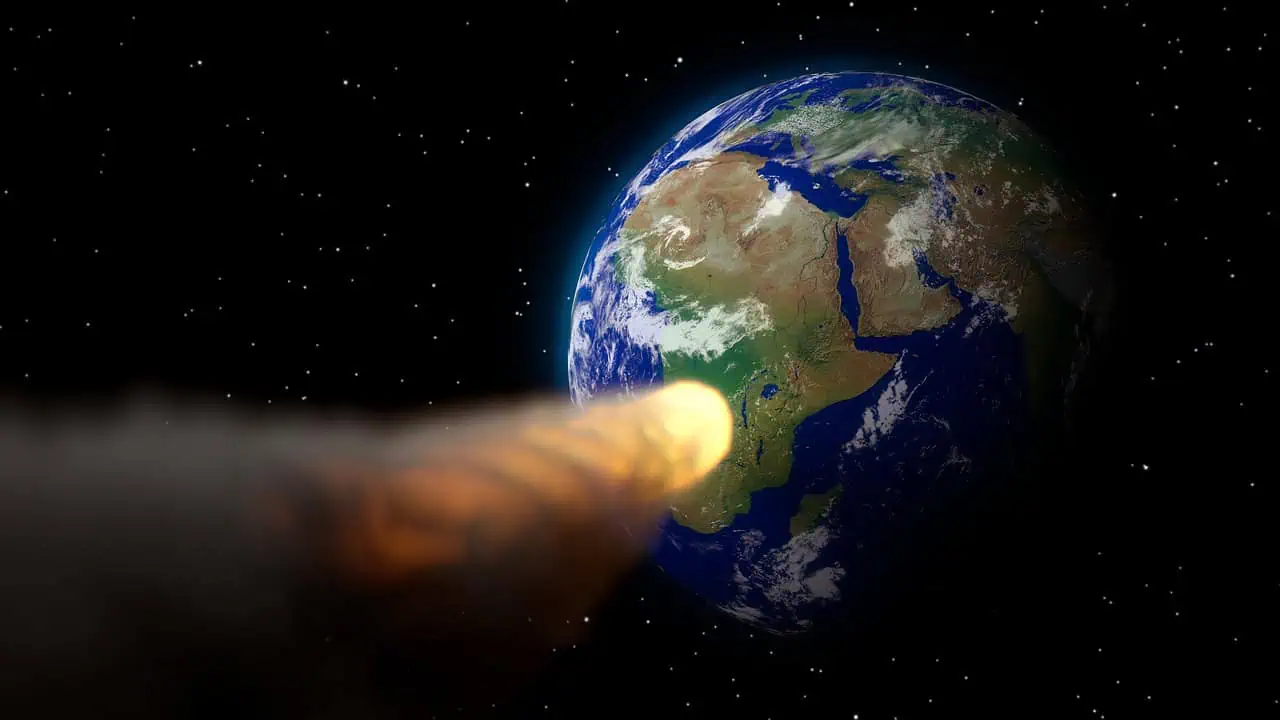
The idea of using a nuclear bomb might seem counterintuitive at first glance, but, in theory, it is quite simple to prevent the end of the world. By detonating a nuclear device near an asteroid, it would release an explosion of X-rays, high-energy particles capable of heating the asteroid’s surface.
This extreme heat would cause part of the asteroid’s material to vaporize, being expelled into space. This process would create a thrust similar to that of a rocket engine, capable of pushing the asteroid off its deadly path.
The concept has been tested in the lab by a team led by Nathan Moore from Sandia National Laboratories. Using an X-ray machine capable of melting diamonds, they conducted experiments on small asteroid-like objects.
By heating their surfaces with X-rays, the vaporized material was ejected, propelling the objects in the opposite direction. This propulsion effect, as demonstrated in simulations, could deflect asteroids up to four kilometers in diameter.
“We Knew We Were On A Promising Path From The Start,” Moore stated. “This rocket effect is exactly what we need in an asteroid deflection scenario.”
Limitations Of Kinetic Impacts
The new X-ray-based deflection technique is inspired by NASA’s successful DART mission, which in 2022 intentionally collided a spacecraft with the asteroid Dimorphos.
The DART mission demonstrated the effectiveness of kinetic impact to alter an asteroid’s trajectory. However, Moore’s approach offers a significant advantage: X-rays could deflect asteroids without the need for physical collisions.
The consensus in the planetary defense community is that X-rays from a nuclear explosion could be the only viable option in cases where the warning time is short. However, the use of nuclear devices in space remains a controversial issue.
A failure in the process could result in the dispersal of radioactive material into the atmosphere, in addition to the geopolitical challenges related to the use of nuclear weapons. Despite these concerns, many scientists believe this technology could be the most efficient solution for large asteroids or in imminent emergency situations.
Kinetic impacts, like those performed by the DART mission, are only effective when the asteroid is detected years in advance. In scenarios where there is less preparation time, X-rays could provide a more immediate and powerful solution.
Furthermore, this approach is less likely to break the asteroid into smaller fragments, which could result in a rain of smaller yet still dangerous pieces over Earth. Direct nuclear explosions, while impressive in movies, can be very risky in reality, as excessive force may create new problems instead of solving the original one.
What Comes Next?
The initial experiments conducted by Moore’s team were carried out in a vacuum chamber. They used a fake asteroid the size of a blueberry, made of quartz, a material commonly found in space rocks.
By exposing this small object to an X-ray explosion, the heated surface vaporized, creating a gas plume that acted as a propellant. The asteroid was propelled away from the X-ray source at a speed of about 250 km/h.
Tests with other materials, such as molten silica, showed the same effect. These experimental results were fed into computer simulations, which indicated that an explosion from an X-ray nuclear bomb could deflect asteroids up to four kilometers wide.
Although this experimental setup is a miniature version of what would be needed in a real mission, the tests provide a safe and practical way to validate the technique without the need for nuclear detonations in space.
The next step is to expand these tests to different and more complex materials, such as iron and multi-mineral compounds, which better mimic real space rocks. “This Is Just The Beginning,” Moore explained. “Asteroids May Be Composed Of A Variety Of Minerals, And We Need To Test Different Scenarios To Ensure The Technique’s Effectiveness.”
Despite the challenges, Moore’s team is optimistic about the future. The success of the DART mission and the promising discoveries from their research indicate that humanity is making progress in building a technological arsenal capable of protecting us from one of the greatest cosmic dangers.






Be the first to react!