






 Portuguese
  Spanish
  4 min of reading
  0 comments


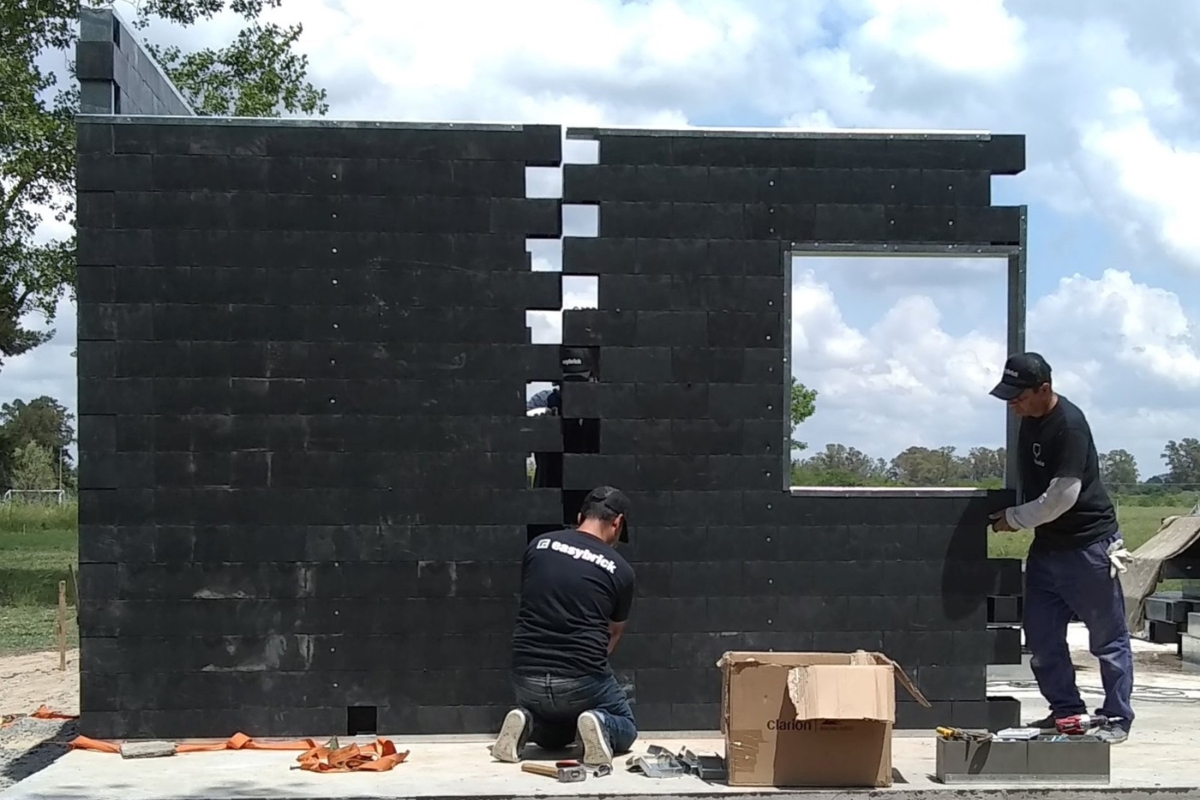
A Compatible System With Traditional Construction Allows for House Expansion, Creating New Floors and Integrating Existing Structures, as Long as Load Calculation and Reinforcements Are Well Planned, Engineering Applied to Fit Without Improvisation
Transforming waste into housing may sound like an experimental idea, but for an entrepreneurial family, it has become a concrete and scalable operation. What started as a traditional business in the plumbing sector evolved into a construction system based on bricks made from recycled plastic. Today, the project has already surpassed 200 completed works and is consolidating as a consistent case of circular economy applied to the construction industry.
The proposal combines productive efficiency, environmental responsibility, and economic viability. In a global context marked by excessive plastic waste and housing deficits, the initiative demonstrates that it is possible to tackle two structural challenges with a single technical solution.
From The Polymer Industry to The Modular Construction System
Before the transformation, the family had been supplying PVC and HDPE solutions for infrastructure for over 20 years. The accumulated knowledge about polymers, logistics, and the production chain was decisive in seeing the potential for a new business model.
-
Bolivian Female Construction Workers Form Association to Combat Discrimination and 38% Pay Gap in the Industry

-
Near Amsterdam, residents buy land and discover they must also build streets, manage drainage, handle waste, and grow food on half their plot.
-
Brazil’s WEG to Open New Factory in China by 2027, Expanding Production of Large Rotating Electric Machines and Low to Medium Voltage Motors in Rugao

-
Chinese Shipyard Secures $1 Billion in Orders for Low-Carbon Container Ships Amid Global Fleet Renewal Efforts


Data on plastic disposal reinforced the urgency for change. Millions of tons are discarded annually around the world, while only a small fraction is recycled. The decision, then, was to develop a product with real structural application, capable of reintroducing this material into the economic cycle in a durable manner.

The development of the brick went through several phases before reaching its current form. The final model measures approximately 30x15x15 centimeters and weighs about one kilogram, allowing for precise fitting and simplified assembly. Each unit can incorporate hundreds of recycled plastic bottle caps, converting everyday waste into constructive elements.
The factory responsible for the process has a recycling capacity of about 150 tons per month. This volume ensures continuous supply and technical standardization, two essential factors for the credibility of the system in the market.
Speed, Efficiency and Technical Performance
The system’s differential lies in its modular fitting, comparable to assembly pieces. This feature significantly reduces construction time and decreases the need for highly specialized labor. A residence of approximately 60 square meters can be completed in about 60 days.
The modularity also aids logistics. The lightness of the components facilitates transportation and expands operational possibilities, even in areas with complex access. The prior planning, with detailed structural calculations, makes execution more predictable and efficient.

Made from polypropylene, the bricks offer relevant thermal and acoustic properties. This contributes to greater energy efficiency of the buildings, reducing operational costs over time. The material’s impermeability prevents moisture absorption, increasing the structure’s durability.
Although it does not allow conventional plaster application, the system accepts coatings compatible with dry construction, such as plasterboard. When asked about the lifespan, the creators often highlight a symbolic point: the same time that plastic takes to degrade in the environment could represent the longevity of the construction.
Practical Applications and Measurable Social Impact
The system is compatible with traditional construction methods and can be used in both complete works and expansions. New floors, horizontal extensions, and additional environments can be integrated into existing structures, as long as the necessary load calculations and reinforcements are respected.
Among the more than 200 projects carried out are family residences and institutional projects. An emblematic example was the construction of a school sports center of approximately 200 square meters in less than three months. The project demonstrated the model’s ability to meet complex demands with agility and organization.
In addition to the technical innovation, there is an evident social component. The possibility of reducing costs by 20% to 25% compared to traditional methods broadens access to housing and reinforces the system’s potential as a viable alternative in contexts of housing deficit.
One of the most important strategic advances was the creation of an in-house recycling plant. This allows for the reuse of not only external waste but also leftovers from the works themselves, reinserting them into the production process. It is a closed cycle that strengthens both environmental sustainability and the financial solidity of the business.
Although the project has international ambitions and is already attracting interest from other Latin American countries, its roots remain well-defined. The family lives in the city of Tigre, in the province of Buenos Aires, Argentina, where the industrial operation that supports the system is also located.
From this local base, a proposal with global reach has been built. More than just a product, it is a purpose-driven engineering vision, a concrete demonstration that waste can be transformed into structure, shelter, and a durable future.





-

2 people reacted to this.