






 Portuguese
  Spanish
  2 min of reading
  0 comments


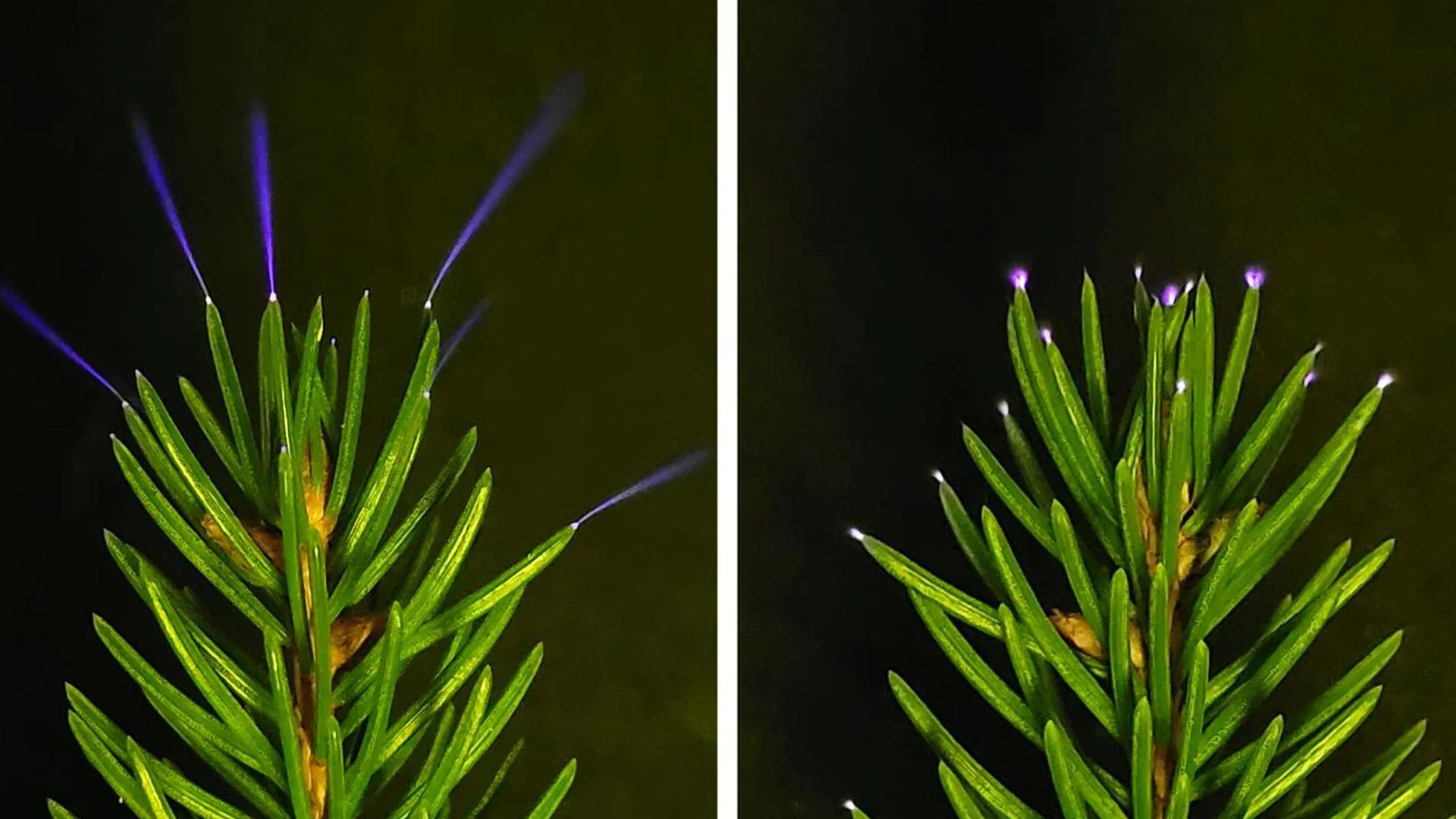
The observation that trees produce electric discharges at the tips of their leaves reveals a profound impact on the atmospheric chemistry of forests.
Scientists have recorded, for the first time in nature, trees emitting visible electric discharges during storms.
The phenomenon, known as “corona discharges,” occurs at the pointed ends of leaves when atmospheric electric fields become extremely intense. The discovery was made by an international team of researchers who used high-sensitivity cameras and chemical sensors in a monitored forest to document the event.
These electric discharges generate a faint glow, often imperceptible to the human eye without special equipment, but with significant chemical effects. The process occurs moments before or during lightning strikes, when the electric charge accumulated in the clouds induces a response at the tips of the branches.
-
Helicopter Drops 180 Tons of Sand and Gravel on Swedish River to Revive Ecosystem Damaged by Decades of Exploitation

-
Brazilian Company Launches Retro Smartphone with 48 MP Camera, T9 Keyboard, and Privacy Features for Social Media-Free Use

-
Self-Taught Chinese Farmer Builds 5-Ton Submarine from Scrap, Launches It in Anhui River
-
Invisible Induction Technology Enables Wireless Power for Blenders, Coffee Makers, and Air Fryers, Reducing Countertop Cables





The study demonstrates that trees are not just passive targets of atmospheric discharges, but active participants in environmental electricity.
Impact on air purity and chemistry
A detailed analysis revealed that the electric discharges emitted by trees produce large amounts of hydroxyl radicals (OH) and hydroperoxyl ($HO_{2}$). These molecules are known as the “detergents of the atmosphere” due to their ability to react and neutralize pollutant gases, such as methane and other organic compounds.
The research indicates that the electricity emanating from the leaves may be a much more important source of atmospheric oxidation than previously believed.
Until now, scientists knew that the impact of lightning on the air produced these radicals, but they had not documented that the trees themselves could generate them through smaller electric discharges. This mechanism acts as a natural chemical pump that cleans the air around the canopies during severe weather conditions.
Measurements of the concentrations of these radicals showed surprisingly high levels, suggesting a direct impact on air quality on a regional scale.
New perspectives for environmental monitoring
The observation of electric glow in trees changes how meteorologists and ecologists understand the interaction between forests and climate. The phenomenon of leaf electric discharges is now seen as an essential component for global atmospheric chemistry models.
Researchers highlight that the geometry of the leaves, especially the thinner and pointed ones, favors the concentration of the electric field and the occurrence of the luminous phenomenon.
The discovery also raises questions about how different tree species may influence the atmosphere in distinct ways during a storm. The sensors installed in the forest continue to collect data to verify the frequency of these electric discharges in different seasons and under varying wind intensities.
The study reinforces that the biological role of forests extends beyond photosynthesis, reaching complex physical and electromagnetic processes.
Click here to access the study.





Be the first to react!