Portuguese
  Spanish


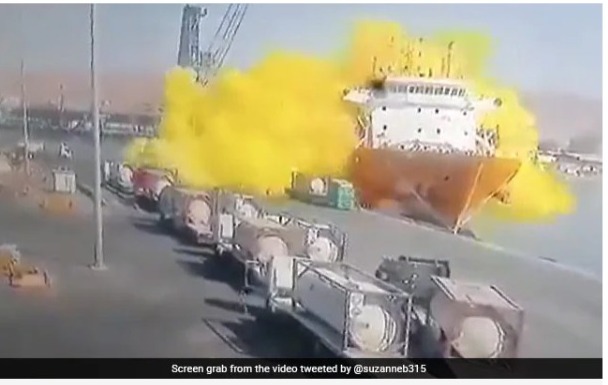

On Tuesday, June 28, a day after the accident, more than 100 people were still hospitalized in Aqaba after inhaling chlorine gas
On the previous Monday, June 27, at least 13 people died and more than 250 were injured after a chlorine gas leak on a ship in Jordan, at the port of Aqaba. The area was cordoned off and the injured were taken immediately to nearby hospitals. The civil defense was on site in an attempt to contain the leak, which occurred after a container fell from one of the ships.
In videos shared on social media and obtained through local cameras, the gas appeared yellowish and spread rapidly throughout the port. People at the scene tried to escape with the vehicles, but despite their quickness, they were unsuccessful. There was no explosion of the ship, only of the container.
See Video Showing the Gas Leak


A Metal Rope That Held the Container Broke, Causing the Leak of Chlorine Gas Instantly
The container fell after one of the metal ropes used for its transport broke. The gas transported by the ships’ logistics system was chlorine. The dockworkers are seen in the camera footage trying to escape the smoke, which can cause respiratory problems when present in large quantities.
-
Mother acts quickly and saves 6 children from fire in studio apartment on the coast of SC before firefighters arrive

-
A 21-year-old woman was carried in the arms to the platform and launched from about 40 meters in a bungee jump in Limeira while a rope appeared coiled on the ground behind the group; witnesses were shouting something that no one around managed to stop in time.

-
Truck breaks down in the middle of the Sahara, leaving Nigerians without water on a remote route and turning the journey back home into a tragedy with nearly 50 dead

-
Unusual incident: a taxi driver stopped at a corner because of a red light and his car with CNG caught fire in Argentina


“Exactly at 3:15 PM this afternoon, a chlorine gas leak occurred at the port of Aqaba as a result of the fall and explosion of a tank containing this substance,” said the government’s crisis cell in a statement, according to AFP.
More Than Half of the People Who Went to Hospitals Were Still Hospitalized on Last Tuesday, June 28
More than half of the individuals who were taken to the hospital after being exposed to chlorine gas remained hospitalized on last Tuesday, June 28. According to Prime Minister Bisher al-Khasawneh, some citizens were classified as critical and were expected to remain hospitalized for a few more days.
After the incident, authorities urged residents of the city of Aqaba, about 16 km from where the explosion at the port occurred, to keep their windows and doors closed at all times. The civil defense also sent professionals to the areas closest to the incident to ensure they were not contaminated. All residents would need to stay home for a few days through remote work.
Now, Minister of Interior Mazen Faraya is responsible for investigating the incident. In an interview with the portal AL Mamlaka, the deputy director of the port of Aqaba stated that a metal rope was responsible for transporting the container, but it could not withstand the weight. The chlorine gas was to be exported to Djibouti and weighed between 25 and 30 tons.
Gaseous Chlorine
Chlorine is a yellow-green gas when exposed to ambient temperature and pressure. It is exported on a global scale to produce household and industrial products. When the gaseous component is inhaled by the human body, Cl atoms react with water molecules to form hydrochloric acid, which is highly toxic to the body, causing fluids to accumulate in the lungs, resulting in pulmonary edema.