





Excavation in Søften, near Aarhus, reveals a craft complex with large-scale textile production, division of labor, and connection with ancient trade routes
A Viking textile factory about a thousand years old was discovered in Søften, Denmark, near Aarhus, and is helping archaeologists to revise the traditional image of the Vikings as merely warriors.
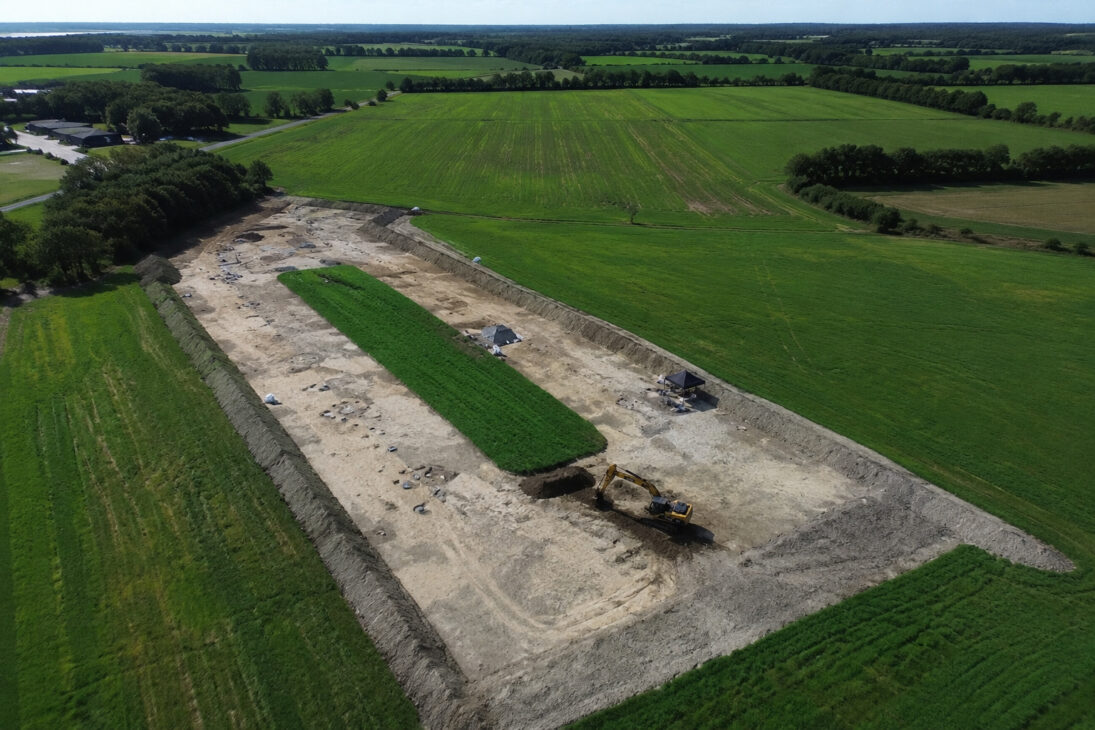
At the site, 82 pit houses were identified, semi-buried structures that, according to researchers, likely functioned as specialized textile workshops.
The archaeological site covers about 100,000 square meters and dates from a period between the 7th and 10th centuries, during the formation of the so-called Viking Age.
-
Bruno Guimarães, 28, Misses Crucial Penalty Against Norway in World Cup After Replacing Vinicius Jr.

-
Inspired by a school lesson on Africa’s water crisis, a young boy raised money through chores to fund a well that transformed a Ugandan community.

-
Brazilian Construction Worker Moves to France, Earns Up to €2,500 Monthly with Home Renovations, Gains Social Media Attention

-
US Navy Sinks USS Oriskany with 230 kg of C-4, Creating World’s Largest Artificial Reef in 37 Minutes





Craft complex indicates organized production
According to the Moesgaard Museum, responsible for the research, the area discovered in Søften presents unusual dimensions for a craft settlement.
Moreover, the number of similar workshops suggests that there were several workstations operating simultaneously.
Therefore, archaeologists believe that the site may have involved task division and some form of production coordination.
The discovery reinforces that the Vikings did not live solely on expeditions, wars, and raids. On the contrary, they also maintained structured economic activities.
Findings show complete textile production chain
During the excavations, loom weights, spindle whorls, and glass beads were found.
These materials indicate that the community produced textiles in quantities far exceeding local needs.
Furthermore, the remains point to a complete production chain, from fiber processing to the creation of the final fabric.
Thus, Søften may have functioned as a textile manufacturing center also aimed at commercial circulation.
Ancient coins reveal long-distance trade
Another point that drew attention was the presence of Arab coins from the Middle East.
Examples were also found minted in regions that today correspond to France and Germany.
Thus, the artifacts indicate that the inhabitants of Søften were connected to extensive trade networks.
These routes, according to researchers, could reach distant regions of Asia.
The location helped in this process. After all, Søften was close to Aros, an ancient commercial center linked to present-day Aarhus.
In this way, goods produced in the complex could be transported and traded more efficiently.

Discovery broadens understanding of the Vikings
For historian Kasper H. Andersen from the Moesgaard Museum, the find shows that the Viking Age was more complex than the idea of just a barbaric and backward period.
According to researchers, the set of workshops and artifacts proves a developed Viking economy, with specialized production and organized trade.
Therefore, the discovery in Søften helps to show a society with craftsmanship, productive planning, and international contact.
Artifacts are still under analysis
Despite the importance of the find, the studies have not yet been concluded.
The analysis of the materials found may take months or even years, as informed by the researchers.
There is still no set date for the public exhibition of the artifacts.
However, they may be presented in the future at the Moesgaard Museum or in other spaces related to Danish archaeology.
And you, did you imagine that the Vikings also had such an organized textile production connected to international trade?





