






 Portuguese
  Spanish
  6 min of reading
  0 comments


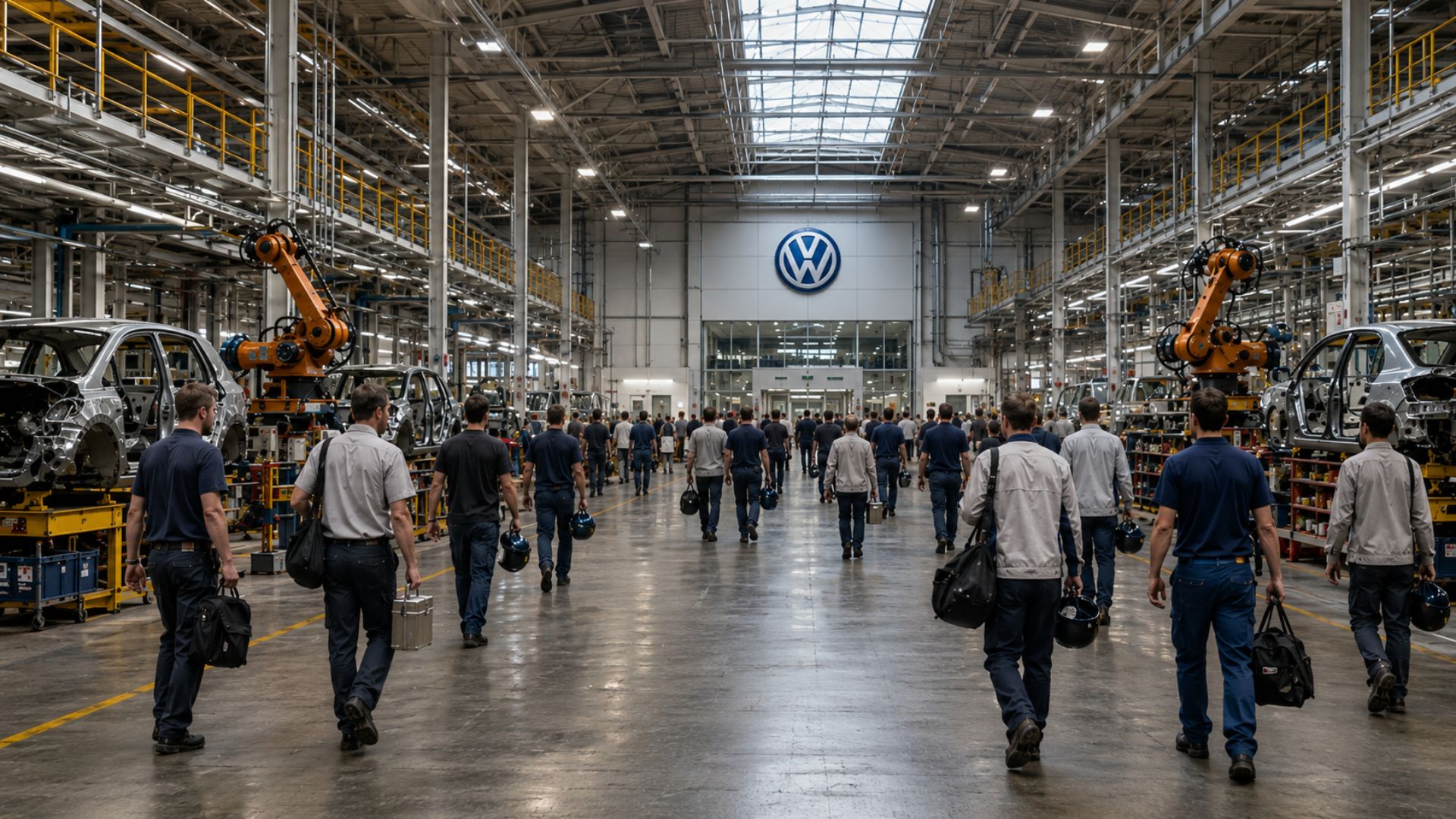
Measure adopted by Volkswagen in Germany became a global reference by reducing the weekly work hours during an industrial crisis, with union negotiation, partial salary compensation, and focus on large-scale job preservation within one of the largest car manufacturers on the planet.
Volkswagen introduced the four-day week to its factories in Germany in a labor negotiation that made history in the global industry by combining reduced work hours, economic crisis, and job preservation.
Signed in November 1993, the agreement reduced the weekly workload from 36 to 28.8 hours and aimed to avoid mass layoffs during a period marked by high costs and excess labor.
Unlike corporate programs focused solely on well-being or flexibility, the measure was born as a response to a concrete difficulty faced by the German manufacturer and its workers.
-
Government wants to pay up to R$ 8,000 to more than 2,300 traditional families in over 100 communities in Acre and Amazonas for environmental services provided to the Amazon.

-
Coal mine purchased for $2 million in Wyoming, the Brook Mine holds rare earth elements and critical minerals estimated at up to $37 billion, in an asset that the US is competing for with China.

-
In the year Brazil won the World Cup, gasoline cost R$ 1.77, the cheapest car was worth R$ 13,000, there were no flex-fuel cars, SUVs were rare, and no Chinese brand sold a single vehicle in the country.
-
Neighboring Balneário Camboriú will receive a R$ 1 billion airport with 225 hangars, an area of 2.2 million m², a technology park, and an export zone that promises to transform the economy and generate thousands of jobs.


In that context, the company, the IG Metall union, and employee representatives negotiated a solution to protect jobs in strategic units, distributing part of the adjustment effects between the company and employees.
The experience became associated with the 28.8-hour weekly schedule, adopted the following year, and represented a 20% reduction in formal work time compared to the previous model.
Although it reduced employee presence in factories, the agreement did not fully maintain salaries, as it provided for partial compensation within a broader negotiation on costs, production, and jobs.
Four-day week at Volkswagen
At the heart of the decision was the attempt to redistribute available work among more people, preventing the drop in activity from directly resulting in widespread staff cuts.
According to Eurofound, the European Union agency dedicated to work and living conditions, the reduction to 28.8 hours was agreed with only partial salary compensation to prevent job losses.
With the new schedule, Volkswagen reduced the weekly time employees spent in German units and had to reorganize shifts, production routines, and labor costs.
Instead of treating the work schedule merely as the number of available hours, the manufacturer began using it as an adaptation tool during a time of financial pressure and industrial reorganization.
The size of Volkswagen helped turn the decision into an international reference, as the company was not conducting a limited test in an office or isolated sector.
It was one of the largest car manufacturers in the world, with strong unions, structured workers’ councils, and thousands of employees directly affected by the change in German factories.

Reports from the time indicated that the negotiation covered six units and responded to the threat of cuts that could affect tens of thousands of workers.
In November 1993, the British newspaper The Independent reported that the agreement aimed to preserve 31,000 jobs then at risk, a number that helped gauge the impact of the measure.
Reduction of working hours had partial compensation
Volkswagen’s experience often appears in current debates about the four-day week, but its design was different from many recent tests adopted by companies and governments.
While some contemporary initiatives evaluate shorter schedules with full salary maintenance, the German case from the 1990s involved losses compensated only partially.
This point helps explain why the agreement had historical significance and, at the same time, cannot be confused with a simple exchange of five days for four.
In practice, the reduced week functioned as a negotiated solution to address an immediate economic problem, impacting remuneration, shift organization, and job security.
At the time, the Los Angeles Times reported that the immediate drop in remuneration would be less than the 20% reduction in working hours, due to adjustments in benefits, bonuses, and future increases.
Even so, the previous salary standard was not fully preserved, which differentiates Volkswagen’s experience from more recent models focused on productivity without income cuts.
Thus, the company and the union tried to build an intermediate response between two pressures advancing simultaneously in the German units.
On one side, there was a business need to reduce costs and respond to excess capacity; on the other, the workers’ representation sought to contain a possible wave of layoffs.
Collective bargaining marked the agreement
The adoption of shorter working hours also reinforced the role of collective bargaining in the German labor relations model, where workers’ councils and unions have strong influence.
Instead of a unilateral decision by the company, the change went through an agreement with IG Metall and employee representatives, which gave institutional legitimacy to the experience.
This arrangement helped turn the case into a reference for companies, governments, and unions interested in alternatives to adjustments based exclusively on layoffs.
The reduction of the week was presented as an economic instrument, not just as a labor concession or as an internal quality of life policy aimed at corporate image.

In Volkswagen’s corporate chronology, the company acknowledges that the flexible model based on the reduction from 36 to 28.8 weekly hours aimed to deal with an estimated surplus of 30,000 positions.
Additionally, the automaker associated the measure with the adoption of lean production and the attempt to improve its cost structure in a more challenging competitive scenario.
By combining industrial crisis, union negotiation, and productive reorganization, the German experience expanded the discussion on productivity within large companies.
Working time became part of a broader strategy, connected to competitiveness, job preservation, and operational adaptability in times of instability.
Shorter working hours returned to the debate at the automaker
In the following years, the 28.8-hour workweek continued to appear in Volkswagen’s negotiations on costs, production, and job guarantees in German units.
In 2006, Eurofound recorded a new agreement between the automaker and IG Metall, now with an extension of the standard workweek in exchange for commitments on production and job preservation.
The subsequent change shows that the four-day week did not work as a fixed formula, immune to the economic context or the industrial needs of each period.
On the contrary, it was part of a series of negotiations where working hours, salary, investments, and job security were adjusted according to the company’s and market’s situation.
Even with later changes, the episode from the 1990s remained a milestone because it showed that an industrial giant could treat the reduction of hours as a concrete crisis management tool.
The agreement did not eliminate all of Volkswagen’s structural challenges, but it offered an alternative to the logic that any drop in activity must immediately result in staff cuts.
For the Brazilian public, the case also draws attention due to the brand’s historical presence in the country and its association with popular models, traditional factories, and strong relevance in the automotive market.
The German experience shows that the debate about shorter working hours did not start now, nor is it limited to offices, startups, or technology companies.
In several countries, the discussion has regained strength because companies and workers are seeking ways to reduce strain, reorganize schedules, and maintain productivity.
In the case of Volkswagen, however, the origin was tougher: the shorter week appeared as a negotiated response to an industrial crisis, with shared costs and a focus on preserving jobs.
More than three decades later, the experience remains relevant for revealing a little-explored possibility in times of economic pressure.
In certain circumstances, cutting hours can be part of a negotiation to avoid worker layoffs, provided that salary, production, and job security are handled with transparency.





Be the first to react!