Portuguese
  Spanish


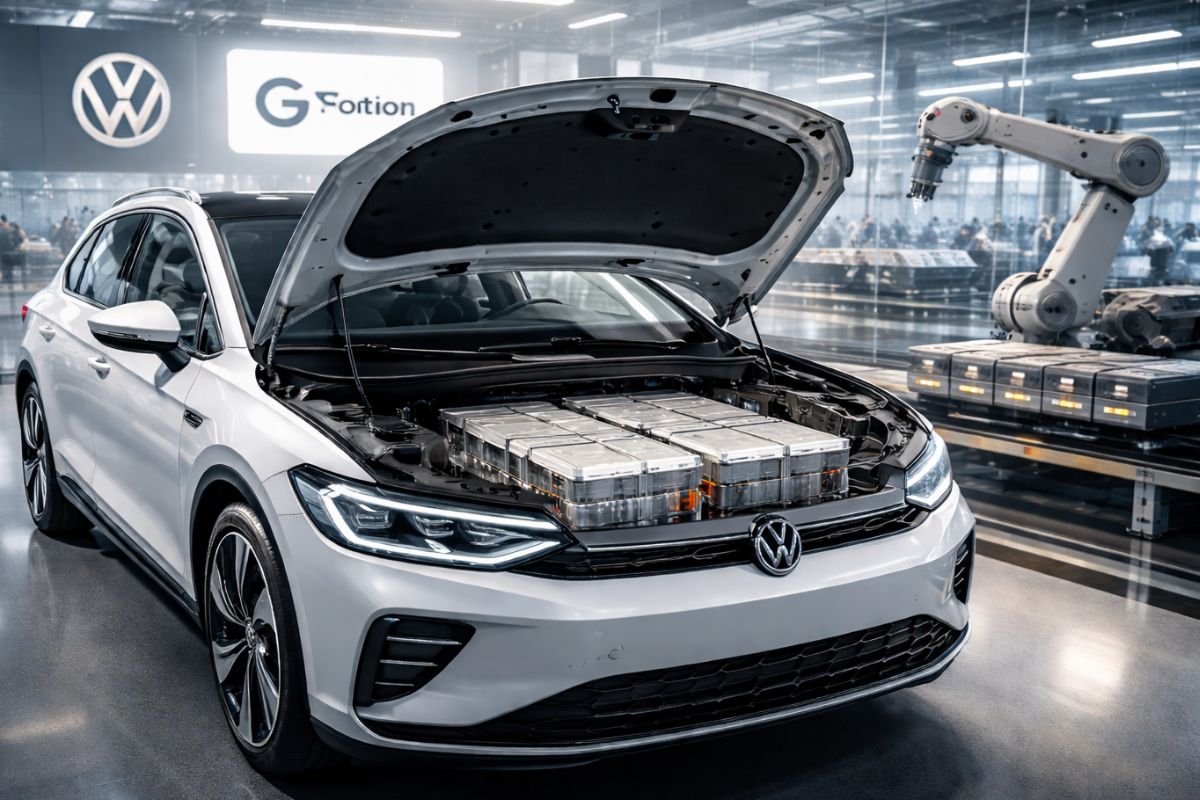


Volkswagen reinforces its bet on Chinese Gotion with expanded participation, a 2 GWh line, and industrial advancement that takes the solid-state battery out of the laboratory and brings it closer to scale production.
Volkswagen appears today as one of the traditional automakers best positioned to start the practical adoption of solid-state batteries in mass-produced electric cars, not as an isolated move, but as a strategy built with direct investment, technological partnership, and presence in the Chinese battery market.
At the center of this movement is Gotion Hightech. Volkswagen initially took about 25% and, it seems, has increased its stake to something close to 33%, combining privileged access to technology, influence in development, and competitive advantage when it comes to implementation.
Why Volkswagen bets on Gotion and does not treat it as a passive investment
The relationship between the two companies is presented as a strategic position. It is not just idle money in stocks: it is a way to ensure access to technology, accelerate testing, and be in the right place when the solid-state battery becomes a commercial product.
-
1983 Chevrolet Runs Over 100,000 km Without Gasoline, Powered by Wood Chips, Reaches 125 km/h in Airport Test

-
Workshop Converts Giant Tractor Tire Tricycle into a Three-Wheel Drive Hybrid with 36,000-Watt Electric Motor Capable of Climbing Hills

-
Sales of Brazil’s Cheapest Electric Car Halted Before First Deliveries: E-Motors Suspends Emova Easy Due to Import Tax Increase and Rising Freight Costs

-
Nissan Discontinues Qashqai SUV Amid Cost-Cutting, Chinese Competition, and Product Line Review



Moreover, the foundation highlights that Gotion is not just making promises. The company has been working on and testing solid-state batteries in electric vehicles for almost two years, which would place it at a maturity level above competitors still stuck in laboratory or conceptual phases.
The milestone of US$ 1 billion and expanded participation to 33%

The history of investment is direct. In 2020, Volkswagen invested about US$ 1 billion to secure its initial stake in Gotion, signaling a long-term vision from the start.
Since then, the relationship has deepened. The increase to about 33% transforms Volkswagen into a partner with real weight, with potential influence and access to a technological route that could redefine the electric car market.
2 GWh line, 90% yield, and the turn toward scale
The base points to an important industrial milestone. Gotion has completed a pilot production line and reported a yield rate of around 90%, a sign that the technology has already surpassed the laboratory stage and is beginning to move towards large-scale production.
Furthermore, the text mentions the project of a production line with a capacity of 2 GWh dedicated to solid-state batteries, indicating a transition from the pilot phase to a stage closer to the commercial cycle, with equipment created in-house.
What the solid-state battery promises to change in autonomy


The promise that stands out is autonomy. Solid-state batteries have the potential to achieve up to 1,000 km on a single charge, changing the perception of the viability of electric cars for those who still see autonomy as a barrier.
The text also contextualizes energy density: the reported figure is around 350 Wh per kg, while current NMC batteries would operate on average close to 280 Wh per kg. In the automotive context, this gain is described as significant, because it directly impacts the final autonomy of the vehicle.
Patents, sulfide electrolyte, and the technical numbers cited
The base states that Gotion has already accumulated more than 30 patents related to the technology and lists some technical indicators released for the version expected in 2025: a 60% increase in the ionic conductivity of the sulfide electrolyte, a 150% growth in cell capacity, and a 90% reduction in pretension pressure, factors related to efficiency, stability, and operational safety.
Another point mentioned is performance in extreme weather. According to Gotion, the batteries would operate from minus 40°C to 80°C, maintaining stability and performance, which is relevant for global application.
The bridge between the present and complete solid-state
As complete solid-state technology advances, the base mentions an intermediate stage. The company presented a semi-solid battery with an energy density of around 300 Wh per kg, treated as a bridge between conventional batteries and the fully solid model.
The idea is progression. Instead of a single leap, evolution can happen over generations, with consistent gains until reaching the complete solid state.
What Volkswagen gains by betting on more than one route
According to Mobility Channel, it suggests that Volkswagen positions itself to lead or closely follow the technological shift. In addition to the partnership with Gotion, Volkswagen also has a stake in QuantumScape itself, reinforcing a diversification strategy, like someone betting on more than one path to increase the chances of arriving first at a viable solution.
In the end, the central reading is that it is not the one with the best advertisement on paper who wins, but the one who turns innovation into a real, scalable, and reliable product, and that is precisely where Volkswagen tries to position itself in advance.
Does this Volkswagen bet on solid-state batteries seem like a decisive step towards 1,000 km of autonomy to you, or is it still too early to pin down this shift in electric cars?