






 Portuguese
  Spanish
  2 min of reading


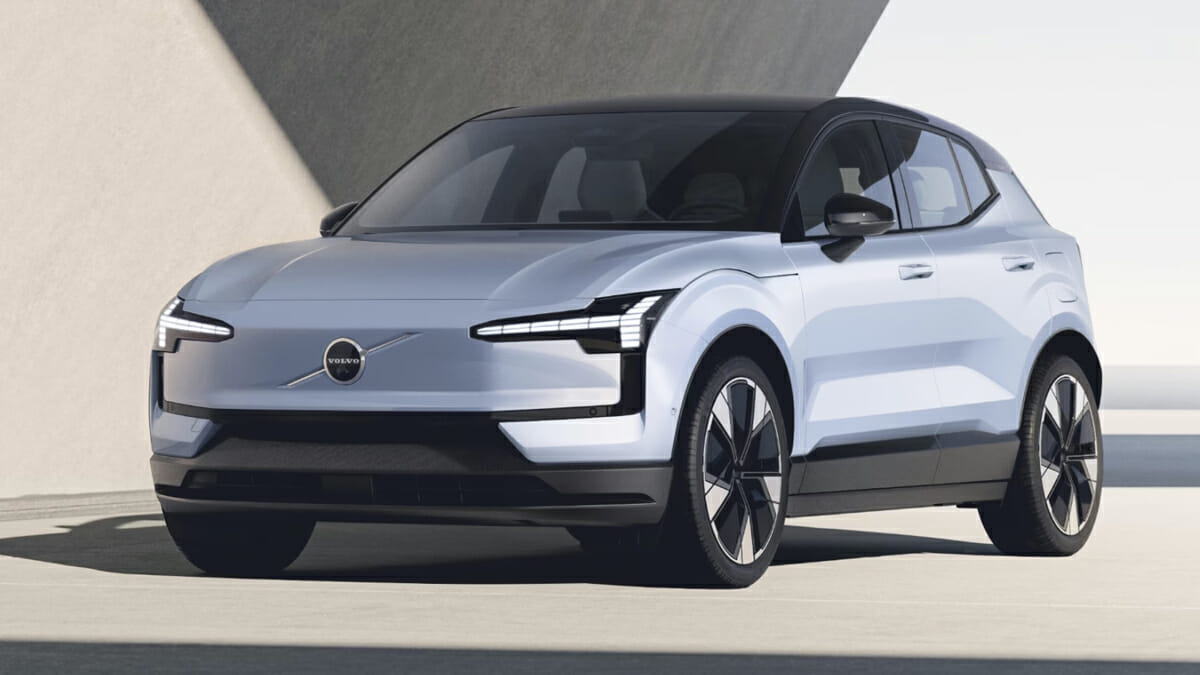
Aiming at the Electric Car Sector, But Not Forgetting Technology and Affordable Price, the Swedish Company Will Bring the Volvo EX30 to Brazil.
Volvo has officially launched its next electric car, the Volvo EX30, which is coming to Brazil as the brand’s most affordable option. Positioned below the XC40, this compact SUV represents the second fully electric model developed by the Swedish automaker, marking the beginning of a new technological era for the company.
Meet the Volvo EX30, the Company’s New Electric Car


Motor and Battery of the Volvo EX30: Surprising Power and Range
One of the main mysteries surrounding the Volvo EX30 was its powertrain. Volvo developed an entirely new set for this compact SUV, offering different battery capacity options to customers.
Surprisingly, despite being smaller, the EX30 is more powerful than its larger siblings. The car will be available in several versions, with variations in power and range.
-
A mechanic opened the engine compartment of an 11-year-old Ford to replace a part and found a wallet with money, gift cards, and the badge of the worker who had assembled that car at the factory.

-
Toyota sells a “Family Spin” cheaper than the Chevrolet Spin in Brazil, with 7 seats and a price starting from around R$ 70,000 in tax-free conversion; Avanza 2026 has a 1.3 or 1.5 engine, manual or CVT transmission, 205 mm ground clearance, and a family proposal that Brazilians don’t have in Indonesia.

-
Five used cars that can handle 100 km per day without breaking the bank, but experts warn that even the most durable ones may hide expensive repairs if they’ve gone years without proper maintenance.
-
Dodge Charger Daytona receives solid-state battery in real test and reignites the race for lighter electric cars, faster to charge and with more range.




The entry-level version is equipped with a single electric motor producing 275 hp and an LFP lithium iron phosphate battery, which provides an urban range of 475 km and a mixed city/highway range of 344 km in the WLTP cycle.
In this version, the EX30 can accelerate from 0 to 100 km/h in just 5.7 seconds. Additionally, there is a version with a single motor and extended range, which uses a more efficient and lighter battery composed of lithium, nickel, manganese, and cobalt.
With these cells, the EX30 can cover 662 km in the urban cycle and 480 km in mixed conditions. In this version, the acceleration from 0 to 100 km/h drops to 5.3 seconds.
Volvo’s New Electric Car Combines Technology and Sustainability in One Model
The top-of-the-line EX30 uses the same battery as the extended-range version, but with two electric motors that total 433 hp and 55.3 kgf/m of torque.
Surprisingly, the range does not change significantly compared to the intermediate variant, offering an urban range of 635 km and 460 km in mixed conditions.
The EX30 accelerates from 0 to 100 km/h in an impressive 3.6 seconds. According to Volvo, depending on the version, it is possible to achieve a fast charging rate of up to 153 kWh, allowing for 80% battery capacity in just 25 minutes.
The Volvo EX30 is a remarkable evolution compared to its larger siblings, the XC40 and C40. The concept of being a luxurious and sustainable electric car is even more evident in this model, making it the most environmentally friendly vehicle ever produced by Volvo.







Be the first to react!