Portuguese
  Spanish


Stuart Jones, a welder from Solihull, found a 16th-century diamond ring after 7 hours with a metal detector in a field in Gloucestershire, England. The gold jewel, in the purity standard of Edward I, was auctioned at Noonans for 17 thousand pounds.
Seven hours sweeping a field with a metal detector yielded an English welder a centuries-old find. Stuart Jones, 42, who works in manufacturing for an automaker in Solihull, unearthed a 16th-century diamond ring in a field in Wormington, Gloucestershire, England. The discovery was announced by the auction house Noonans.
The result crowned his patience. The gold jewel, with eight diamonds, was auctioned in June 2026 for 17 thousand pounds, over 100 thousand reais, at a Noonans auction in London. The detail that enchants specialists is technical: the gold of the ring follows a purity standard set during the reign of Edward I, around 1300, although the piece itself is much more recent.
The 7 hours with the metal detector
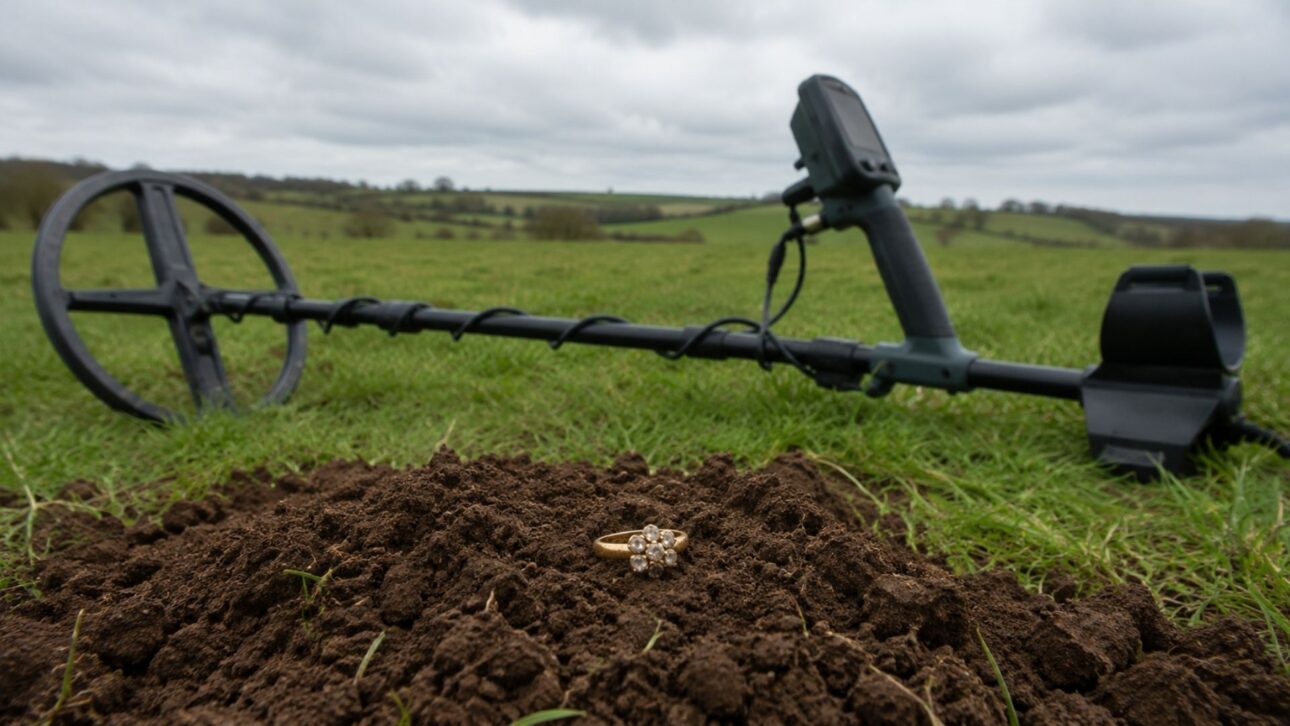
The discovery was the reward for a whole day of searching. Stuart Jones, who works as a welder on the line of an automaker in Solihull, is also a detectorist in his spare time, and spent about 7 hours scouring a field in Wormington before finding something out of the ordinary.
-
Former Merchant Marine Captain Invents Fuel-Free Barrier, Removes 20,000 Tons of Trash from Chennai Rivers

-
14-Year-Old Maxim Harris Turns School Project into Anti-Rage Gaming Accessory, Sells 1,000 Units Across 46 U.S. States, Donates 20% of Profits to Charity
-
Brazilian Health Agency Approves First Oral Medication for Cancer Patients
-
11-Year-Old Boy and His Mother Discover 1.8-Million-Year-Old Elephant Tooth on English Beach Eroded by the Sea





The signal that changed the day came near the end of the journey.
The moment was memorable. According to Yahoo News UK, Jones described the find as a “once-in-a-lifetime” discovery and said he was “completely overwhelmed with joy” upon realizing what he had in his hands.
For those who use metal detecting as a hobby, unearthing an ancient jewel is the kind of dream that rarely comes true.
The location was not chosen by chance. England is fertile ground for detectorists, with centuries of history buried beneath fields now used for planting.
It was in one of these rural areas, in November 2024, that the diamond ring remained hidden for generations until Jones’s metal detector beeped over it.
The 16th Century Diamond Ring
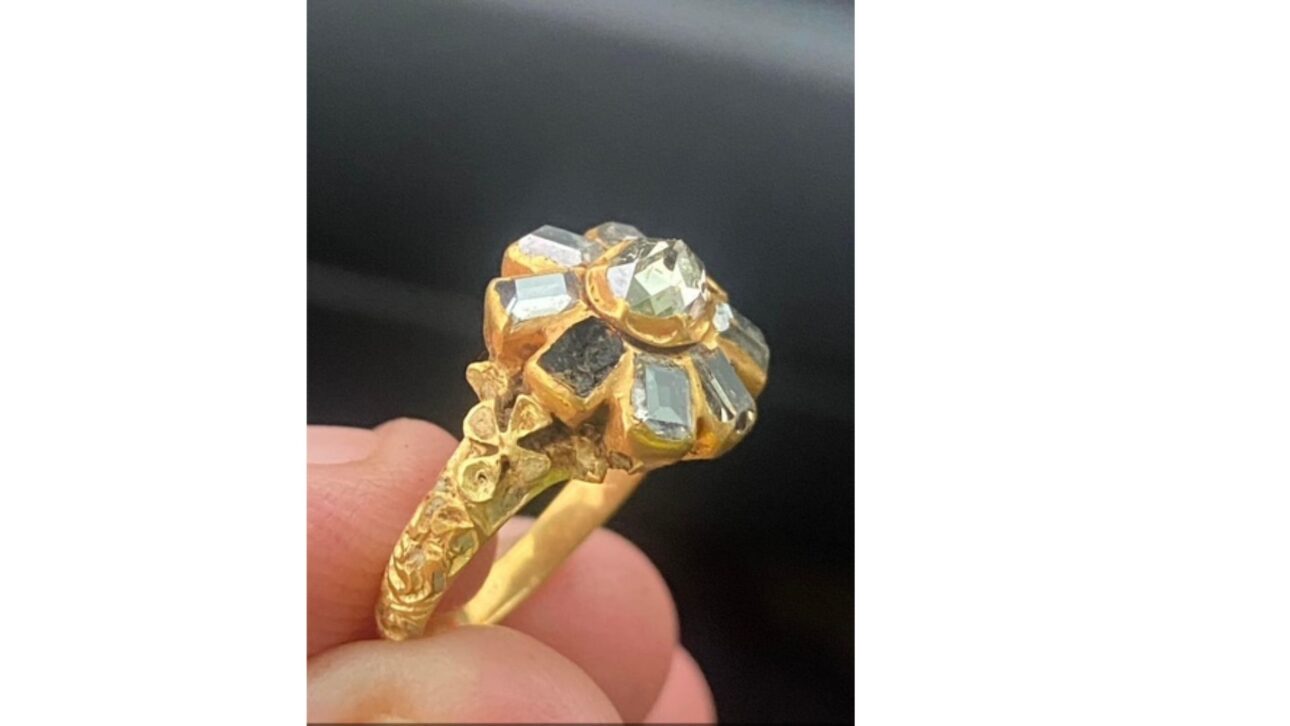
The piece is as rare as it is beautiful. It is a diamond ring from the late 16th or early 17th century, with a flower-shaped design formed by a cluster of eight diamonds cut in the old style, known as “hogback”.
This type of arrangement is uncommon and helps explain why the jewel attracted so much attention.
Not everything survived intact over time. Of the eight diamonds, two were loose when the ring was recovered, a detail that did not detract from the piece’s historical value.
Jones described it as a beautiful jewel from the Tudor era, “lost for centuries,” until it came to light in an English field.
The importance of the find was confirmed by experts. The diamond ring was examined by technicians from the British Museum and registered in the Portable Antiquities Scheme, the UK program that catalogs archaeological finds made by civilians.
This official endorsement lent credibility to the story and paved the way for the auction.
The Gold in Edward I’s Standard
Here comes the detail that links the jewel to medieval royalty. Analyses conducted with an X-ray fluorescence device, the XRF, showed that the gold of the ring has a purity of 19.2 carats.
This specific degree of purity corresponds to a standard set by a law created during the reign of Edward I, around the year 1300.
It’s worth clearing up any confusion. The ring did not belong to Edward I, nor is it from his time: the king lived between the 13th and 14th centuries, and the jewel is from the 16th century.
What links one to the other is just the gold standard, a purity norm created centuries earlier and still followed when the piece was made.
This type of information is gold for historians, in both the literal and figurative sense. Knowing the exact metal content helps date the piece and understand how gold regulations spanned centuries in England.
It is metallurgy telling history, transforming a ring found in a field into a document about the past.
The 17 Thousand Pound Auction
The jewel ended up in the collectors’ market. The diamond ring was taken to Noonans auction house, in Mayfair, London, and auctioned on June 23, 2026.
The estimate before the auction ranged from 15 thousand to 20 thousand pounds, and the hammer fell at 17 thousand pounds, with the piece sold to a buyer bidding by phone.
The amount exceeded the expectations of the finder. Jones stated that the auction result was “beyond anything he could imagine,” quite an outcome for someone who just wanted to spend the afternoon with a metal detector.
The 17 thousand pounds represent more than 100 thousand reais for a single day of searching.
The money, however, does not all stay with him. Under British rules for this type of discovery, the auction value is divided equally with the landowner where the diamond ring was found.
It’s the agreement that keeps the hobby going and encourages detectorists and landowners to collaborate.
Why England is Experiencing a Detector Fever
Jones’s case is far from isolated. England is one of the places in the world where the most treasures are unearthed with metal detectors, precisely because it accumulates layers of occupation from the Romans to the Tudors.
Every field can hide coins, brooches, and jewels lost hundreds of years ago.
Local rules encourage the practice. The United Kingdom has laws that organize what to do with valuable finds, ensuring that important pieces are registered and that the profit from a possible auction is shared between the finder and the landowner.
This balance has turned metal detecting into a popular and productive hobby.
The result frequently appears in the headlines. Stories like the 16th-century diamond ring fuel the imagination of thousands of people who head out on weekends, dreaming of the beep that announces gold.
England has thus become synonymous with modern treasure hunting.
What Changes When It Comes to Brazil
Here, the game has different rules. Metal detecting also attracts the curious in Brazil, but finds of historical value cannot simply be sold at auction: archaeological pieces are considered protected heritage and belong to the Union, which completely changes the fate of a discovery like this.
Even so, the fascination is the same. The idea that a common field can hide gold and history sparks the same gleam in the eyes in any country.
The difference is that, in Brazil, the happy ending for an ancient jewel is usually a museum, not a millionaire auction.
In the end, the story teaches about patience and chance. It took 7 hours of walking and relatively simple equipment to turn an ordinary day into a find that yielded more than 100 thousand reais.
The diamond ring proves that sometimes the treasure is indeed just a few centimeters underfoot.
And you, would you go out with a detector?
Stuart Jones’s story shows how a hobby can yield a museum-worthy jewel: a 16th-century diamond ring, gold in the pattern of Edward I, found with a metal detector in a field in England and auctioned for 17 thousand pounds at Noonans. All this after just 7 hours of searching.
And you, would you have the patience to spend hours with a metal detector in the hope of unearthing a treasure like this? Tell us in the comments if you’ve ever found something curious along the way and what you would like to find buried out there.