Portuguese
  Spanish


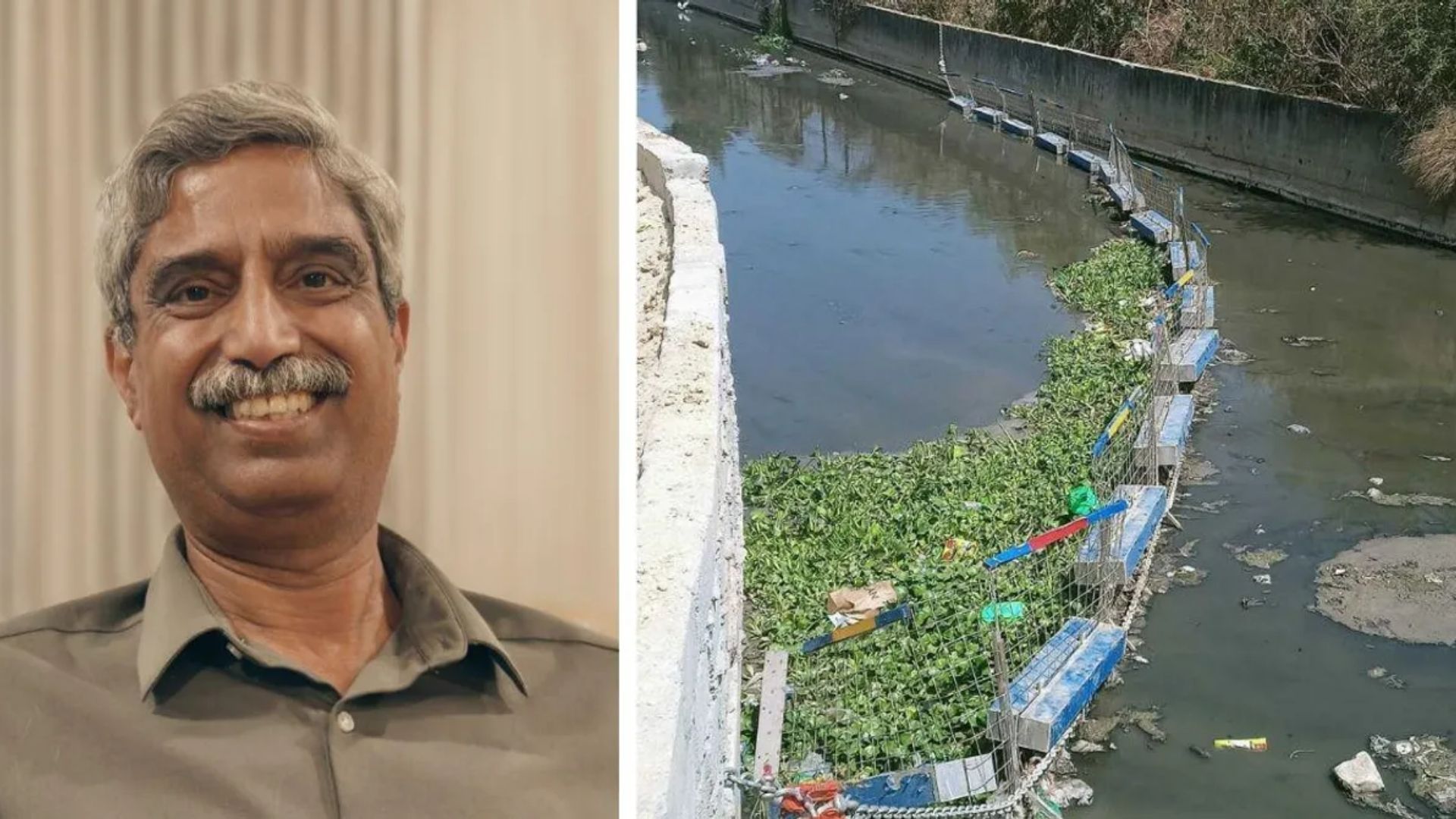

Captain DC Sekhar left the merchant navy after 26 years and created a low-cost floating barrier that requires no fuel and uses the current to push river trash to the shore. In Chennai, India, the system has already removed 20,000 tons of waste before it reached the ocean.
Those who spent decades at sea learned to read the power of water, and it was this reading that turned into a solution on land. Captain DC Sekhar, a merchant navy officer for 26 years, created a floating barrier that doesn’t burn a drop of fuel: it harnesses the river’s own current to push trash to the shore, where the material is collected. In the rivers of Chennai, India alone, the system has removed over 20,000 tons of waste. The story was reported by The Better India.
It’s important to separate the numbers to avoid confusion. The 20,000 tons are what the floating barrier removed from the Cooum and Adyar rivers in Chennai. Adding up all fronts, the vehicle itself claims that the invention has already prevented about 100,000 tons of trash from reaching the ocean. No matter the context, the achievement is significant: an inexpensive, simple, and fuel-free equipment tackling a problem that usually requires expensive machinery.
The captain who traded the sea for river cleaning

Behind the invention is a lifetime connected to water. DC Sekhar served in the merchant navy for 26 years, accumulating practical experience with currents, tides, and the behavior of moving water.
-
14-Year-Old Maxim Harris Turns School Project into Anti-Rage Gaming Accessory, Sells 1,000 Units Across 46 U.S. States, Donates 20% of Profits to Charity

-
Brazilian Health Agency Approves First Oral Medication for Cancer Patients
-
11-Year-Old Boy and His Mother Discover 1.8-Million-Year-Old Elephant Tooth on English Beach Eroded by the Sea

-
3,400-Year-Old Leather Shoe Found in Melting Norwegian Ice Leads to Discovery of 4,500 Artifacts, Including Clothing, Arrows, Skis, and Tools




It was this onboard knowledge, not a laboratory, that gave rise to the idea of using the river itself as the engine for cleaning.
Sekhar is the founder of AlphaMERS, an Indian engineering company focused on solutions for aquatic environments, and a graduate of IIM Bangalore, one of India’s most respected management schools.
According to Digit, his team designed, developed, and installed barriers that trap waste and plastic and bring them to the shore 24 hours a day, using only the natural flow of the water.
The motivation is straightforward. Polluted rivers act as conveyors that carry plastic and debris from the city to the sea, and stopping this flow in freshwater is much more affordable than trying to collect the waste already spread in the ocean.
Instead of tackling the problem at the end of the line, the former merchant navy officer decided to address it along the way.
How the fuel-free floating barrier works
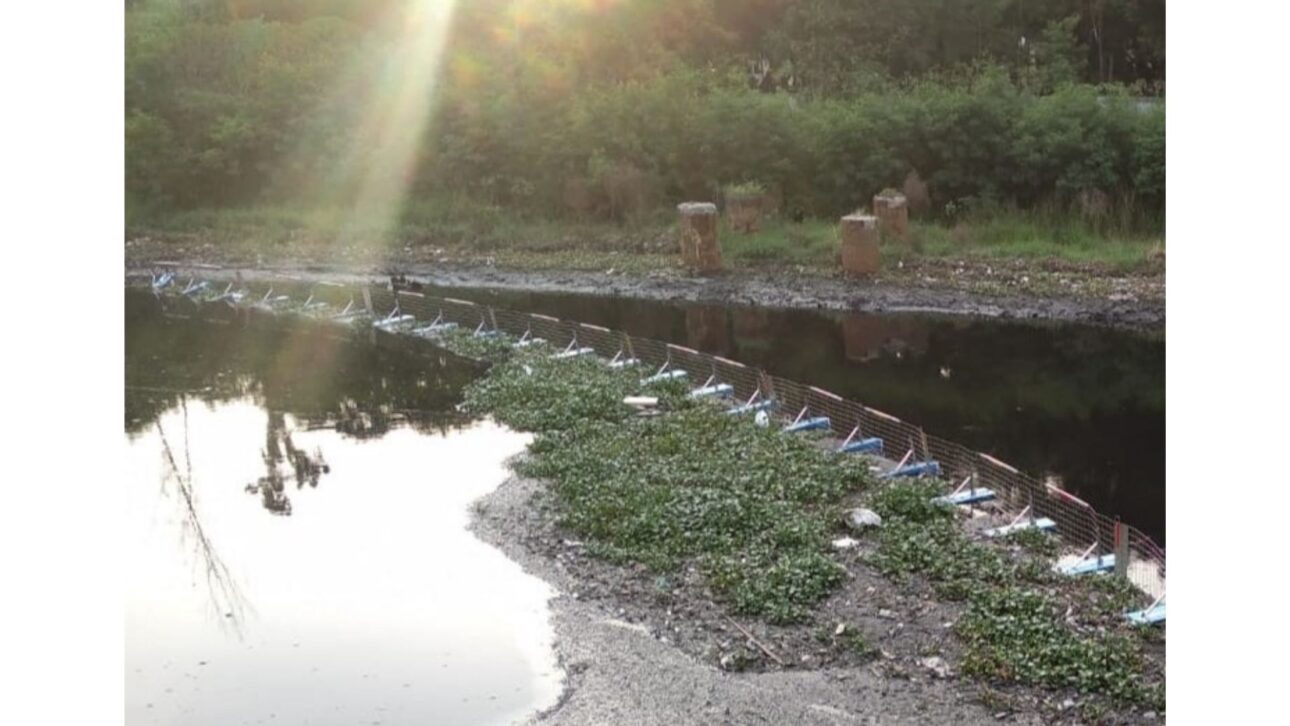
The secret lies in the geometry. The floating barrier is installed diagonally, crossing the river at an angle, so that the current does not hit it head-on but rather glides along it.
This design makes the water’s own movement push the floating waste to one of the banks, where a sweeping system collects the material.
The most ingenious part is what it lacks. The floating barrier does not use fuel, does not rely on a motor or pump, and does not require an operator all the time.
It is completely passive: it works alone, day and night, driven only by the river’s force. The water continues to flow freely, so the course is not dammed, only what floats is retained.
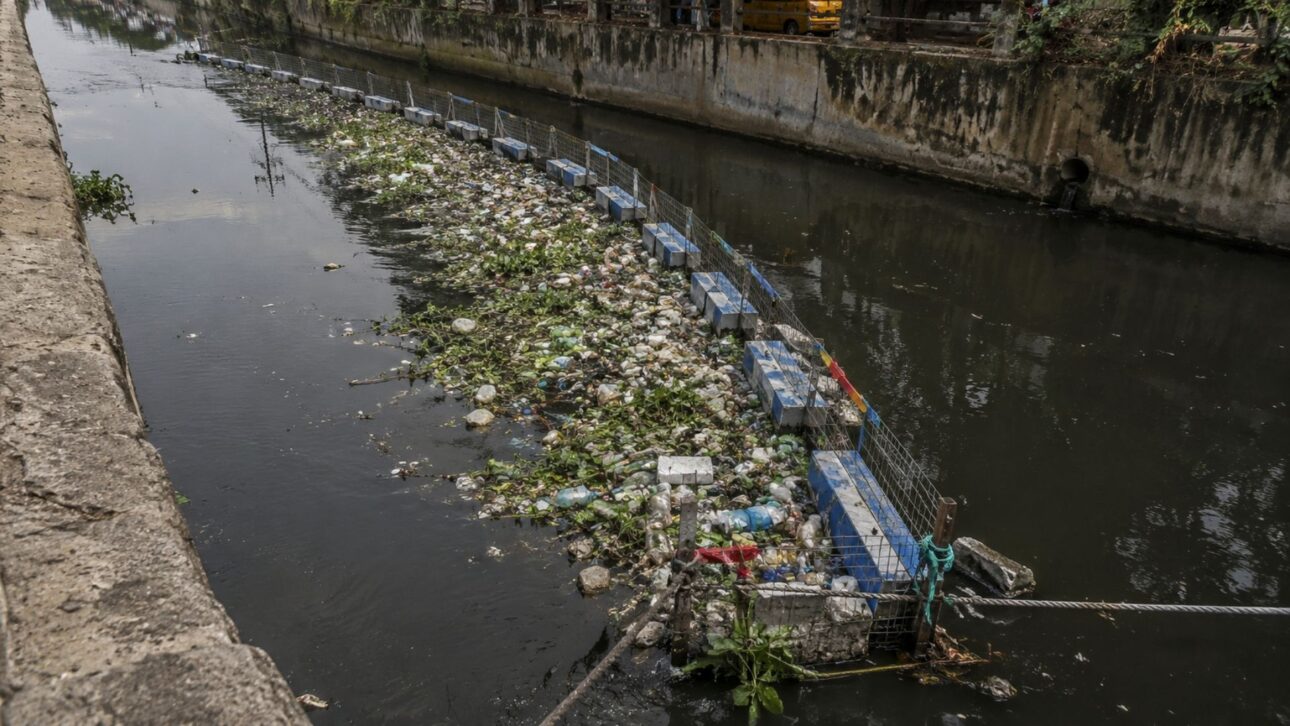
This simplicity is also the greatest technical advantage. Without fuel to supply and without heavy machinery to maintain, the operating cost plummets and the risk of breakdown practically disappears.
Where a collector boat would need diesel, crew, and constant maintenance, Sekhar’s floating barrier does the job for free, taking advantage of an energy that was already there: the current.
20 thousand tons removed from the rivers of Chennai
The results appear in weight. In the Cooum and Adyar rivers, which cut through Chennai, in southern India, the barriers have already removed more than 20 thousand tons of waste, according to The Better India.
It’s a mountain of plastic, branches, and debris that, without the equipment, would have gone straight to the sea.
The history helps to understand the scale. According to Digit, the system removed about 2,200 tons of plastic in the first year of operation in a coastal river in 2018, and the numbers have only grown since then as new barriers were installed.
Removing the trash from the rivers in such high volume, and continuously, is what differentiates the solution from occasional task forces.
That’s why the experience in Chennai became a showcase. Demonstrating that it’s possible to remove trash from rivers on a large scale, without burning fuel and at low cost, turned the floating barrier into a case cited by public managers.
What started as an idea from a retired merchant navy captain is now living proof that river cleaning doesn’t need to be expensive to work.
Up to 30 times cheaper than imported ones
The price is the argument that wins over city councils. According to The Better India, Sekhar’s floating barrier costs about 30 times less than imported alternatives that do similar work. For a city with a tight budget, this difference decides between cleaning the river or leaving it polluted.
The savings don’t stop at the purchase. Since the equipment doesn’t use fuel and requires no constant operation, the day-to-day expense is also very low, making the final cost even lighter than motor-driven solutions.
It’s low cost in installation and low cost in maintenance, a rare combination in this type of environmental technology.
This is the point that gives scale to the project. An expensive solution is restricted to a few wealthy places, but a cheap floating barrier can multiply across dozens of rivers.
By lowering the price, the captain took river cleaning out of the realm of luxury projects and made it accessible to any municipality willing to try, inside and outside of India.
The goal of stopping trash before the ocean


The ultimate target of all this is the sea. Each ton caught by the floating barrier is a ton that doesn’t become marine pollution, and that’s why working on rivers matters so much for the ocean.
According to The Better India, the invention has already prevented about 100,000 tons of trash from reaching the salty waters.
The next frontier is even more ambitious. In Goa, on the west coast of India, a project is underway to install barriers in all rivers flowing into the Arabian Sea, so that the state’s plastic stops flowing into the ocean.
According to reports, the goal is to complete this protection network in about two years.
Recognition follows the results. Sekhar’s solution has attracted the interest of municipalities, state governments, and even India’s defense forces, all looking for a cheap way to prevent river trash from ending up in the ocean.
When it comes to marine pollution, stopping the problem in fresh water has become the smartest bet.
What does Brazil have to do with this
Here, the idea is not unfamiliar. Brazil already uses so-called ecobarriers in rivers and bays, from simple nets to structures with PET bottles, to retain floating trash before it reaches the sea.
The principle is the same as the Indian invention: intercept waste in fresh water, where collection is easier.
The difference lies in scale and ingenuity. Sekhar’s proposal shows how smart design, which takes advantage of the current and requires no fuel, can multiply the result without multiplying the cost.
For a country with so many polluted rivers and tight budgets, the lesson is clear: removing trash from rivers can be cheap, as long as the engineering is good.
In the end, the story connects with a problem that is also ours. Much of the plastic that pollutes Brazilian beaches flows down the rivers, exactly the path that the floating barrier cuts off in India.
Adapting low-cost solutions like this is a concrete way to protect the ocean starting far from the beach, right at the source of the problem.
And you, do you think this would work in Brazilian rivers?
The journey of Captain DC Sekhar proves that experience and creativity are worth more than a huge budget.
After 26 years in the merchant navy, he created a fuel-free floating barrier, driven by the current, which has already removed 20,000 tons of trash from the rivers of Chennai and helped to block about 100,000 tons before reaching the ocean, all at a cost up to 30 times lower than imported ones.
And you, do you believe that a low-cost floating barrier like this could clean Brazil’s polluted rivers and protect the ocean? Share in the comments which river in your city you would like to see free of trash, and what is still needed for that to happen.