






 Portuguese
  Spanish


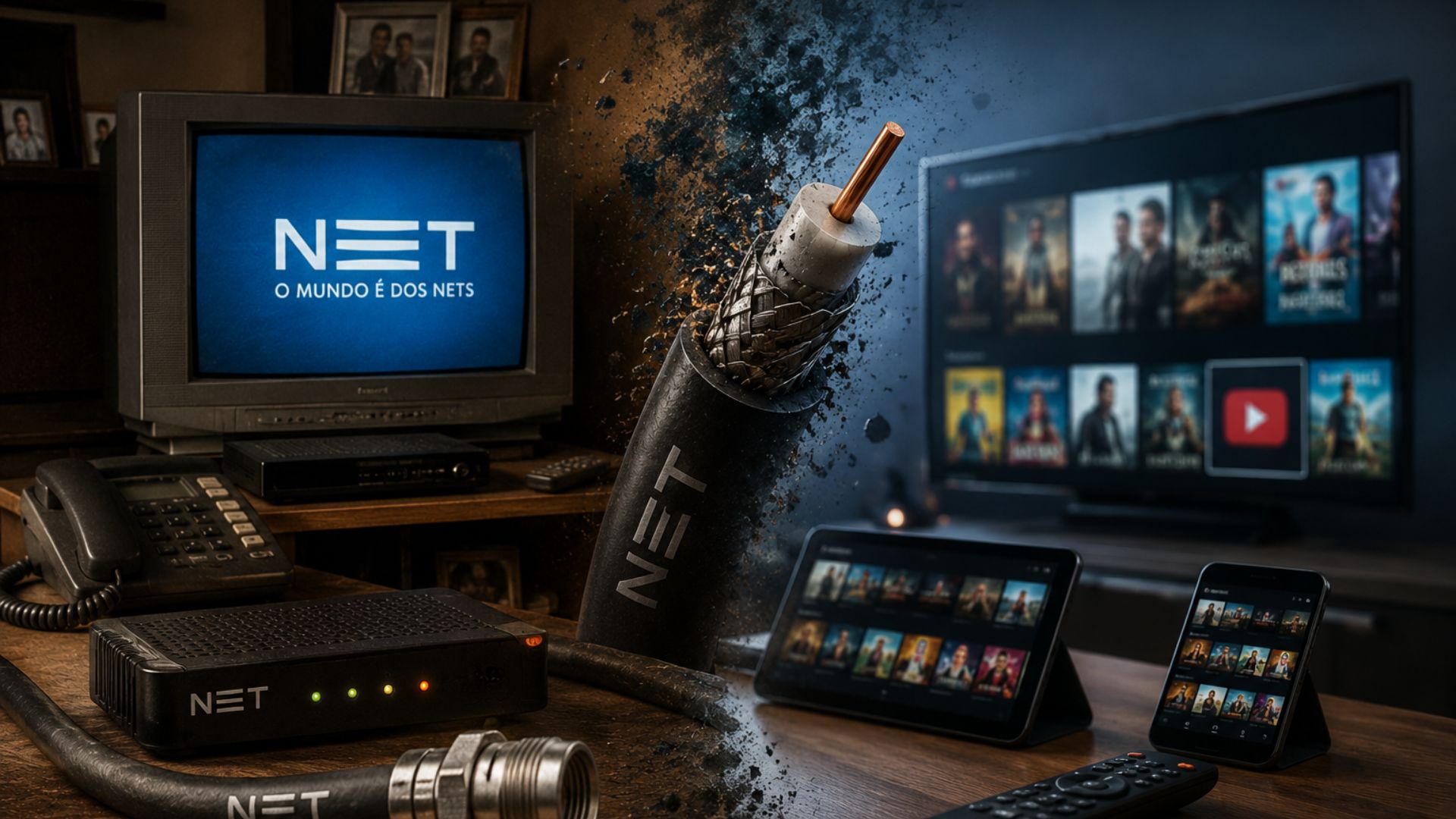

Understand how NET became Claro, why the brand disappeared, and how streaming, fiber, and mergers changed paid TV in Brazil.
NET did not disappear due to bankruptcy or sudden closure. The brand that for years was synonymous with cable TV, broadband, and landline in Brazil was absorbed by Claro, as part of a corporate and commercial integration process involving Claro, NET, and Embratel. Today, the former official NET website states that “NET is now Claro” and directs residential services for internet, TV, phone, and mobile within the Claro ecosystem.
The disappearance of the brand also coincided with a profound market change. Pay-TV, the sector in which NET grew and became dominant, peaked in Brazil last decade and then entered a strong retraction with the advance of streaming, the decline of landline telephony, changes in consumer habits, and the migration of competition to broadband, fiber optics, applications, and digital packages.
Below, understand how a company that entered millions of Brazilian homes with the promise of putting everything on a single cable ended up becoming part of a larger brand.
-
Woman Claims to Have Spotted a Technical Pattern in Recent FIFA Tournaments, Predicts Possible World Cup Winner

-
Chevrolet Offers Chance to Win a 2026 Sonic RS for Free via WhatsApp
-
Earthquake vs. Tsunami: Which Causes More Destruction and Why One Can Be Even More Dangerous
-
Hospital Cook Discovers 1,700-Year-Old Pot of 52,503 Roman Coins Using Metal Detector in Field



NET didn’t die, it was incorporated by Claro in a reorganization that unified TV, internet, landline, and mobile.
The most direct answer to the question “what happened to NET?” is this: the brand ceased to operate as the main name and was integrated into Claro’s portfolio. The service continued to exist, but the identity changed.
The modem, the bill, the app, customer service, and offers gradually began to be pushed into the Claro universe, especially with names like Claro net vírtua, Claro net fone, Claro tv, and later, Claro tv+.
This movement did not happen overnight. It was the result of years of consolidation within the América Móvil group, the Mexican conglomerate that controls Claro in Brazil. NET, which started as a cable TV powerhouse and later consolidated in residential broadband, became part of an increasingly integrated business structure with Embratel and Claro.


In 2014, Anatel’s Board of Directors granted prior consent for the corporate integration between Claro, NET, and Embratel. At the time, the process was described by specialized coverage as one of the most complex consolidation operations ever submitted to the agency, precisely because it involved companies with different operations, including mobile telephony, fixed telephony, broadband, pay TV, and corporate services.
From then on, the commercial logic became clear: instead of maintaining three strong separate brands, the group would move towards a convergent operation. Claro would bear the weight of the main brand for mobile, internet, TV, and digital services; Embratel would remain more associated with the corporate market; and NET would be gradually absorbed into the residential segment.
The brand grew because it sold a simple idea: everything on a single cable inside the house.
NET’s strength came from a promise that seems common today but was very powerful in Brazil in the 2000s: bringing together pay TV, broadband internet, and landline phone in a single package. This model became known in the sector as triple play, a combination of video, data, and voice delivered by the same infrastructure.
For millions of Brazilians, NET was the name of the cable that reached the living room, the modem that blinked in the corner of the house, the TV decoder, the monthly bill, and the landline included in the combo. The company became a daily presence because it managed to transform technical infrastructure into a simple domestic experience: paid channels, fast internet for the time, and phone calls all under one contract.
This was the brand’s big turning point. NET was not just a pay TV operator. It became a residential telecommunications platform before the term “ecosystem” became fashionable in the sector. The connected Brazilian home, before streaming, went through coaxial cables, decoders, modems, and combined packages sold by NET.
The peak of pay TV created the perfect environment for NET to dominate millions of homes.
NET’s best moment coincided with the peak of pay TV in Brazil. In November 2014, Anatel registered 19.81 million pay TV subscriptions in the country, with a density of 30.20 subscriptions per 100 households. This was the period when channel packages, football, movies, series, children’s programming, HD channels, and on-demand services still formed the core of paid home entertainment.
In this environment, NET benefited from an important advantage: it had a fixed network, strong urban presence, a consolidated subscriber base, and a combined service offering. In many neighborhoods of large cities, subscribing to pay TV and internet practically meant subscribing to NET.
Even when the brand was already part of Claro’s structure, its commercial weight remained significant. In its first-quarter 2019 results report, Claro still treated NET’s fixed broadband as a growth engine for residential services, stating that NET had added 74,000 new fixed broadband accesses in the quarter and maintained leadership in “ultrabroadband” connections, above 34 Mbps, with 54% market share in this segment.
This data shows an important point: NET was still strong when it began to visually disappear. The weakening of the name did not mean that the operation had immediately lost relevance. On the contrary, the infrastructure and customer base remained valuable within Claro.
The decline of pay TV changed the strategic value of the NET brand
NET grew at a time when pay TV was the aspirational product. Consumers paid for more channels, movies, soccer, international journalism, children’s programming, and superior image quality. However, this market changed rapidly.
According to IBGE data, in 2024, 18.3 million households with television had pay TV service, equivalent to 24.3% of households with TV, a decrease compared to 2023. In the same survey, 32.7 million households had paid video streaming service, representing 43.4% of homes with television.

The number is decisive for understanding NET’s disappearance from the country’s routine. The brand that was born strong in pay TV began to carry a direct association with a shrinking market. Streaming changed the logic of consumption: the user chooses what to watch, when to watch, on which screen to watch, and without depending on a traditional linear schedule.
Pay television did not end, but it lost cultural centrality. Before, the channel package was the heart of the connected home. Now, broadband has become the main product, because it supports Netflix, YouTube, Globoplay, Max, Prime Video, online games, home office, social networks, video conferences, and smart TVs.
Streaming didn’t kill NET alone, but it accelerated the identity change
It’s simplistic to say that NET disappeared solely because of Netflix or any isolated platform. What happened was a combination of factors: corporate consolidation, brand change, decline of pay TV, advance of streaming, decrease in fixed telephony, and the transformation of broadband into the most important product in the residential package.
The IBGE data helps measure this shift. In 2024, among households with paid streaming, 8.2% no longer had access to either free-to-air TV or pay TV. In 2022, this percentage was 4.7%. This shows a change in behavior: a growing portion of households now experience paid audiovisual content directly via the internet, without relying on the traditional channel package.
For Claro, maintaining NET as the main brand for TV, internet, and fixed telephony made less sense in a convergent market. The company needed to sell mobile, fiber, 5G, streaming, apps, internet TV, and digital services under a single brand. It was in this scenario that Claro began to absorb the symbolic space previously occupied by NET.
Claro absorbed the brand precisely when the battle shifted to fiber, 5G, and digital packages
NET was strong in cable. Claro was strong in mobile. Embratel was strong in infrastructure and corporate services. The integration allowed these fronts to be combined into a single operation.
Today, Claro’s official website places fixed internet, TV and streaming, phone, mobile, and digital services within the same commercial showcase. The old NET page also directs consumers to internet plans, Claro tv+, mobile, and customer service in Minha Claro. The website itself states that the old Minha NET is now in Minha Claro and that the app serves products such as Claro net vírtua, Claro net tv, Claro net fone, and Claro tv.

This detail shows how the brand was gradually emptied. The customer who used to say “I’m going to pay NET” started accessing Minha Claro. The product that used to be NET Virtua became Claro net vírtua. The TV that used to be NET became Claro TV and then Claro tv+. The NET name survived in some commercial combinations, but it ceased to be the center of communication.
The infrastructure continued to be used, the customer base continued to exist, and the services remained active, but the brand lost prominence to Claro.
Pay TV shrank faster than broadband, and this changed the entire business logic
The NET brand had two main strengths: pay TV and fixed internet. However, these two markets took different paths.
Pay TV shrank significantly. Data consolidated by Anatel, cited by Tele.Síntese, indicates that the Conditional Access Service ended 2025 with approximately 7.6 million active points, compared to 9.2 million in 2024 and 11.7 million in 2023. The same analysis shows that the number of pay TV accesses fell from approximately 19.1 million in 2015 to less than 8 million in 2025.
Fixed broadband, on the other hand, became essential infrastructure. Consumers can cancel channel packages, but they can hardly live without residential internet. NET’s former technical strength, therefore, remained relevant, but the product that emotionally sustained the brand, pay TV, lost its place in everyday life.
This is the central point of the transformation: NET became less of an entertainment brand and more of an invisible infrastructure within Claro. The cable that once delivered closed channels now competes with fiber, streaming, and Wi-Fi inside the home.
The NET name disappeared because it carried an era that Claro wanted to overcome
Brands don’t disappear solely due to legal decisions. They vanish when they cease to represent the company’s strategic future. In NET’s case, the name carried a very strong memory of cable TV, residential bundles, landline phones, and linear programming.

Claro needed to represent something else: mobility, 5G, fiber, streaming, apps, multi-screen TV, digital customer service, and convergence between home and mobile. The unification helped reduce fragmentation in communication, customer service, and sales.
From a commercial standpoint, it made more sense to tell the customer that everything was with Claro. A single app, a single bill in many cases, a single customer relationship center, a single visual identity, and a broader brand to compete with Vivo, TIM, regional fiber providers, streaming platforms, and digital services.
NET became a memory for a generation that discovered fast internet before popular fiber
For an entire generation, NET Virtua was synonymous with fast internet. In many urban centers, cable internet offered speeds superior to traditional ADSL connections, becoming a desired option for those who played online, downloaded files, watched videos, and started connecting more devices inside the home.
The brand also became associated with specific moments in Brazilian domestic culture: technician installation, modem on the rack, HD channels, decoder remote control, soccer packages, landline phone in the bundle, and the famous “is NET down?” used even by those who no longer knew exactly which company provided the service.
This cultural weight explains why the brand’s disappearance still sparks curiosity. NET was not just an operator. It was part of the transition between the analog home and the connected home.
What remained of NET within Claro
What remained of NET was mainly infrastructure, customer base, residential products, and brand memory. The name still appears in some commercial contexts, especially linked to “Claro net” in offers, old bills, customer service pages, and customer references. But the institutional brand, as a separate national protagonist, was absorbed.
Today, when consumers look for NET, they find Claro. When they look for Minha NET, they are directed to Minha Claro. When they look for TV and streaming, they find Claro tv+. The company is not trying to resurrect NET as an independent brand; it is using its assets within a larger operation.
This is the difference between dying and being incorporated. NET didn’t end as a service. It ceased to be the facade.
NET’s disappearance shows how the internet triumphed over TV within the operator itself
The NET case summarizes a major shift in the Brazilian market. The company that became famous for bringing pay TV to millions of homes ended up being swallowed by a reality where the internet became more important than TV.

Before, broadband was sold as a complement to the channel package. Today, the logic has reversed: TV, when it exists, has become a complement to the internet. Consumers choose streaming, apps, live channels, YouTube, social media, and games within the same connection.
NET put TV, internet, and telephone on the same cable. Later, streaming and broadband transformed that cable into something much bigger: the gateway to all digital entertainment in the home.
In the end, the brand that helped Brazil enter the era of residential bundles disappeared precisely because the market it helped create became too big to fit the name NET. The question that remains is: did Claro inherit only the customers and infrastructure, or did it also manage to preserve the symbolic strength that NET had in the daily lives of millions of Brazilians?


