Portuguese
  Spanish


The first gas station opened in 1913 created an innovative refueling model that influenced the industry worldwide.
On a corner in the city of Pittsburgh, in the state of Pennsylvania, in the United States, an innovation inaugurated on December 1, 1913, transformed the drivers’ experience and helped shape the future of mobility. At that location, the Gulf Refining Company put into operation what is considered the first gas station designed exclusively to serve automobiles, creating a model that would be adopted in various countries over the decades.
According to the magazine SuperInteressante, the enterprise was installed at the intersection of Baum Boulevard and St. Clair’s Street and emerged at a time when the number of cars was rapidly increasing in the United States. With about 500,000 vehicles already circulating in the country, drivers still faced difficulties refueling.
Gasoline was typically purchased in hardware stores or other commercial establishments and stored in metal containers, requiring each owner to refuel on their own.
-
Two Newborns Named Cecília Share Same Birth Minute at Brazilian Hospital, Creating Rare Coincidence

-
Brazilian Couple Turns Property into Culinary Hub, Investing $400,000 to Build a Business Earning $800,000 Annually
-
Couple Quits Jobs, Converts 1981 VW Van into Home, Travels 80,000 Kilometers Across the Americas, and Wins Surprise Tickets to See Messi Make History at the World Cup

-
Rio de Janeiro School’s Listening Program Reduces Dropout Rates and Boosts Literacy, Set to Expand to 350 Municipal Schools


The novelty presented by Gulf changed this scenario by bringing together fuel, specialized service, and services exclusively aimed at drivers in a single space. The result was a success that helped create a new automotive culture.
What was the first gas station in history like?
Unlike modern stations, the facility inaugurated in 1913 had quite particular architectural features. The project was designed by architect J. H. Giesey and featured a hexagonal shape, walls covered with red bricks up to approximately shoulder height, and a flat roof finished with mortar.
Around the construction, there was a circular track that allowed vehicles to easily approach the fuel pumps. The concept already included elements similar to the drive-thru system known today.
Drivers could refuel their vehicles by paying 27 cents per gallon, a measure equivalent to approximately 3.7 liters. Additionally, they found assistance for tasks that are now considered common at gas stations.
Among the services offered were:
- Tank refueling;
- Checking and refilling water in the radiator;
- Tire pressure check;
- Service provided by trained staff.
According to the Smithsonian Institution, drive-in stations played a much broader role than just selling fuel. The institution states that these facilities helped develop the very automotive culture of the United States.
First Gas Station Had a Modest Start
Despite its historical importance, the first days of operation were relatively modest. On the opening Monday, sales totaled only 30 gallons of fuel, equivalent to about 113 liters. However, the novelty quickly aroused the curiosity of the city’s residents.
In less than a week, demand grew significantly. By the Sunday following the opening, the volume sold had already reached 350 gallons per day, approximately 1,320 liters.
The increase demonstrated that there was a demand for a place dedicated exclusively to serving automobiles. From that moment on, the concept began to be reproduced in different regions and became a reference for the fuel industry.
Before the First Gas Station, Refueling Was Very Different
Automobiles did not emerge alongside fuel stations. In fact, cars had been on the road for a few years when Gulf opened its pioneering facility. At that time, acquiring gasoline was a much less practical task.
Vehicle owners had to look for establishments that sold various types of products, especially hardware. In some places, fuel could also be found in pharmacies.
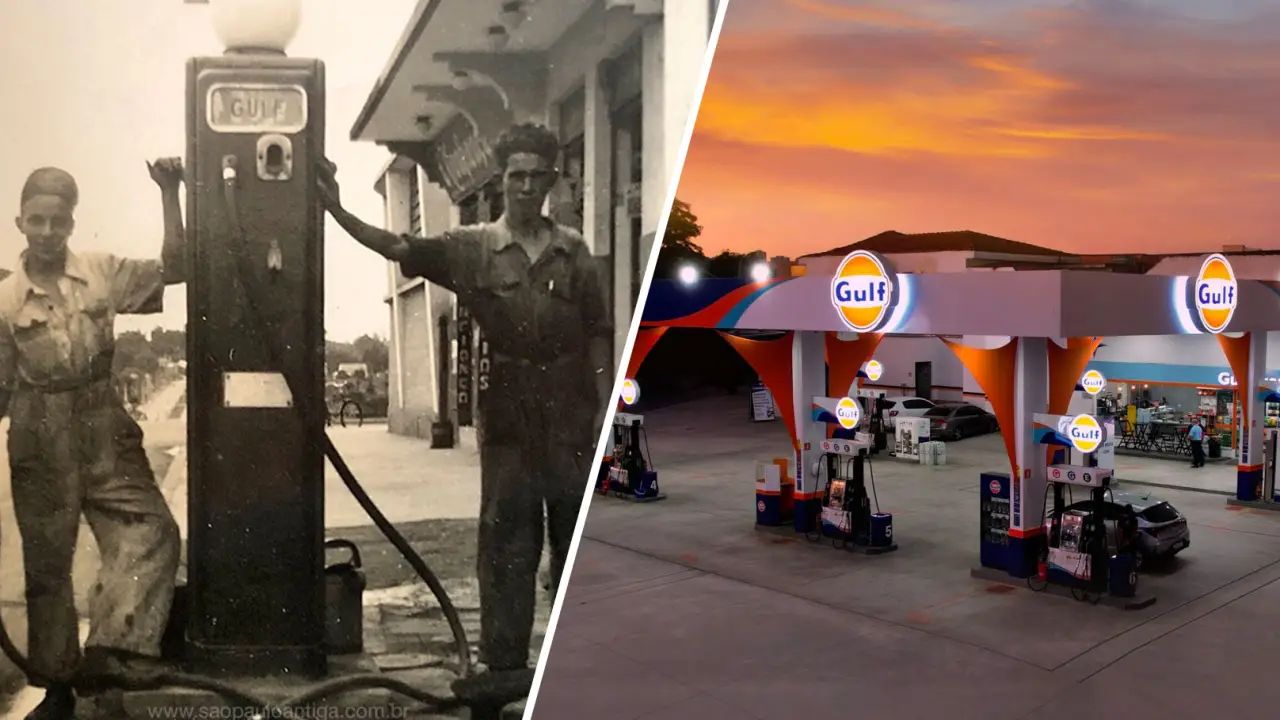
After the purchase, it was up to the driver to manually transfer the gasoline to the car’s tank. Another curious detail is that the tanks were usually located under the driver’s seat, making the process even less convenient.
Although there were some improvised refueling points along sidewalks during the 1900s, none of them offered a structure similar to the one created by Gulf. The American Oil and Gas Historical Society highlights that the facility was specifically designed to serve drivers, something innovative for the time.
The first gas station also created new services
The innovation was not limited to refueling. In addition to offering basic mechanical assistance, the location introduced another idea that would become quite popular among drivers: the free distribution of road maps.
At the time, traveling by car was still a relatively new experience for much of the population. As a result, many people did not have reliable references to plan trips between cities.
The delivery of maps helped drivers organize routes and encouraged the use of cars on longer journeys. Over the years, this initiative would be copied by several companies in the sector.
The legacy that remains more than a century later
More than 110 years after its inauguration, the location that hosted the first gas station no longer houses the original structure. Today there is a parking lot in the area where the pioneering facility operated. Nevertheless, a historical plaque recalls the importance of that address for the evolution of the fuel sector.
The inscription records that at that point Gulf inaugurated, in December 1913, the first drive-in facility specifically built to provide gasoline, oils, and lubricants to the automotive public. The recognition demonstrates the lasting impact of the initiative, which helped define service standards adopted in various countries.
More than a century after the inauguration of the first gas station in Pittsburgh, the model created by Gulf remains present in the daily lives of millions of drivers. The pioneering concept of offering fuel, services, and specialized service in a single location has crossed generations, influenced the expansion of automotive culture, and remains a reference for the sector to this day.
With information from SuperInteressante Magazine