





 Portuguese
  English
  Spanish
  5 min of reading
  0 comments


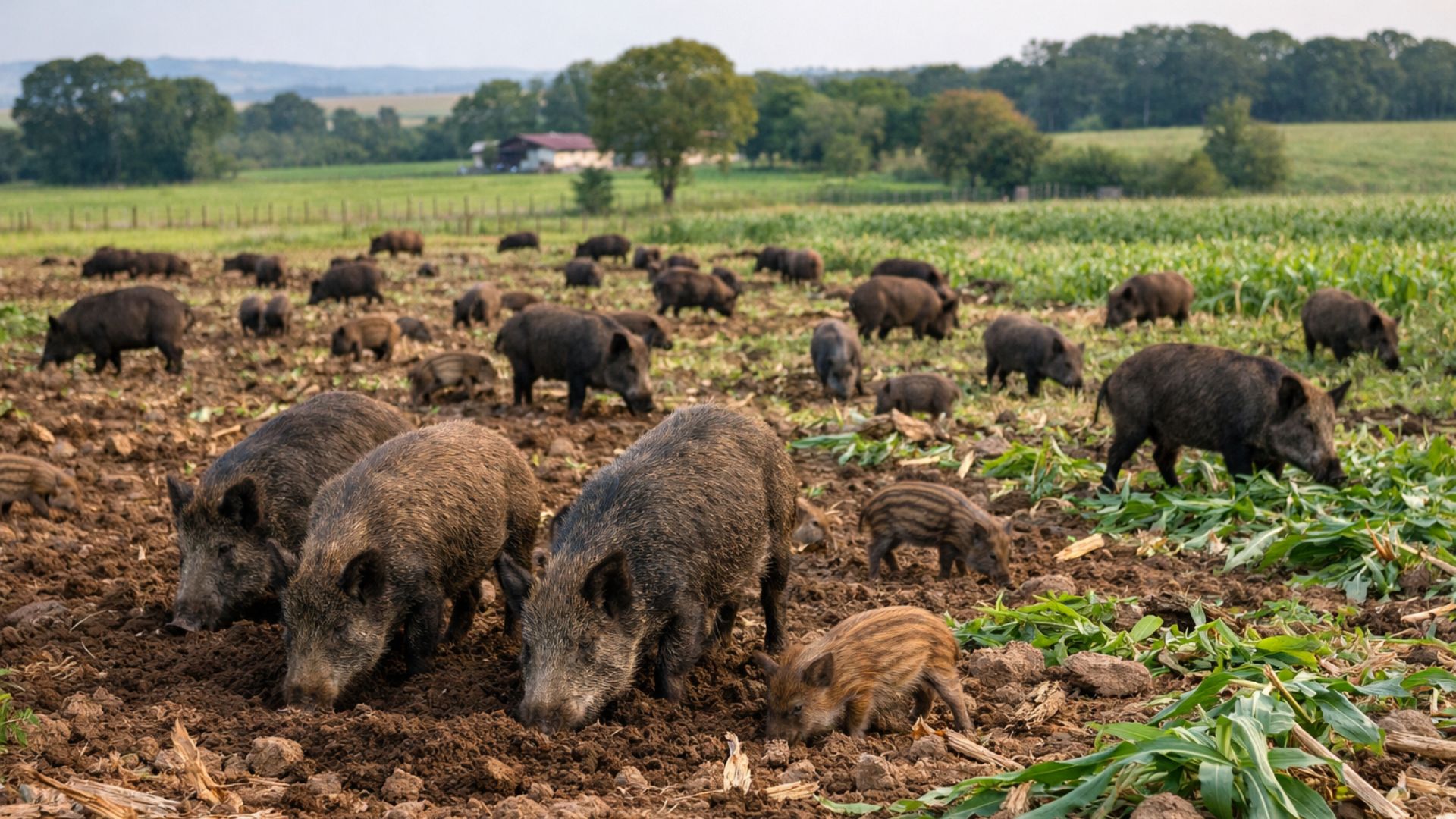
Global expansion of wild boar pressures crops, threatens production chains, and boosts the premium meat market in different regions of the world, amid sanitary risks and structural challenges of supply and population control.
The wild boar has ceased to be merely an environmental and sanitary problem and has also transformed into a niche product in the international meat market.
The global trade of wild boar meat was estimated at US$ 1.32 billion, with projections to reach US$ 2.21 billion by 2033, at an average annual rate of 5.8%, according to the consultancy Growth Market Reports.
This advancement occurs at the same time that several countries are trying to contain the expansion of feral populations that pressure crops, threaten livestock, and increase control costs in the field.
-
Santa Catarina leads national production in 12 agribusiness chains and dominates more than 50 segments ranging from apples to oysters and from pork to knit fabrics. The state consolidates its position among the five largest producers in Brazil in almost everything it produces.

-
The most consumed fish in Brazil may be added to the official list of invasive exotic species this Wednesday, and Conabio’s proposal regarding tilapia divides the government, alarms fish farming, and reignites a debate that the Ministry of the Environment insists does not mean a ban.
-
After BYD and others, China invades Brazil with giant tractors of up to 700 hp, 50% fuel savings, and a billion-dollar factory planned after Zoomlion projects R$ 500 million in sales in Brazilian agriculture.
-
China buys 1.1 million tons of beef in four months, an increase of 25.75%, and Brazil leads with 612.87 thousand tons




The contradiction helps explain the growing interest in the animal.
In regions of Europe and North America, the wild boar is treated as an invader and a target for population management, but it also supplies restaurants, specialized butcher shops, and direct sales platforms.
According to a report published by Forbes magazine, this movement reveals the coexistence between combating the species and its transformation into a valued product in the gastronomic market.
In the United States, the federal government classifies feral swine as an invasive species and estimates the damages and control costs associated with the animal in the agricultural sector to be in the billions of dollars.
In Texas, where the concentration is one of the highest in the country, state surveys indicate significant losses for agriculture, consolidating the wild boar as a relevant economic problem.
Sanitary risk and economic impact of wild boar
The market expansion is not only explained by gastronomic appeal.
The wild boar and other feral pigs are at the center of sanitary concerns because African swine fever affects domestic pigs and wild boars and can reach mortality rates of up to 100%, according to international animal health organizations.
In Italy, the spread of the disease led the government to expand containment measures to protect a chain of cured meats and hams that generates about € 8.2 billion per year and supports approximately 50,000 jobs.
In this context, according to Forbes magazine, the advancement of the disease has elevated the status of the wild boar from agricultural pest to strategic economic risk in European countries, especially those with a strong tradition in cured meat production.
At the same time, wild boar meat maintains cultural and commercial value in countries like Italy, where it has appeared for decades in regional preparations, especially in rural areas and traditional hunting grounds.
The overlap between an excess of free-ranging animals, sanitary risk, and niche demand creates a peculiar market, where population control coexists with the consumption of a protein seen as differentiated.
Expansion of wild boar in Brazil and losses in the field
In Brazil, the problem is more associated with the impact in the field than with the formation of a robust meat market.
Ibama reports that the wild boar is an exotic invasive species, with a recorded presence in 15 federative units, and reminds that population control of the animal in the wild has been authorized in the country since 2013.
The difficulty of containment is linked to the reproductive capacity and adaptability of the animal.
Technical documents indicate accelerated population growth due to the absence of relevant natural predators and the availability of food in agricultural areas.
In Santa Catarina, agricultural sector entities recorded over 120,000 wild boars slaughtered between 2019 and 2024, yet they still estimate over 200,000 animals distributed across 236 municipalities.
The losses go beyond the overturned crops.
The wild boar destroys plantations, compacts the soil, affects springs, pressures native fauna, and increases the risk of disease transmission to commercial pig farming.
Estimates released by agricultural entities indicate that a sanitary emergency involving diseases such as classical swine fever or foot-and-mouth disease could lead to losses of up to R$ 50 billion in severe scenarios.
Additionally, the newspaper also pointed out that, in certain Brazilian regions, damage to crops can reach up to 40% of production, especially in crops like corn and soybeans, although this data still appears more frequently in sector surveys.
Wild boar meat market and consumption challenges
While management progresses unevenly, the transformation of wild boar into premium protein depends on factors that go beyond capture or slaughter.
The academic literature itself shows that there is room for expansion, but also consumer resistance.
A study published in the journal Sustainability with 80 evaluators concluded that wild boar meat can serve as a partial substitute for pork, including a willingness to pay equivalent among part of the public.
Still, the research pointed out significant barriers to increasing consumption, such as distrust regarding sanitary inspection, rejection of hunting, and low availability in conventional retail.
In this scenario, according to Forbes magazine, the expansion of global consumption directly depends on greater transparency in sanitary certification and the expansion of distribution channels, especially outside specialized niches.
This combination helps to understand why the global market growth remains concentrated in premium profile restaurants and processed products.
Sausages, cured meats, and portioned cuts tend to lower the entry barrier for consumers interested in trying the protein without taking on the entire preparation of a less common meat.
Geographically, the Asia-Pacific region appears as the fastest-expanding area of this market.
The block generated US$ 270 million in 2024 and is expected to grow at 7.2% per year until 2033, driven by urbanization, rising income, and the search for premium meats in countries like China, Japan, and South Korea.
For Brazil, this movement suggests a potential opportunity, but the gap between environmental control, sanitary traceability, and supply organization still prevents the country from treating wild boar as a relevant chain of value-added protein.






Be the first to react!