






 Portuguese
  Spanish


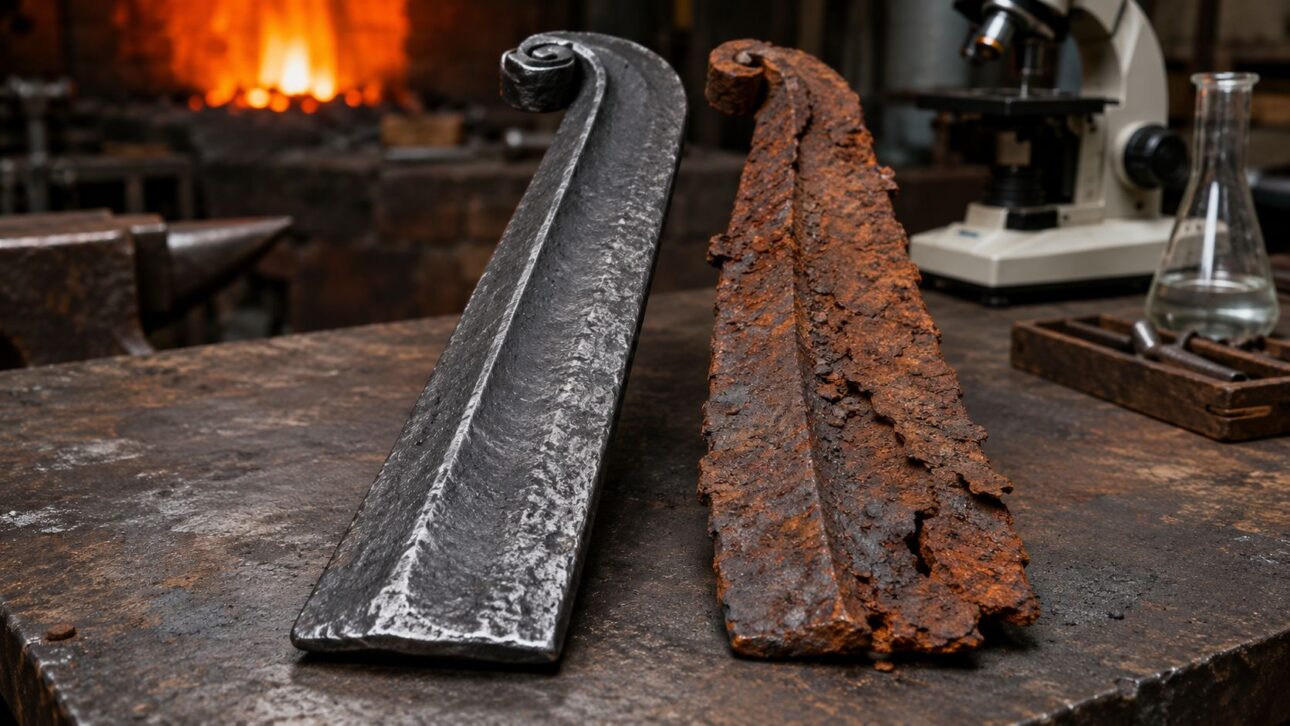
A study published in the journal Scientific Reports, from the Nature Portfolio group, showed that irons produced by an ancient traditional Indian technique could develop superior rust resistance due to the way they were manufactured, worked, and modified by corrosion over time.
The research analyzed iron samples produced by methods associated with the Agaria tribes in Chhattisgarh, Central India.
The work investigated why this material exhibited an unusual resistance to corrosion, even though it was made by an artisanal process, prior to modern metallurgy.
Research did not analyze any medieval iron, but helps explain the phenomenon
The investigation did not directly address European medieval swords, armor, or common pieces from ancient castles. The focus was on iron produced by an Indian metallurgical tradition preserved by Agaria communities.
-
NOAA Scientists Discover Mysterious, Perfectly Aligned Holes on the Mid-Atlantic Ridge Seafloor, Origin Still Unknown

-
California Startup Develops Giant “Space Sling” to Launch Vehicles at Mach 6, Reducing Fuel Use and Enabling Thousands of Satellite Deployments

-
ChatGPT Alerts FBI to Prevent Planned Murder of 8-Year-Old in Brazil’s Espírito Santo
-
Scientists Discover 125-Million-Year-Old “Pregnant Fossil” with Preserved Embryos and Microscopic Larvae Inside Mollusk in England



Even so, the results help understand why certain ancient irons, especially those forged by pre-industrial techniques, can resist corrosion better than common carbon steels used today.
The explanation is not in a single factor. The study shows that the resistance came from a combination of the ore used, the presence of slag, the mineral phases formed on the surface, the oxidation process, and the hot hammering applied after the initial production of the iron.
Samples came from a traditional iron production region
The samples analyzed were obtained in Aamadandh, in the Korba district, in the state of Chhattisgarh. According to the researchers, members of the Agaria tribes donated the iron used in the investigation.
The team also collected ore and slag in the same region. This detail was important because it allowed comparison of the final iron with the materials involved in its production.
The article highlights that many remnants of the ancient traditional furnaces were destroyed by the action of time. Therefore, researchers worked with available fragments and with the scientific reconstruction of the process from the samples, chemical composition, and internal structures of the material.
Ancient furnace produced spongy iron mixed with slag
The Agaria technology of iron production in bloomery-type furnaces may have existed before 1200 AD, although the exact date is not defined. This type of furnace did not produce liquid iron as in modern blast furnaces. The result was a mass of spongy iron, mixed with slag, which then needed to be manually worked.
The traditional furnace described in the study was bowl-shaped and was usually constructed below ground level. The pit was about 800 millimeters high and 200 millimeters in diameter. The furnace shaft was below the 600-millimeter mark. The bowl-shaped hearth was about 240 millimeters in diameter and 100 millimeters deep.
The structure also had a hole for slag drainage. During production, air was blown to maintain the temperature around 1150 °C. The process took approximately 5 to 6 hours for each kilogram of iron produced.
Hot hammering was decisive for improving the material
After the initial production, the spongy iron needed to undergo forging. In this stage, hot hammering helped to compact the metallic mass, reduce internal pores, and remove part of the slag inclusions.
The study compared hammered and non-hammered iron through neutron tomography. The result showed that mechanical work consolidated internal pores and helped eliminate inclusions present in the material.
The hammered iron presented a thicker passive corrosion film than the non-hammered iron. For the authors, this thicker film was one of the factors that helped explain the superior corrosion resistance.
In practice, hammering not only shaped the iron. It also improved its internal structure and favored the formation of a more protective surface against rust.
Corrosion layer functioned as a natural protection
One of the central findings of the research was the presence of a thick layer of corrosion products on the iron. At first glance, this may seem contradictory, as corrosion is usually associated with the destruction of metal.
In the analyzed case, however, this layer was not just a sign of degradation. It also functioned as a protective barrier, hindering the advance of corrosion into the interior of the material.
The microscopic analysis showed visible cracks in this layer, mostly in the range of approximately 4 to 5 micrometers, as well as some larger fissures. In areas where the surface film was thicker, researchers observed fewer cracks.
The formation of small flakes on the surface was associated with atmospheric corrosion, rather than an aggressive marine environment. This indicates that the material was mainly affected by exposure to air and humidity, not by saltwater.
Hematite, quartz, and calcite appeared on the surface film
The composition of the corrosion layer was analyzed with different techniques. Grazing incidence X-ray diffraction indicated the presence of hematite, quartz, and calcite.
Through Rietveld analysis, researchers found 70% by mass of Fe2O3, 19% of SiO2, and 11% of CaCO3. These compounds helped form a stable film on the iron surface.
Hematite, an iron oxide, was one of the most important phases identified. The study describes hematite as the most stable iron oxide among the observed phases. Its free energy of formation was indicated as -744.4 ± 1.3 kJ mol−1.
Maghemite was also identified, but as a less stable phase, with a free energy of formation of -731.4 ± 2.0 kJ mol−1 at 298 K and 1 bar of pressure.
Neutron analysis revealed the internal structure of iron
In addition to surface analyses, researchers used neutron diffraction to investigate the interior of the material. This technique is important because neutrons can penetrate deeper into iron than other forms of radiation used in surface analyses.
Neutron diffraction confirmed the presence of iron, cementite, and maghemite. Through Rietveld analysis, the material showed about 92% by mass of iron, 1.1% of Fe3O4, and 1.7% of Fe3C. Unidentified phases represented about 5% of the sample.
The study also recorded unclassified peak positions at 40.62°, 42.38°, 64.49°, 76.86°, 96.73°, and 115.34°. These signals indicate that there were phases not yet fully identified in the analyzed material.
The detection of the BCC α-Fe structure led the authors to consider that the Agaria furnace likely operated below 1000 °C under a certain effective condition of material formation. At the same time, the description of the traditional process mentions a temperature around 1150 °C during production, which shows the complexity of reconstructing an ancient artisanal technique solely through preserved samples.
Calcium may have come from the clay used in the furnace
Another important finding was the presence of calcium and silicon in the corrosion layer. The analyzed ore showed hematite, kaolinite, and anatase, but did not show calcium.
For this reason, the authors hypothesized that calcium may have entered the process from the clay used at the bottom of the furnace. Another possibility mentioned is the presence of fine coal dust or an inclined bamboo platform coated with clay, used to slide the load into the furnace.
This observation shows that the strength of the iron did not depend solely on the ore. Auxiliary materials from the furnace, the lining, and the production environment may also have influenced the final composition of the protective layer.
Study did not find phosphorus in the analyzed samples
The absence of phosphorus was another relevant point of the research. In many debates about the resistance of ancient Indian irons, especially in the case of the famous Iron Pillar of Delhi, phosphorus appears as a possible factor responsible for protection against corrosion.
In this study, however, the presence of phosphorus was not detected in the iron or in the corrosion layer within the limits of the techniques used. This means that, in the analyzed Agaria samples, the superior resistance to rust was not attributed to phosphorus.
The conclusion reinforces that different ancient irons may have resisted corrosion through distinct mechanisms. In some cases, phosphorus may play an important role. In this specific case, the protection was mainly associated with the layer formed by oxides and mineral compounds, hot hammering, and the consolidated structure of the material.
Ancient iron was not better in everything than modern steel
The study does not claim that all ancient iron was better than modern steel. The conclusion is more specific: irons produced by certain traditional techniques could form an efficient protective layer against corrosion.
This resistance should not be confused with that of modern stainless steel, which is manufactured with alloys designed to resist oxidation, especially due to the presence of chromium. The more appropriate comparison is with common carbon steels, which can rust quickly when exposed to moisture without adequate protection.
It is also important to remember that ancient production varied greatly. The quality of the iron depended on the ore, the furnace, the temperature, the fuel, the skill of the blacksmith, and the forging steps. Therefore, not all medieval or ancient iron had the same resistance to rust.
Discovery shows sophistication of traditional metallurgy
The main contribution of the study is to show that ancient metallurgy could generate materials with complex properties, even without modern industrial control instruments.
In the case of the Agaria samples, corrosion resistance arose from a sequence of factors: ore rich in iron oxides, use of bloomery furnace, slag formation, hot hammering, pore reduction, removal of inclusions, and development of a surface film rich in hematite, quartz, and calcite.
This combination created a natural protection, capable of delaying the advance of rust. The research also shows that artisanal processes, often seen as simple or rudimentary, could produce sophisticated results when mastered by specialized communities.
Source
This article was based on the study Uncovering the superior corrosion resistance of iron made via ancient Indian iron-making practice, published in the journal Scientific Reports.


