






 Portuguese
  Spanish
  4 min of reading
  0 comments


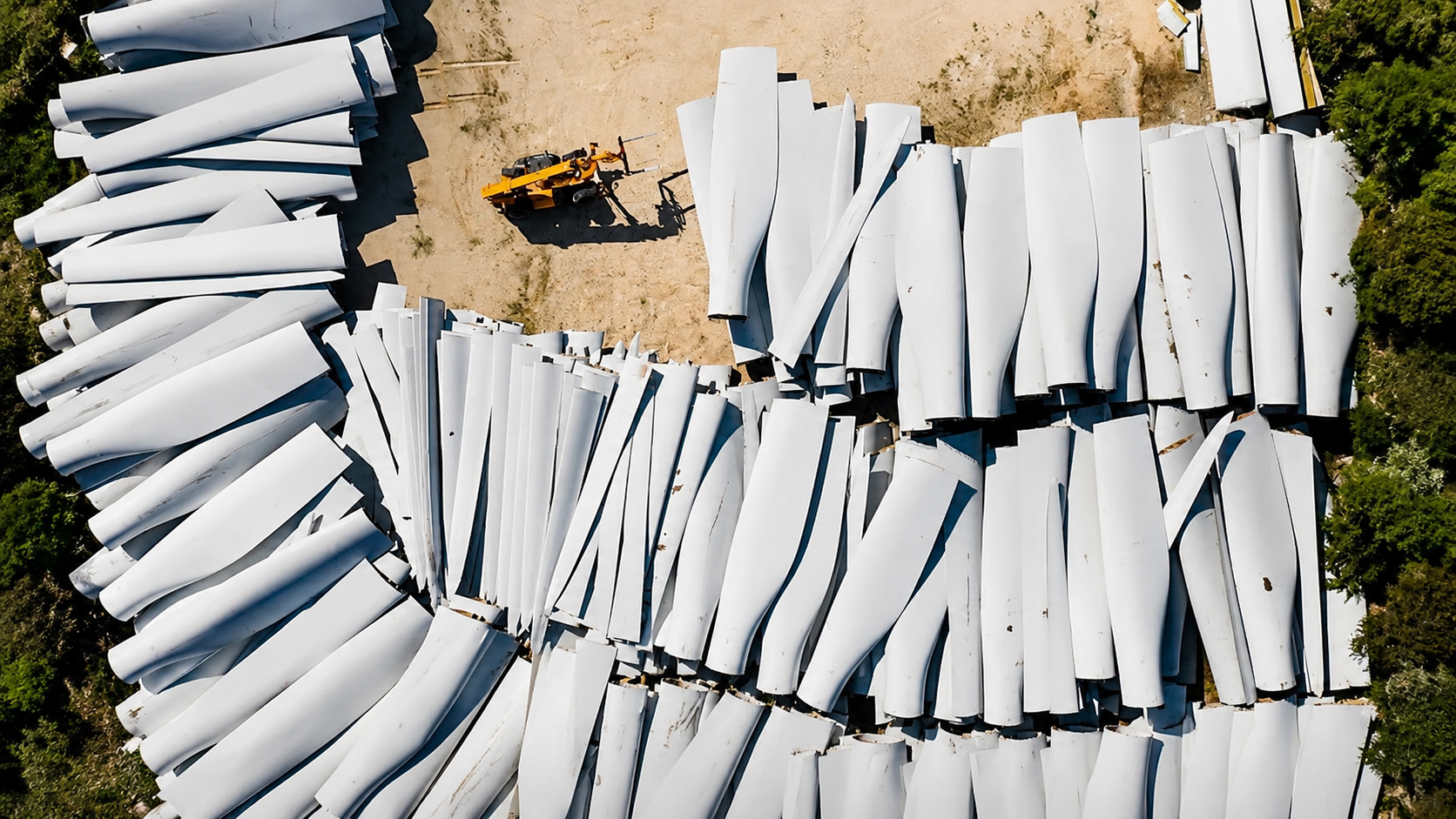
Wind turbine blade waste could reach 43 million tons by 2050 and challenge the recycling of the renewable energy industry.
The expansion of wind energy has turned turbines into one of the global symbols of the energy transition. But, while thousands of new parks continue to emerge, another problem begins to grow silently: the fate of the gigantic blades that reach the end of their useful life. Studies indicate that the world could accumulate about 43 million tons of wind turbine blade waste by 2050, creating an industrial challenge involving recycling, landfills, repurposing, and the development of new materials. The problem is especially concentrated in countries that led the expansion of wind energy in recent decades, such as China, the United States, and European members.
The same technology that helped expand renewable energy created giant structures that are difficult to recycle
The modern blades are primarily constructed with composite materials, including fiberglass, carbon fiber, and special resins developed to withstand decades of operation under wind, rain, thermal variations, and constant mechanical stress.


This type of construction increases durability and reduces weight, but creates a problem when the turbine is retired.
-
Long before sustainable construction became a trend, China built earthen fortresses with multiple floors, a central courtyard, and the capacity to house up to 800 people living in a community.

-
He got tired of renting, bought an old school bus, removed the seats, modified the roof, reinforced everything with steel, and created a two-story mobile home that looks small on the outside but houses two bedrooms inside.
-
A mother of four sought a safer family environment, watched tutorials on the internet, built a 325 m² house with her family, and learned foundation, walls, plumbing, and electrical work without any professional experience.
-
Iron ore falls to 762 yuan in China as real estate sales decline and steel production hits lowest level since 2018




Unlike steel, aluminum, or copper, the composites used in the blades cannot simply be melted and turned into new parts in the same way as other industrial materials.
The result is that many blades end up being cut into large sections and sent to landfills, something that has generated criticism precisely because wind energy is often presented as an environmentally sustainable alternative.
Study projects 43 million tons of waste by 2050 and puts China, Europe, and the United States at the center of the problem
One of the most cited estimates on the subject was published in the scientific journal Waste Management. The research calculated that the accumulated global waste from wind blades could reach approximately 43 million tons by 2050.
According to the study, the distribution of this volume would be dominated by countries and regions that have installed the most turbines in recent decades. China would concentrate about 40% of the waste, followed by Europe with approximately 25% and the United States with about 16%.

These numbers reflect the size of the wind infrastructure built around the planet. As the first generations of turbines age, thousands of components are approaching the end of their operational life.
Some modern blades already exceed 100 meters and can be larger than the wings of many commercial airplanes
The problem does not only involve total weight. The physical size of the blades also complicates transportation, disassembly, and repurposing.
Manufacturers have spent years increasing the dimensions of turbines to capture more wind and generate more energy. Today, some blades easily exceed 100 meters in length, approaching the dimensions of wings used in large aircraft.
Moreover, structures of this size can weigh tens of tons, requiring special equipment for cutting, transportation, and processing. This increases logistical costs and reduces the economic viability of many recycling projects.
Companies rush to prevent retired turbines from ending up in landfills
The industry is trying to accelerate solutions before the disposal volume increases drastically. Some companies have started using parts of the blades in pedestrian bridges, urban structures, concrete reinforcements, and architectural elements. Such projects have already been tested in European countries and other regions.

Other initiatives focus on the chemical recovery of materials. Manufacturers like Vestas have developed technologies to separate fibers and resins, allowing partial reuse of components.
In China, Ming Yang announced in 2026 a turbine blade considered fully recyclable, using an architecture based on carbon fiber panels and chemical separation processes aimed at future material reuse.
The race for blade recycling has become a new frontier in renewable energy
The problem has become so relevant that experts have started to treat it as one of the main sustainability issues of the wind industry.
Researchers highlight that the accelerated expansion of renewable generation has created a challenge similar to that observed with electric car batteries and solar panels: technologies designed to reduce emissions now need to deal with enormous future volumes of retired materials.

Recent reports show that governments, manufacturers, and wind farm operators are increasing investments in recycling, structural repurposing, and the development of new composites that are easier to process at the end of their life cycle.
The future of wind energy may depend not only on building turbines but also on dismantling them
For years, the main concern of the wind industry was to produce more energy with increasingly larger turbines. Now, a new issue is gaining ground: what to do when these giant structures age.
The same blades that helped drive the global energy transition are beginning to form a new mountain of industrial waste spread across the planet.
If recycling does not advance at the same pace as the expansion of wind farms, the world could face an unusual situation: millions of tons of components created to generate clean energy ending up buried in the ground after decades of spinning above it.




Be the first to react!