Portuguese
  Spanish


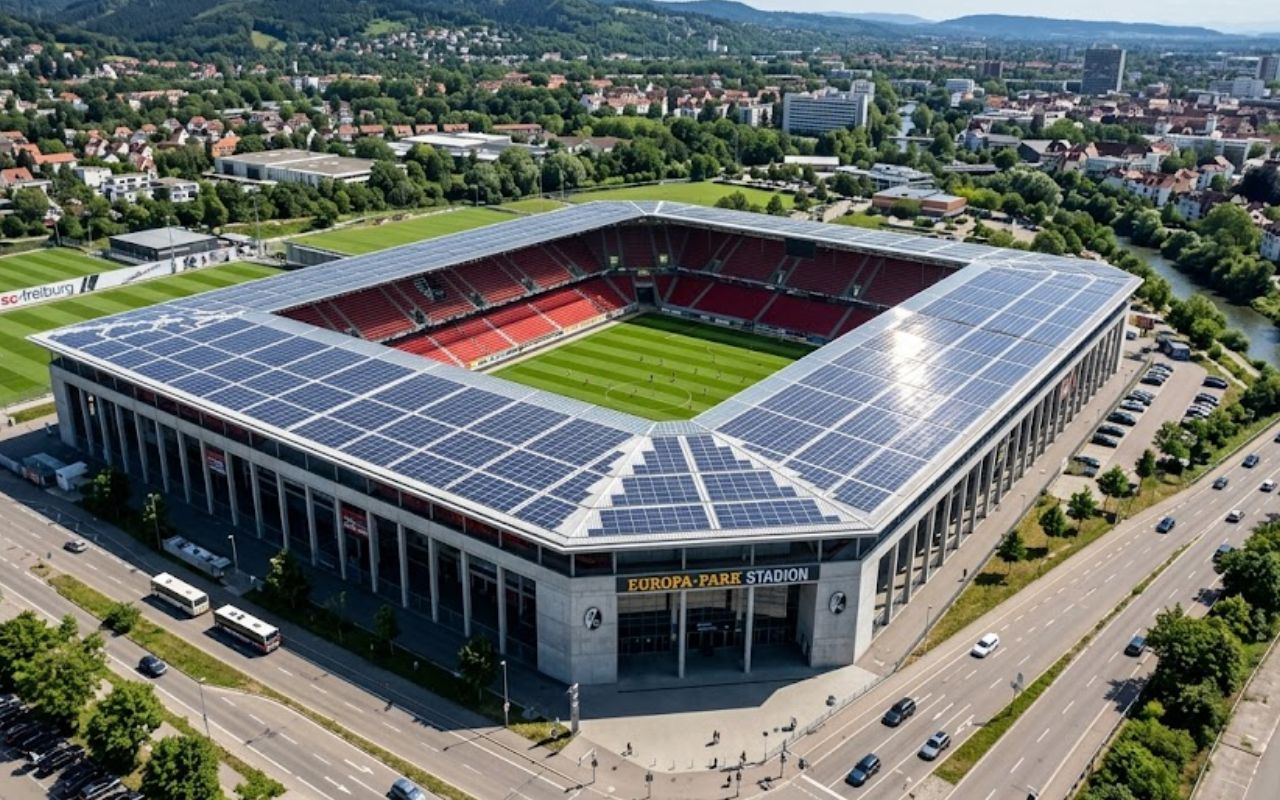


Discover the Europa-Park Stadium in Freiburg, Germany. A project that combines total accessibility, fan culture, and a solar roof capable of generating clean energy.
The experience of going to the stadium has taken on new contours in Freiburg, in southwestern Germany, with the establishment of the Europa-Park Stadium as an icon of modern architecture. Designed to be a public facility integrated into the city, the home of SC Freiburg breaks away from the model of isolated arenas and focuses on social interaction and respect for fans.
With a capacity of about 34,700 spectators, the stadium was designed to ensure that the transition from the street to the seat is as smooth as possible, treating accessibility and safety as fundamental pillars of engineering.
Unlike many contemporary projects that sacrifice tradition for luxury, this arena has preserved the German culture of the stands. The space perfectly balances the modernity demanded by the market with the fervent support of organized fan groups.
-
Brazilian Senate Approves Bill to Automate Child Support Payments Directly from Debtors’ Accounts

-
Brazilian Student in the U.S. Helps Provide Clean Water to 50 Families in São Paulo Slum, Launches Year-Long Volunteer Project with National Expansion Plans
-
Daughter of Farmers from Brazil Uses Social Media to Highlight Rural Life and Promote Agriculture
-
Free Willy’s Orca, Captured as a Calf, Became a Global Star in a Mexican Tank and Was Part of the Most Controversial Attempt to Return a Captive Whale to the Wild


Moreover, the project was designed to be a model of inclusion, offering barrier-free routes and privileged visibility for all audience profiles, regardless of their mobility limitations.
Europa-Park Stadium combines comfort and accessibility
One of the biggest concerns in the design of the Europa-Park Stadium was maintaining the vibrant atmosphere inherited from the club’s old stadium. To achieve this, the architecture focused on stands with a steep incline and a minimum distance between the seats and the pitch.
This proximity ensures an intense experience for fans, even in games with less commercial appeal.
The organization of the sectors was done strategically to embrace different audiences:
- Standing Tradition: The stadium features over 12,000 places for fans who prefer to watch the match standing, keeping chants and flags alive.
- Seated Sections: There are over 22,000 seats that offer comfort and a panoramic view of the field.
- Structural Inclusion: About 144 spots dedicated to wheelchair users, integrated in a way that visibility is not obstructed.
- Urban Mobility: The complex offers complete infrastructure for vehicles and, notably, many bike parking spaces, encouraging clean transportation.
Circulation logistics and safety at the Europa-Park Stadium
To manage the flow of thousands of people, engineering implemented an intuitive circulation system. Wide entrances located at the four corners of the structure direct the public to a perimeter ring.
This circular corridor facilitates the distribution of fans throughout the sectors and avoids the traditional congestion on days of major events.

Therefore, universal accessibility is not just a detail, but part of the structure. Ramps smoothly connect the street level to the public distribution areas, ensuring that arrival at the seat is obstacle-free.
Additionally, clear signage allows for a quick and safe evacuation flow in case of emergency through pre-organized routes.
The photovoltaic roof: the stadium as an energy producer
The major technological differentiator that places the Europa-Park Stadium at the center of the debate on environmental responsibility is its gigantic roof. Thousands of solar modules cover the arena’s roof, forming one of the largest installations of this type in sports complexes.
This system is capable of annually generating enough energy to supply the stadium’s entire electricity demand, transforming the venue into a producer of clean energy. By adopting this strategy, SC Freiburg and the city of Freiburg show how large-scale projects can neutralize their direct CO² emissions.


The roof ceases to be merely a protective cover and becomes an active part of the urban environmental strategy. Thus, the stadium stops being a major consumer of resources and starts returning renewable energy to the system, reinforcing its commitment to future generations.
The success of this project reveals that contemporary arenas can be compact, socially inclusive, and energy-efficient. The Europa-Park Stadion serves as a guide for the future, where sustainability is already an integral part of the basic agenda for any major public work.
Source: O Antagonista