Portuguese
  Spanish


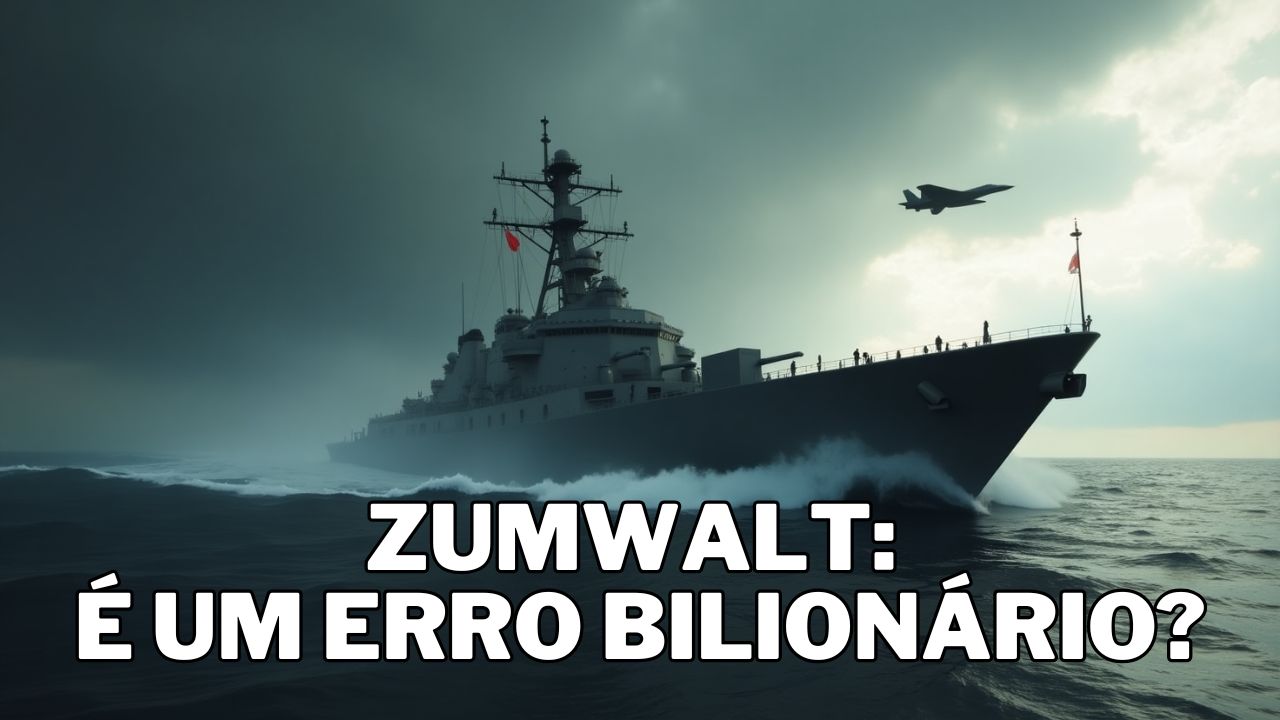


With 16,000 Tons, Stealth Technology, and an Absurd Cost of US$ 9 Billion per Unit, the Zumwalt is the Largest and Most Advanced Destroyer Ever Built by the U.S. But After Failures, Cuts, and Mission Changes, Is It Still Worth the Investment?
The Zumwalt was designed to be the vanguard of 21st-century naval warfare. Equipped with stealth technology, hypersonic missiles, and a revolutionary design, it was supposed to be the terror of enemies. However, its journey has been anything but smooth, marked by budget overruns, mission changes, and technical failures. Let’s explore how this giant came to be, its advancements, and challenges.
What Made the Zumwalt Necessary?
In the 1990s and 2000s, the U.S. Navy realized its ships were becoming vulnerable. Arleigh Burke-class destroyers and Ticonderoga cruisers, while efficient, lacked stealth and long-range land attack capabilities. At the same time, rival powers began developing long-range anti-ship missiles and more advanced detection systems.
The solution? A new destroyer capable of operating close to enemy shores, launching surgical strikes, and escaping undetected. Thus, the Zumwalt was born, a ship designed to hide in plain sight while carrying cutting-edge weaponry.
-
The FLIP: A 108-Meter Ocean Laboratory That Stood Vertically for 60 Years, Dismantled in 2023

-
North Korean Fiasco: Launch of the Largest Warship Ends in Sinking

-
While giant ships still burn heavy fuel and the maritime sector races against climate targets, Maersk and Vale are starting to bet on ethanol as a new route to reduce emissions at sea.

-
China begins construction of the world’s largest LNG ship, a 344-meter giant capable of supplying 4.7 million homes for a month, carrying 271,000 m³ of gas, and placing QatarEnergy in the largest naval order ever recorded in world history.


Futuristic Design and Stealth Technology
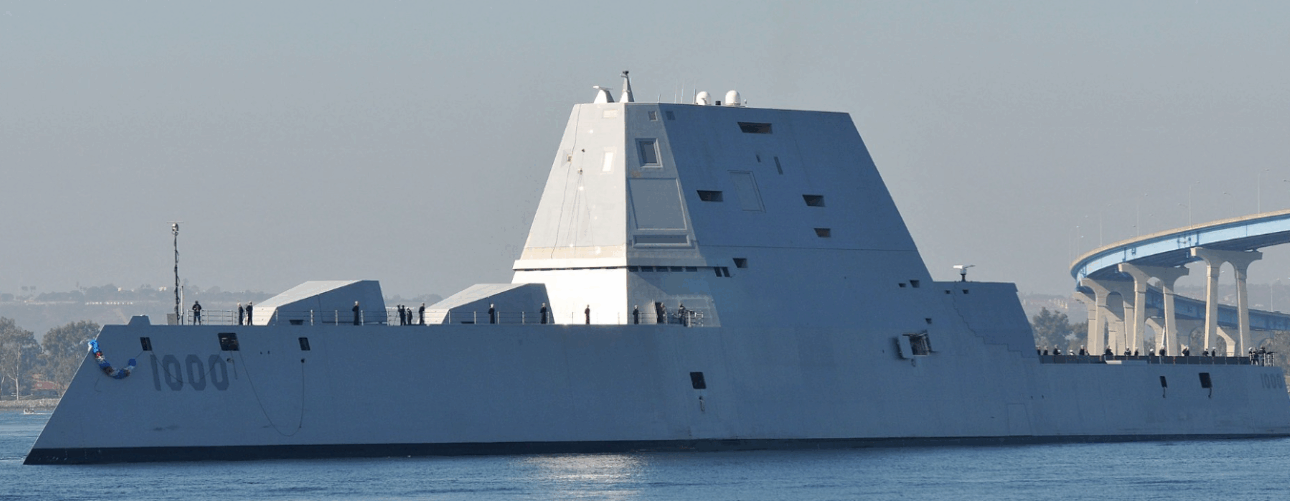
If you look at the Zumwalt, you will notice it does not resemble any other warship. This is because its tumblehome hull slopes inward, drastically reducing its radar signature. To an unsuspecting enemy, it appears as just a small fishing boat on radar, when in fact, it is a 16,000-ton monster.
Its superstructure is made of composite materials that absorb radar waves, while its exhaust systems minimize heat emission, making thermal detection difficult. Even its propulsion system was designed to be quiet, making it a hard target even for submarines.
But does all this technology justify the astronomical price?
Firepower, from Dream to Reality
Originally, the Zumwalt was designed to bombard land targets with its two 155mm guns (AGS – Advanced Gun System). The idea was to use long-range guided projectiles (LRLAP) to hit targets up to 116 km away with surgical precision.
The problem? Each round cost between US$ 800,000 and US$ 1 million! Yes, a cannon shot that costs more than a guided missile. With such an absurd cost, the munition project was canceled, leaving the Zumwalt’s guns completely useless.
To remedy this, the Navy decided to remove the guns and install hypersonic CPS missiles (Conventional Prompt Strike), which can hit targets thousands of kilometers away at speeds exceeding Mach 5. But this raises another question: Is the Zumwalt still a traditional destroyer or has it become a missile launch platform?
The High Cost of the Future of Naval Warfare
If the Zumwalt were a Hollywood movie, it would be that expensive blockbuster filled with visual effects, but no one knows if it was truly worth producing. The original plan was to build 32 ships, but as costs skyrocketed, that number dropped to just 3 units.
According to Interesting Engineering, the total program budget has already exceeded US$ 24.5 billion, making the Zumwalt one of the most expensive naval projects in history. And the worst part? Many experts question whether it is truly as useful as cheaper ships, like the Arleigh Burke, which cost less than half and carry more missiles.
The Zumwalt’s innovative design also brought challenges. Its tumblehome hull, though stealthy, can be unstable in rough seas, increasing the risk of operational issues. Not to mention that, having fewer missile launch cells than other destroyers, it might find itself at a disadvantage in prolonged combat.