






 Portuguese
  Spanish
  4 min of reading
  0 comments


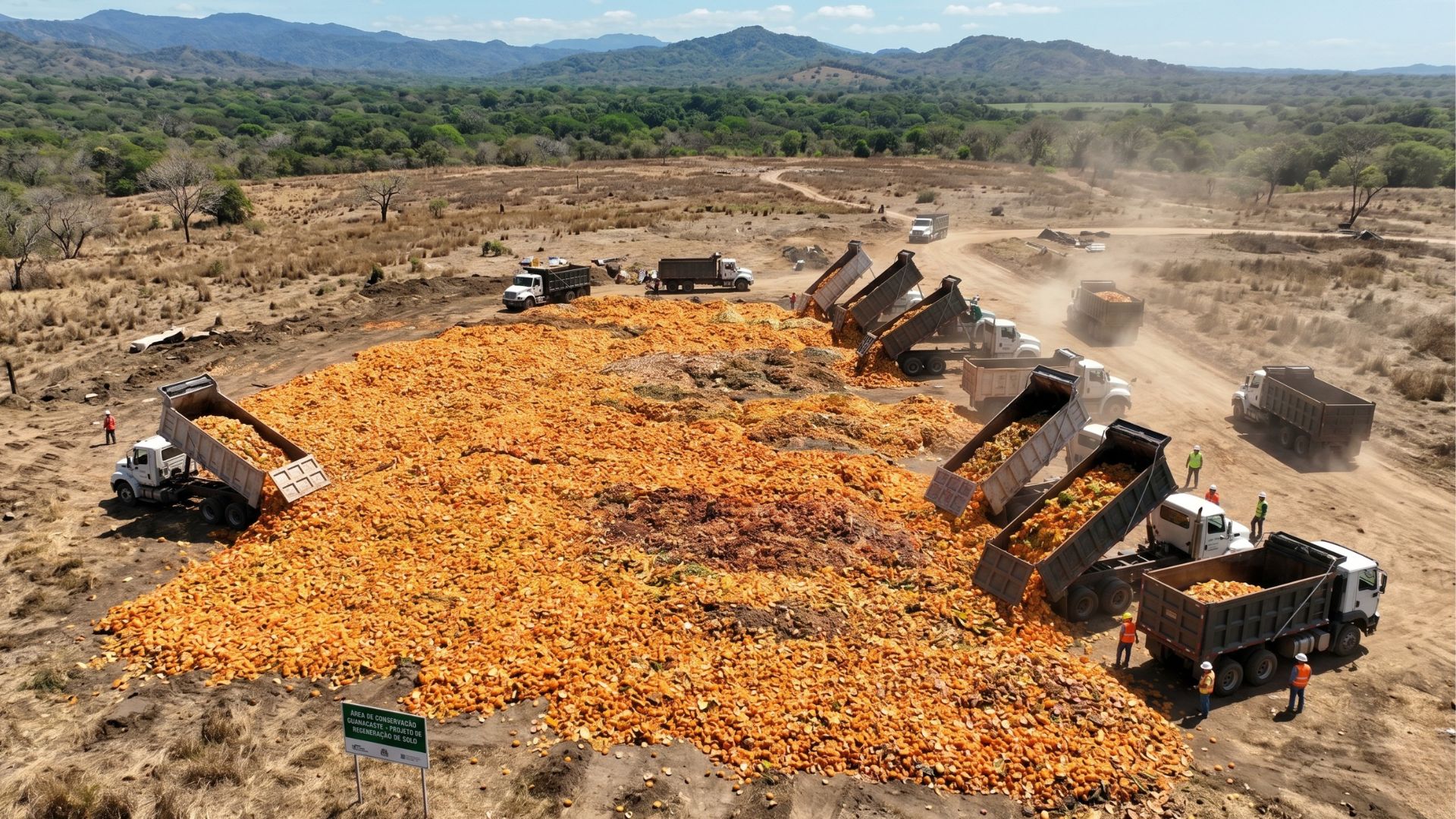
Experiment in Costa Rica transformed 12,000 tons of orange peels into dense forest after years of environmental degradation.
In the mid-1990s, a degraded area in Costa Rica received something that seemed absurd even by environmental standards: about 12,000 tons of discarded orange peels and pulp from a juice factory. The material was dumped on a practically dead former pasture within the Guanacaste Conservation Area in the northwest of the country.
What seemed like just industrial waste ended up producing one of the most impressive cases of ecological regeneration ever documented in a tropical forest. Decades later, researchers found the site completely taken over by trees, vines, and dense vegetation, with forest growth far exceeding the neighboring area that did not receive the organic waste.
1,000 trucks took orange waste to a practically dead area
The experiment began after a partnership between ecologists linked to the Guanacaste Conservation Area and the orange juice company Del Oro.
-
Two young inventors create a terracotta brick that uses water, air, and solar energy to cool cities, and the idea points to buildings that stop worsening urban heat.

-
Without power for millions, Madagascar receives a proposal for a floating hydroelectric plant inspired by the baobab that promises clean energy, greenhouses, and tourism, but still needs to be realized.
-
China has a giant rice terrace carved over 1,300 years in the mountains, with up to 3,000 terraces, 82 villages, and 445 km of canals, but the ancestral work that overcame droughts now faces growing tourism, landslides, and rural abandonment.

-
The largest Gothic church in Northern Europe began in 1248 to house the relics of the Three Wise Men, remained unfinished for centuries, and was only completed 632 years later, with steel, steam, and a German national campaign that turned the delay into a historical symbol.


At the time, part of the region had been degraded by:
- intensive livestock
- deforestation
- burning
- soil erosion
Researchers proposed using organic waste from the juice industry to try to accelerate land recovery. Between 1996 and 1998, approximately 1,000 trucks dumped about 12,000 metric tons of orange peels and pulp over an area of approximately 3 hectares, equivalent to about four football fields.
Area became unrecognizable after years forgotten by Justice
The project was halted shortly after it began. A competing company, TicoFruit, went to court claiming that the disposal “contaminated” the national park. The case reached the Supreme Court of Costa Rica, which terminated the agreement and prohibited the continuation of the initiative.

The site ended up abandoned and practically forgotten for about 15 years.
When researcher Timothy Treuer from Princeton University returned to the area in 2013 to reassess the experiment, he found a radical transformation.
According to the report published by Princeton, the vegetation had grown so much that he could barely find the huge yellow sign originally installed to mark the experiment.
Biomass grew 176% compared to the neighboring area
The researchers compared the area treated with orange peels to a neighboring area that remained without intervention.
The results published in the scientific journal Restoration Ecology showed huge differences:
- increase of 176% in above-ground biomass
- greater species diversity
- soil richer in nutrients
- much greater forest canopy closure
- accelerated growth of woody vegetation
While the control area still had exposed soil, dry grass, and erosion, the site covered with orange waste had transformed into a dense tropical forest.
Orange peels acted as a gigantic natural fertilizer
According to the researchers, the organic waste acted as a kind of “ecological superfertilizer”. The decomposition of the peels and pulp:
- added organic matter to the soil
- increased moisture retention
- elevated nutrients
- reduced erosion
- accelerated the growth of pioneer plants
Additionally, the material helped to smother invasive grasses that hindered the natural regeneration of the forest. Over the years, trees and vines completely dominated the space.
Researchers called the project “recycling in the best sense”
The study gained international attention because it showed that agricultural waste can have enormous ecological value when used correctly.

Professor David Wilcove, one of the authors of the work at Princeton, stated that the project demonstrated how “leftovers” from industrial food production could help to recover degraded tropical forests.
The scientists highlighted that:
- the waste had virtually zero cost
- the material would no longer go to traditional disposal
- the forest sequestered carbon
- biodiversity increased
The case began to be cited in debates about:
- ecological restoration
- reuse of organic waste
- low-cost tropical regeneration
- natural carbon capture
Project also showed how political disputes can interrupt environmental solutions
Another aspect that drew attention was the fact that the experiment almost disappeared due to political and commercial reasons.
According to reports published by Princeton, the competitor’s lawsuit completely halted the expansion of the project, even after the first positive signs of regeneration.
The researchers state that the case ended up becoming an example of how innovative environmental initiatives can face resistance even when they present promising results.
Scientists believe that agricultural waste can accelerate forest recovery
Although researchers warn that not all types of organic waste can be indiscriminately dumped in natural ecosystems, the study showed that certain agricultural materials can strongly accelerate the regeneration of degraded areas when used under technical control.
The authors state that similar strategies can help in the recovery of:
- degraded pastures
- deforested areas
- impoverished soils
- eroded tropical zones
As long as there is adequate environmental monitoring.
What seemed like industrial waste ended up becoming a tropical forest
For years, those 12,000 tons of orange peels were treated only as disposable waste from the food industry.
But the experiment in Costa Rica showed something much bigger: when organic matter returns to the land on a massive scale, it can literally accelerate the return of the forest.
And perhaps that is precisely what makes the story so impressive: one of the most surprising cases of tropical ecological regeneration began not with sophisticated machines or billions in investments, but with mountains of orange peels that were going to end up in the trash.






-

1 person reacted to this.