






 Portuguese
  Spanish
  5 min of reading
  0 comments


The Via Mar, a 145 km highway with six lanes that will connect Joinville to Greater Florianópolis, is sold as the solution to the chaos of BR-101 in Santa Catarina. But the fine print reveals details that few people mention: it will have tolls, will cost billions, and faces engineering challenges that could delay everything.
Anyone who has faced the traffic on BR-101 along the coast of Santa Catarina knows the size of the problem. A trip between Joinville and Greater Florianópolis, which should be quick, usually takes over three hours on a normal day, and becomes a nightmare on holidays or when there is an accident. It is precisely this bottleneck that the Santa Catarina government promises to solve with Via Mar, a new highway announced as a historic project, expected to start being implemented by 2026.
The promise is enticing: cutting the journey from three hours to about one. But before celebrating, it’s worth reading between the lines of the project. Via Mar will not be free, it is not simple to build, and has a schedule that depends on many things going right. We have gathered here what usually gets left out of the more enthusiastic headlines about the new highway in Santa Catarina.
What is Via Mar, in summary
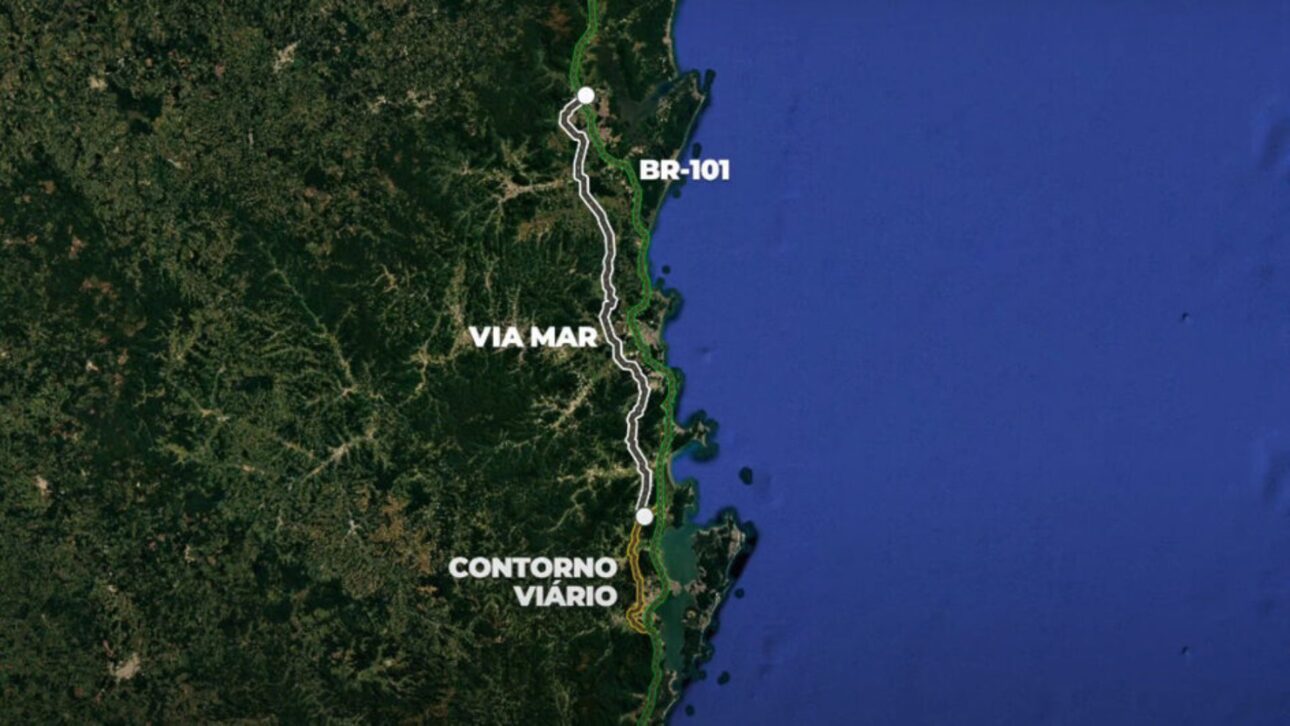
Before the fine print, the basics. Via Mar is planned as a highway parallel to BR-101, with about 145 kilometers in length, six lanes in total, three in each direction, and a maximum speed of 120 km/h. As detailed by NSC Total, the route will have viaducts, bridges, and even a tunnel, connecting Joinville to the Greater Florianópolis ring road and passing through cities like Guaramirim, Navegantes, and Itajaí.
-
To halt the advance of the Sahara, the 8,000 km Great Green Wall in the Sahel relies on reforestation to combat desertification, but by 2026 it remains far behind the goal of 100 million hectares.

-
Long before sustainable construction became a trend, China built earthen fortresses with multiple floors, a central courtyard, and the capacity to house up to 800 people living in a community.

-
While in the rest of the world building a hospital takes years from design to inauguration, China erected the Huoshenshan Hospital from scratch in just 10 days, with 1,000 beds, foundation, structure, electrical installations, plumbing, and oxygen system ready to receive patients, mobilizing 7,000 workers.

-
Without mortar, grout, or traditional construction: the ClickBrick system assembles brick facades with ceramic pieces held by metal clips, eliminating the need for glue, speeding up installation, and even allowing everything to be dismantled later without turning the construction into expensive permanent debris.


The estimated cost of the project is between R$ 7 billion and R$ 9 billion, and the project has been divided into five lots to facilitate execution. In theory, it will be one of the most modern highways in the country, designed from the start for high capacity and fast traffic. If it delivers what it promises, Via Mar could indeed transform mobility on the coast of Santa Catarina and relieve much of the pressure on the BR-101. The detail is that this “if” carries a lot of weight.
The novelty that few people mention: the toll
Here is the point that many reports forget to highlight. Via Mar will be the first state highway in Santa Catarina with a toll, according to Gazeta do Povo. In other words, the relief in traffic will come with a charge for each trip, something that Santa Catarina drivers are not used to on the state’s roads.
This happens because of the financing model. The project will be carried out through a public-private partnership, where the State funds the first phase, with around R$ 1 billion, and is then reimbursed by a concessionaire, which takes over the rest of the construction and operation of the highway. To get a return on the billion-dollar investment, this company will charge a toll from those who use Via Mar. In practice, the driver trades the time lost on the BR-101 for a financial cost on the new highway, and each one will have to do this calculation in their own pocket.
Soft soil and rice fields: the engineering challenges
Building 145 kilometers of high-standard highway on the coast of Santa Catarina is no trivial task. The route of Via Mar crosses sections of soft soil, areas of rice fields, and regions that will require elevated structures, such as long viaducts and bridges, to overcome unstable and swampy terrain. All this increases the cost of the project and complicates the schedule.
It’s not a small detail. Soft soil means more expensive and time-consuming foundations, and the coast of Santa Catarina has precisely this type of terrain in several spots. The more viaducts, bridges, and tunnels a highway needs, the greater the risk of delays and budget overruns. Via Mar is ambitious, but the technical challenge of making it cross the coastal plain of Santa Catarina is significant, and paper accepts any promise.
When will it be ready? The realistic timeline


And here comes the question everyone asks: when can it be used? The government of Santa Catarina intends to start the works of Via Mar still in 2026, but the minimum estimated time for completion, after the concessionaire is contracted, is about three years. In practice, this pushes the delivery to the end of the decade, and only if nothing is delayed along the way.
Delay in highway construction in Brazil is almost a rule. The BR-101 itself in Santa Catarina is an example of this, with famous bottlenecks, such as Morro dos Cavalos, dragging on for years even with billions planned. The Via Mar emerges precisely amid criticisms about the slowness of road works in the state, which increases the distrust of part of the population. The promise to relieve the BR-101 is good, but recent history suggests celebrating only when the asphalt is ready.
Why this matters for SC and the country
Despite the caveats, it is undeniable that Via Mar targets a real and costly problem. The northern coast of Santa Catarina hosts some of Brazil’s busiest ports, such as Itajaí and Navegantes, in addition to the industrial hub of Joinville and booming summer tourism. When the BR-101 gets jammed, it’s not just leisure that suffers: the entire region’s economy feels it, with delayed shipments and higher costs.
Therefore, a highway that truly relieves this corridor would have an impact that goes far beyond travel time. It would mean more efficient logistics, fewer accidents, and more competitiveness for one of the country’s most productive states. The case of Via Mar well summarizes the dilemma of Brazilian infrastructure: solutions exist and are announced with fanfare, but they depend on funding, engineering, and timelines to stop being mere promises. For Santa Catarina, the real test begins when the first machine hits the ground.
Via Mar embodies the essence of large Brazilian projects: exciting at the announcement and full of open questions. On one hand, the real chance to transform the journey between Joinville and Florianópolis and relieve the congested BR-101. On the other, the toll, the soft soil, the billions, and the timeline that only time will confirm. Knowing both sides helps ensure the project actually comes to fruition.
And you, would you agree to pay a toll on a new highway in Santa Catarina to escape the traffic of the BR-101, or do you think the state should first fix what already exists? Share your opinion in the comments.






Be the first to react!