






 Portuguese
  Spanish
  5 min of reading
  0 comments


Baobab Waterfall Project draws attention for imagining a structure in the ocean capable of generating electricity with artificial waterfalls, housing greenhouses, and becoming a tourist hub in Madagascar
A futuristic proposal of a floating hydroelectric plant inspired by the baobab, the symbolic tree of Madagascar, drew attention by imagining a giant structure in the ocean capable of combining clean energy generation, agriculture, social rehabilitation, and tourism. The project, called Baobab Waterfall, is still conceptual but gained attention precisely for trying to address a real problem: the lack of reliable access to electricity in much of the African country.
As reported by Casa e Jardim Magazine in June 2026, the idea uses the shape of the baobab as a starting point for a circular construction installed on the coast of Madagascar. The proposal is not a conventional river hydroelectric plant, but a system of artificial “waterfalls” in the sea, with water being directed to turbines below the surface.
The concept was developed by architect Ahmad Eghtesad, with a team consisting of Mohammad Aghaei and Nastaran Fazeli. The project appears as an entry for the Jacques Rougerie Foundation competition, a foundation known for encouraging architectural proposals focused on the sea, space, and future environmental scenarios.
-
China has a giant rice terrace carved over 1,300 years in the mountains, with up to 3,000 terraces, 82 villages, and 445 km of canals, but the ancestral work that overcame droughts now faces growing tourism, landslides, and rural abandonment.

-
The largest Gothic church in Northern Europe began in 1248 to house the relics of the Three Wise Men, remained unfinished for centuries, and was only completed 632 years later, with steel, steam, and a German national campaign that turned the delay into a historical symbol.
-
A city in India was inaugurated in 1968 in front of 5,000 people, welcomed young people from 124 nations, and today gathers more than 3,300 residents from 60 nationalities trying to prove that humanity can live without divisions of country, religion, and politics.
-
An abandoned weapons factory that still contains ammunition and military vehicles has been discovered.


Despite the impressive visuals, it is important to highlight that the Baobab Waterfall is not a project under construction and still does not have disclosed installed capacity, construction schedule, or detailed public cost. Today, it functions more as an architectural provocation on how infrastructure, energy, and social use of spaces could be thought together.
The tree that stores water became the symbol of a plant that tries to imitate nature
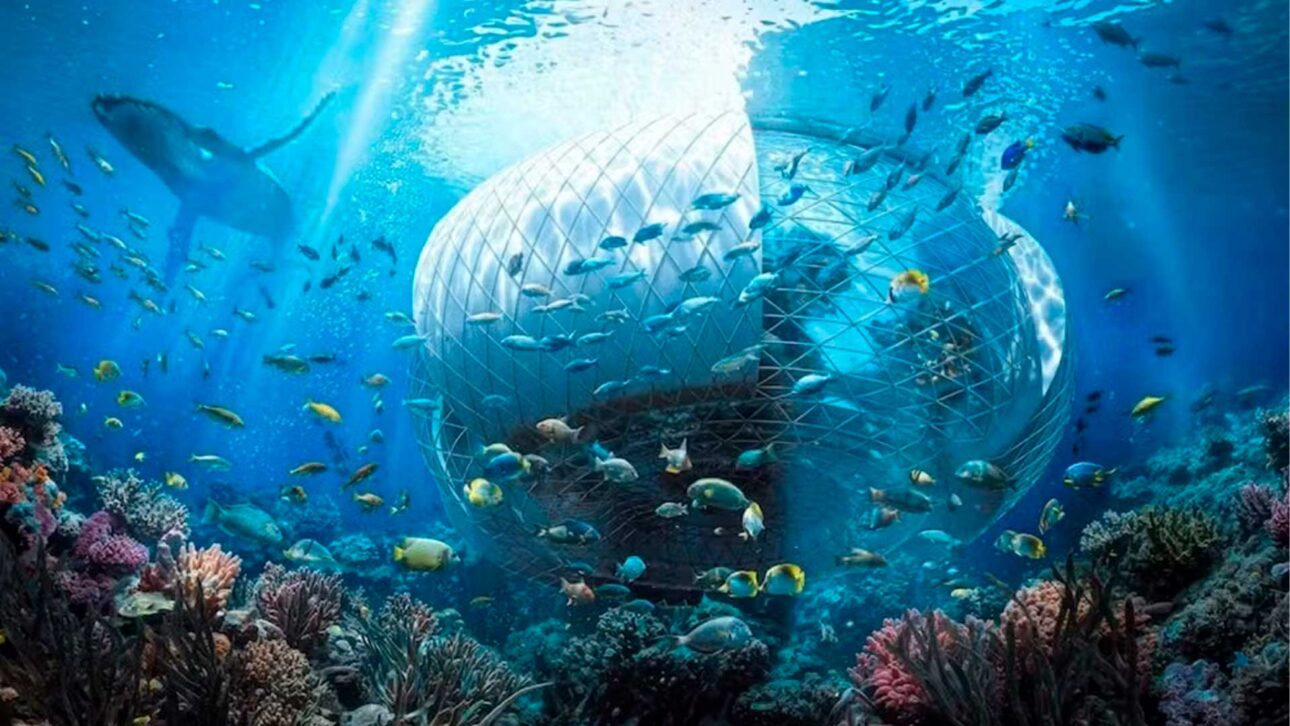
The baobab was not included in the project just as an aesthetic reference. According to the Royal Botanic Gardens, Kew, six of the world’s eight baobab species are found only in Madagascar, which helps explain why the tree is treated as a natural and cultural symbol of the island.
In the design of the Baobab Waterfall, the central “trunk” concentrates areas for socializing, administration, greenhouses, and educational spaces. The wide “canopy,” inspired by the shape of the tree, appears as protection and a visual landmark, creating a structure that aims to look both technical and organic.
The choice also has narrative value. The baobab is known for its ability to store water and withstand dry environments, which is why it is often associated with survival. In the project, this idea is transferred to an infrastructure that promises to transform seawater into useful movement to generate electricity.
The energy promise targets a concrete problem in Madagascar


According to the World Bank, Madagascar had an electrification rate of around 30% in 2024, meaning that about 7 out of 10 inhabitants still did not have access to electricity. The problem affects rural areas, low-income families, and communities further from the grid more severely.
The International Energy Agency also lists Madagascar among the countries with low electrical coverage, with access concentrated in a limited portion of the population. This scenario helps explain why renewable energy proposals, even if conceptual, gain traction in development debates.
The Baobab Waterfall proposes using the ocean as an energy source through continuous waterfalls. In practice, the imagined structure would channel large volumes of water to turbines installed below the surface, creating a system similar to a hydroelectric plant but without relying on a dammed river.
The difference is that, for now, the proposal does not present sufficient public information to confirm technical feasibility, environmental impact, generated power, or cost per megawatt. These points would be essential before any discussion of actual construction, especially in a sensitive marine area.
Greenhouses, education, and tourism expand the project beyond energy generation
According to Amazing Architecture, the Baobab Waterfall was described as a mixed-use infrastructure, with an energy function, educational spaces, transparent greenhouses, and social areas. The initial proposal also includes a social rehabilitation component, with agricultural activities and professional training within the structure.
This part of the project is one of the most ambitious and also one of the most delicate. The idea of combining energy, food production, and social reintegration in a single complex seems innovative, but would require clear governance rules, human rights, safety, and public participation.
As shown by Yanko Design, the concept also envisions a future transition to a multifunctional resort and green energy hub. The logic would be to transform a structure initially aimed at social and energy problems into a sustainable tourist destination with international appeal.
This type of proposal draws attention because it mixes engineering, architecture, and urban imagination. At the same time, it requires caution: the more functions a project promises to solve, the greater the need for transparency about costs, impacts, operation, and real benefits for the local population.
What makes the Baobab Waterfall curious also raises doubts
The visual strength of the project is evident. A circular artificial island, surrounded by waterfalls in the ocean and crowned by a tower inspired by the baobab, creates an image hard to ignore. It is precisely this impact that helps the proposal circulate on architecture, technology, and sustainability websites.
But a floating hydroelectric plant of this size would face complex challenges. It would be necessary to evaluate environmental licensing, marine corrosion, maintenance at sea, risk to coastal ecosystems, connection to the power grid, and resistance to storms in the Indian Ocean.
There is also the social issue. Madagascar needs practical, accessible, and scalable energy solutions, such as grid expansion, mini-grids, solar systems, and improvements in the operation of existing infrastructure. A conceptual megaproject can inspire debates but does not replace public electrification policies.
An idea of the future that works better as a warning than as a promise
The Baobab Waterfall gains relevance because it transforms an invisible problem for many readers into a strong image: a country with low electrification imagining a power plant at sea inspired by its most emblematic tree. It is a creative way to draw attention to the relationship between energy, poverty, nature, and development.
At the same time, the proposal needs to be read carefully. Until there are public studies, budget, detailed engineering, and an environmental plan, it should be treated as a futuristic concept, not as a ready solution for Madagascar’s energy crisis.
Even so, the project plays an important role by provoking a bigger question: if the infrastructure of the future can generate energy, produce food, and create new living spaces, which ideas deserve to come off the drawing board and which should remain just as a laboratory of imagination?


Be the first to react!